

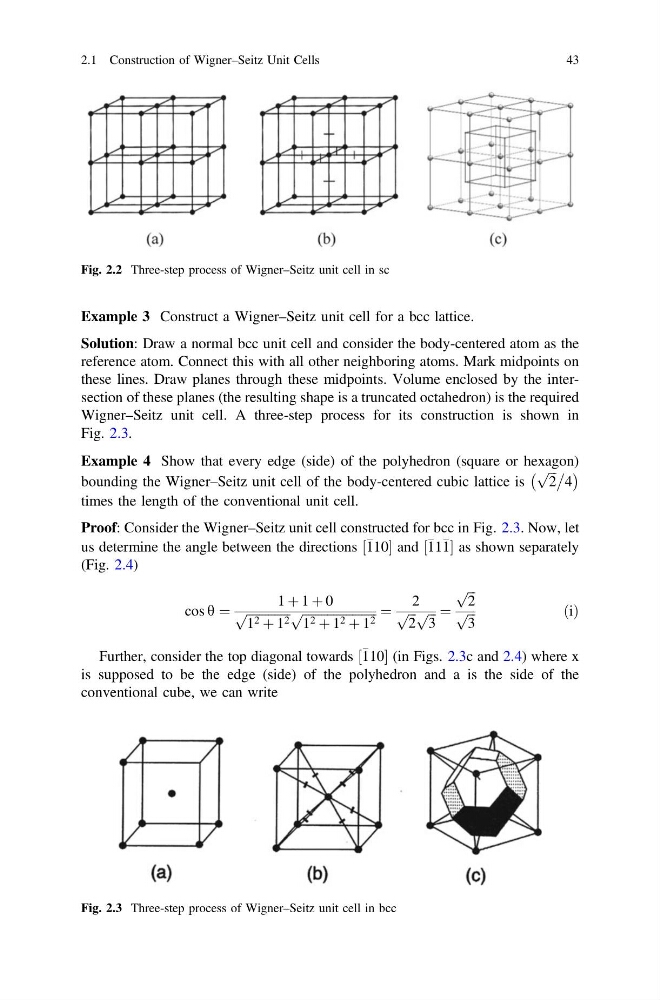
Example 3 Construct a Wigner–Seitz unit cell for a bcc lattice.
Solution: Draw a normal bcc unit cell and consider the body-centered atom as the
reference atom. Connect this with all other neighboring atoms. Mark midpoints on
these lines. Draw planes through these midpoints. Volume enclosed by the intersection of these planes (the resulting shape is a truncated octahedron) is the required
Wigner–Seitz unit cell. A three-step process for its construction is shown in
Fig. 2.3.
Example 4 Show that every edge (side) of the polyhedron (square or hexagon)
bounding the Wigner–Seitz unit cell of the body-centered cubic lattice is
ffiffi ffi
2
p
4
À
Á
times the length of the conventional unit cell.
Proof: Consider the Wigner–Seitz unit cell constructed for bcc in Fig. 2.3. Now, let
us determine the angle between the directions 110
½
and 11 1
½
as shown separately
(Fig. 2.4)
cos h ¼
1 þ 1 þ 0
ffiffiffiffiffiffiffiffiffiffiffiffiffiffi
1 2 þ 1 2
p
ffiffiffiffiffiffiffiffiffiffiffiffiffiffiffiffiffiffiffiffiffiffiffiffi
1 2 þ 1 2 þ 1 2
p
¼
2
ffiffi ffi
2
p ffiffi ffi
3
p ¼
ffiffi ffi
2
p
ffiffi ffi
3
p
ðiÞ
Further, consider the top diagonal towards 110
½ (in Figs. 2.3c and 2.4) where x
is supposed to be the edge (side) of the polyhedron and a is the side of the
conventional cube, we can write
Fig. 2.2 Three-step process of Wigner–Seitz unit cell in sc
Fig. 2.3 Three-step process of Wigner–Seitz unit cell in bcc
2.1 Construction of Wigner–Seitz Unit Cells
43
Solution: Draw a normal bcc unit cell and consider the body-centered atom as the
reference atom. Connect this with all other neighboring atoms. Mark midpoints on
these lines. Draw planes through these midpoints. Volume enclosed by the intersection of these planes (the resulting shape is a truncated octahedron) is the required
Wigner–Seitz unit cell. A three-step process for its construction is shown in
Fig. 2.3.
Example 4 Show that every edge (side) of the polyhedron (square or hexagon)
bounding the Wigner–Seitz unit cell of the body-centered cubic lattice is
ffiffi ffi
2
p
4
À
Á
times the length of the conventional unit cell.
Proof: Consider the Wigner–Seitz unit cell constructed for bcc in Fig. 2.3. Now, let
us determine the angle between the directions 110
½
and 11 1
½
as shown separately
(Fig. 2.4)
cos h ¼
1 þ 1 þ 0
ffiffiffiffiffiffiffiffiffiffiffiffiffiffi
1 2 þ 1 2
p
ffiffiffiffiffiffiffiffiffiffiffiffiffiffiffiffiffiffiffiffiffiffiffiffi
1 2 þ 1 2 þ 1 2
p
¼
2
ffiffi ffi
2
p ffiffi ffi
3
p ¼
ffiffi ffi
2
p
ffiffi ffi
3
p
ðiÞ
Further, consider the top diagonal towards 110
½ (in Figs. 2.3c and 2.4) where x
is supposed to be the edge (side) of the polyhedron and a is the side of the
conventional cube, we can write
Fig. 2.2 Three-step process of Wigner–Seitz unit cell in sc
Fig. 2.3 Three-step process of Wigner–Seitz unit cell in bcc
2.1 Construction of Wigner–Seitz Unit Cells
43