

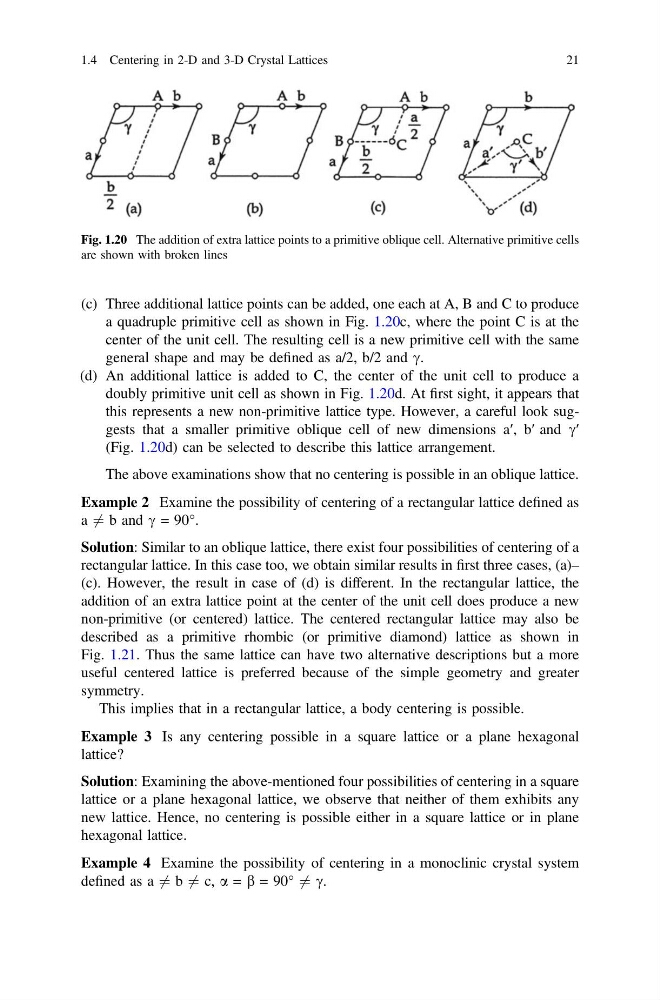
(c) Three additional lattice points can be added, one each at A, B and C to produce
a quadruple primitive cell as shown in Fig. 1.20c, where the point C is at the
center of the unit cell. The resulting cell is a new primitive cell with the same
general shape and may be defined as a/2, b/2 and c.
(d) An additional lattice is added to C, the center of the unit cell to produce a
doubly primitive unit cell as shown in Fig. 1.20d. At first sight, it appears that
this represents a new non-primitive lattice type. However, a careful look suggests that a smaller primitive oblique cell of new dimensions a′, b′ and c′
(Fig. 1.20d) can be selected to describe this lattice arrangement.
The above examinations show that no centering is possible in an oblique lattice.
Example 2 Examine the possibility of centering of a rectangular lattice defined as
a 6 ¼ b and c = 90°.
Solution: Similar to an oblique lattice, there exist four possibilities of centering of a
rectangular lattice. In this case too, we obtain similar results in first three cases, (a)–
(c). However, the result in case of (d) is different. In the rectangular lattice, the
addition of an extra lattice point at the center of the unit cell does produce a new
non-primitive (or centered) lattice. The centered rectangular lattice may also be
described as a primitive rhombic (or primitive diamond) lattice as shown in
Fig. 1.21. Thus the same lattice can have two alternative descriptions but a more
useful centered lattice is preferred because of the simple geometry and greater
symmetry.
This implies that in a rectangular lattice, a body centering is possible.
Example 3 Is any centering possible in a square lattice or a plane hexagonal
lattice?
Solution: Examining the above-mentioned four possibilities of centering in a square
lattice or a plane hexagonal lattice, we observe that neither of them exhibits any
new lattice. Hence, no centering is possible either in a square lattice or in plane
hexagonal lattice.
Example 4 Examine the possibility of centering in a monoclinic crystal system
defined as a 6 ¼ b 6 ¼ c, a = b = 90° 6 ¼ c.
Fig. 1.20 The addition of extra lattice points to a primitive oblique cell. Alternative primitive cells
are shown with broken lines
1.4 Centering in 2-D and 3-D Crystal Lattices
21
a quadruple primitive cell as shown in Fig. 1.20c, where the point C is at the
center of the unit cell. The resulting cell is a new primitive cell with the same
general shape and may be defined as a/2, b/2 and c.
(d) An additional lattice is added to C, the center of the unit cell to produce a
doubly primitive unit cell as shown in Fig. 1.20d. At first sight, it appears that
this represents a new non-primitive lattice type. However, a careful look suggests that a smaller primitive oblique cell of new dimensions a′, b′ and c′
(Fig. 1.20d) can be selected to describe this lattice arrangement.
The above examinations show that no centering is possible in an oblique lattice.
Example 2 Examine the possibility of centering of a rectangular lattice defined as
a 6 ¼ b and c = 90°.
Solution: Similar to an oblique lattice, there exist four possibilities of centering of a
rectangular lattice. In this case too, we obtain similar results in first three cases, (a)–
(c). However, the result in case of (d) is different. In the rectangular lattice, the
addition of an extra lattice point at the center of the unit cell does produce a new
non-primitive (or centered) lattice. The centered rectangular lattice may also be
described as a primitive rhombic (or primitive diamond) lattice as shown in
Fig. 1.21. Thus the same lattice can have two alternative descriptions but a more
useful centered lattice is preferred because of the simple geometry and greater
symmetry.
This implies that in a rectangular lattice, a body centering is possible.
Example 3 Is any centering possible in a square lattice or a plane hexagonal
lattice?
Solution: Examining the above-mentioned four possibilities of centering in a square
lattice or a plane hexagonal lattice, we observe that neither of them exhibits any
new lattice. Hence, no centering is possible either in a square lattice or in plane
hexagonal lattice.
Example 4 Examine the possibility of centering in a monoclinic crystal system
defined as a 6 ¼ b 6 ¼ c, a = b = 90° 6 ¼ c.
Fig. 1.20 The addition of extra lattice points to a primitive oblique cell. Alternative primitive cells
are shown with broken lines
1.4 Centering in 2-D and 3-D Crystal Lattices
21