

Solved Examples
Example 1 Examine the possibility of centering of an oblique lattice defined by
the lattice parameters as a 6 ¼ b, and c is arbitrary.
Solution: Simple examination of the lattice reveals the following four possibilities
of centering may arise:
(a) An extra lattice point can be added to the center of an edge (say) at A to give a
doubly primitive cell as shown in Fig. 1.20a. The resulting cell is simply
another primitive cell with the same general shape but with the lattice parameters a, b/2 and c. A similar argument will apply if the additional lattice point is
added at the mid points of the other cell edges.
(b) Two additional lattice points can be added to centers of both the cell edges A
and B, to give a triply primitive lattice as shown in Fig. 1.20b. However, this
does not constitute a lattice, because the environment of A and B are now
different and does not fulfill the criterion of a lattice.
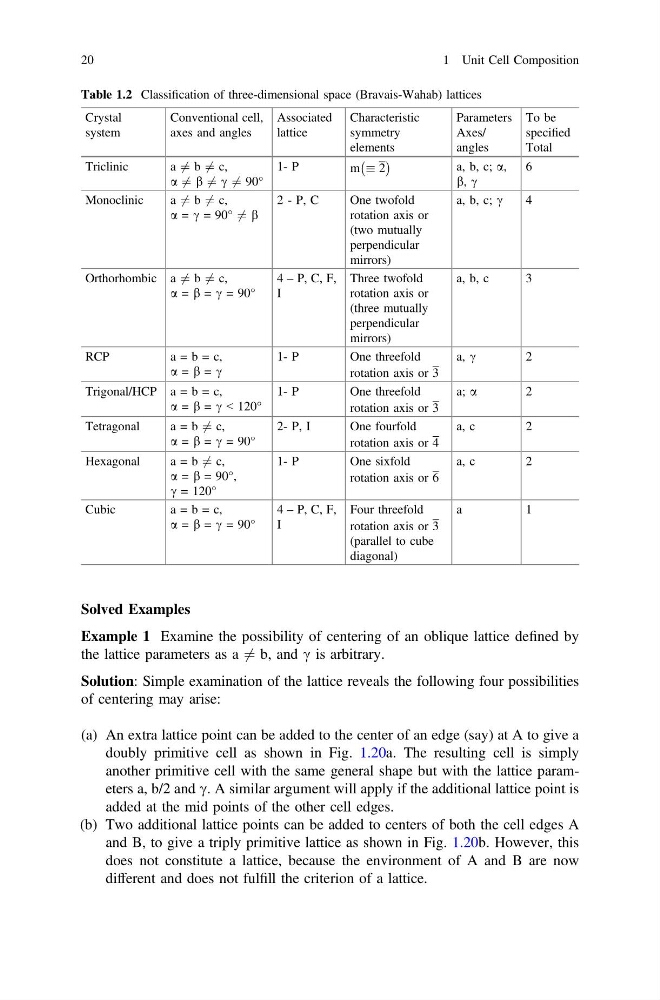
Table 1.2 Classification of three-dimensional space (Bravais-Wahab) lattices
Crystal
system
Conventional cell,
axes and angles
Associated
lattice
Characteristic
symmetry
elements
Parameters
Axes/
angles
To be
specified
Total
Triclinic
a 6 ¼ b 6 ¼ c,
a 6 ¼ b 6 ¼ c 6 ¼ 90°
1- P
m 2
À
Á
a, b, c; a,
b, c
6
Monoclinic
a 6 ¼ b 6 ¼ c,
a = c = 90° 6 ¼ b
2 - P, C
One twofold
rotation axis or
(two mutually
perpendicular
mirrors)
a, b, c; c
4
Orthorhombic a 6 ¼ b 6 ¼ c,
a = b = c = 90°
4 – P, C, F,
I
Three twofold
rotation axis or
(three mutually
perpendicular
mirrors)
a, b, c
3
RCP
a = b = c,
a = b = c
1- P
One threefold
rotation axis or 3
a, c
2
Trigonal/HCP a = b = c,
a = b = c ˂ 120°
1- P
One threefold
rotation axis or 3
a; a
2
Tetragonal
a = b 6 ¼ c,
a = b = c = 90°
2- P, I
One fourfold
rotation axis or 4
a, c
2
Hexagonal
a = b 6 ¼ c,
a = b = 90°,
c = 120°
1- P
One sixfold
rotation axis or 6
a, c
2
Cubic
a = b = c,
a = b = c = 90°
4 – P, C, F,
I
Four threefold
rotation axis or 3
(parallel to cube
diagonal)
a
1
20
1 Unit Cell Composition
Example 1 Examine the possibility of centering of an oblique lattice defined by
the lattice parameters as a 6 ¼ b, and c is arbitrary.
Solution: Simple examination of the lattice reveals the following four possibilities
of centering may arise:
(a) An extra lattice point can be added to the center of an edge (say) at A to give a
doubly primitive cell as shown in Fig. 1.20a. The resulting cell is simply
another primitive cell with the same general shape but with the lattice parameters a, b/2 and c. A similar argument will apply if the additional lattice point is
added at the mid points of the other cell edges.
(b) Two additional lattice points can be added to centers of both the cell edges A
and B, to give a triply primitive lattice as shown in Fig. 1.20b. However, this
does not constitute a lattice, because the environment of A and B are now
different and does not fulfill the criterion of a lattice.
Table 1.2 Classification of three-dimensional space (Bravais-Wahab) lattices
Crystal
system
Conventional cell,
axes and angles
Associated
lattice
Characteristic
symmetry
elements
Parameters
Axes/
angles
To be
specified
Total
Triclinic
a 6 ¼ b 6 ¼ c,
a 6 ¼ b 6 ¼ c 6 ¼ 90°
1- P
m 2
À
Á
a, b, c; a,
b, c
6
Monoclinic
a 6 ¼ b 6 ¼ c,
a = c = 90° 6 ¼ b
2 - P, C
One twofold
rotation axis or
(two mutually
perpendicular
mirrors)
a, b, c; c
4
Orthorhombic a 6 ¼ b 6 ¼ c,
a = b = c = 90°
4 – P, C, F,
I
Three twofold
rotation axis or
(three mutually
perpendicular
mirrors)
a, b, c
3
RCP
a = b = c,
a = b = c
1- P
One threefold
rotation axis or 3
a, c
2
Trigonal/HCP a = b = c,
a = b = c ˂ 120°
1- P
One threefold
rotation axis or 3
a; a
2
Tetragonal
a = b 6 ¼ c,
a = b = c = 90°
2- P, I
One fourfold
rotation axis or 4
a, c
2
Hexagonal
a = b 6 ¼ c,
a = b = 90°,
c = 120°
1- P
One sixfold
rotation axis or 6
a, c
2
Cubic
a = b = c,
a = b = c = 90°
4 – P, C, F,
I
Four threefold
rotation axis or 3
(parallel to cube
diagonal)
a
1
20
1 Unit Cell Composition