

the Bravais representation of trigonal, rhombohedral and hexagonal structures,
Wahab and Wahab (2015) in their studies on close packing of identical atoms
(spheres) discovered the hexagonal close packing (HCP) and rhombohedral
close packing (RCP) as the two new and independent space lattices (called
Wahab lattices). The 16 space lattices they named as Bravais-Wahab lattices or
simply as space lattices as before. They then classified them into 8 crystal
systems (Table 1.2) on the basis of symmetry.
Further, a recent study on symmetry made by Wahab (2020) has shown that
mirror is the only fundamental symmetry in crystals and all other symmetries such
as rotation, inversion, rotoreflection, rotoinversion and translational periodicity are
derivable from different combinations of mirrors. According to the mirror combination scheme, it is necessary and inevitable to make some changes in the earlier
assigned point groups in some low symmetry crystal systems such as triclinic,
monoclinic and orthorhombic. The resulting changes and some other information
are provided in Table 1.2.
1.4 Centering in 2-D and 3-D Crystal Lattices
The basic criterion to verify the existence of non-primitive (or centered) lattice in
crystals is to add a lattice point (or lattice points) at appropriate positions without
disturbing the essential symmetry of the original lattice (or unit cell) and then
examining whether a smaller primitive cell may be chosen with the same general
shape or not. Two possibilities will arise:
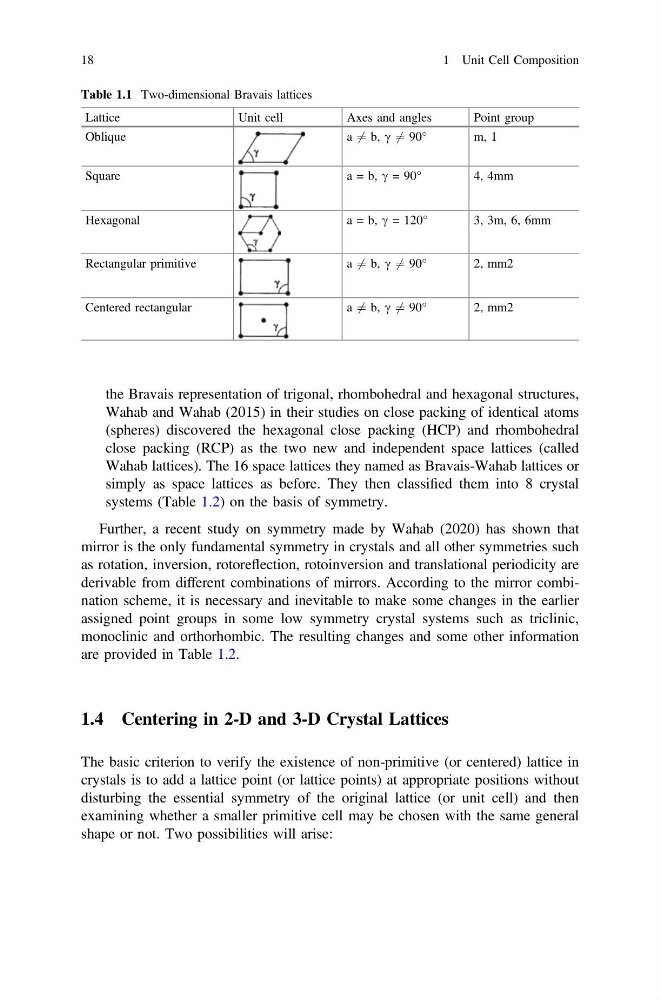
Table 1.1 Two-dimensional Bravais lattices
Lattice
Unit cell
Axes and angles
Point group
Oblique
a 6 ¼ b, c 6 ¼ 90°
m, 1
Square
a = b, c = 90°
4, 4mm
Hexagonal
a = b, c = 120°
3, 3m, 6, 6mm
Rectangular primitive
a 6 ¼ b, c 6 ¼ 90°
2, mm2
Centered rectangular
a 6 ¼ b, c 6 ¼ 90°
2, mm2
18
1 Unit Cell Composition
Wahab and Wahab (2015) in their studies on close packing of identical atoms
(spheres) discovered the hexagonal close packing (HCP) and rhombohedral
close packing (RCP) as the two new and independent space lattices (called
Wahab lattices). The 16 space lattices they named as Bravais-Wahab lattices or
simply as space lattices as before. They then classified them into 8 crystal
systems (Table 1.2) on the basis of symmetry.
Further, a recent study on symmetry made by Wahab (2020) has shown that
mirror is the only fundamental symmetry in crystals and all other symmetries such
as rotation, inversion, rotoreflection, rotoinversion and translational periodicity are
derivable from different combinations of mirrors. According to the mirror combination scheme, it is necessary and inevitable to make some changes in the earlier
assigned point groups in some low symmetry crystal systems such as triclinic,
monoclinic and orthorhombic. The resulting changes and some other information
are provided in Table 1.2.
1.4 Centering in 2-D and 3-D Crystal Lattices
The basic criterion to verify the existence of non-primitive (or centered) lattice in
crystals is to add a lattice point (or lattice points) at appropriate positions without
disturbing the essential symmetry of the original lattice (or unit cell) and then
examining whether a smaller primitive cell may be chosen with the same general
shape or not. Two possibilities will arise:
Table 1.1 Two-dimensional Bravais lattices
Lattice
Unit cell
Axes and angles
Point group
Oblique
a 6 ¼ b, c 6 ¼ 90°
m, 1
Square
a = b, c = 90°
4, 4mm
Hexagonal
a = b, c = 120°
3, 3m, 6, 6mm
Rectangular primitive
a 6 ¼ b, c 6 ¼ 90°
2, mm2
Centered rectangular
a 6 ¼ b, c 6 ¼ 90°
2, mm2
18
1 Unit Cell Composition