

(a) Crystal Systems in 2-D
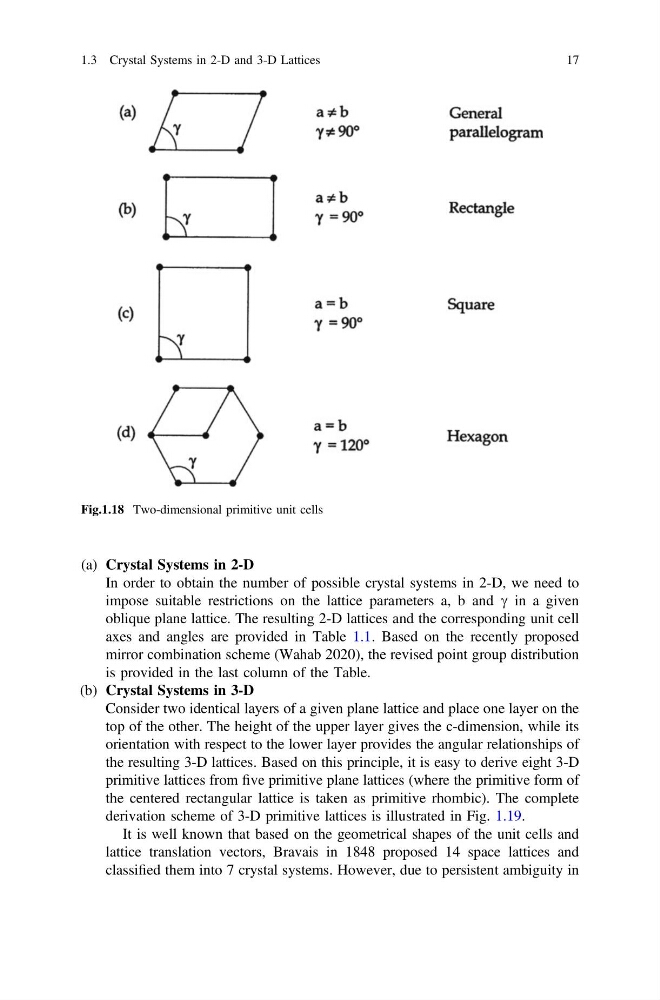
In order to obtain the number of possible crystal systems in 2-D, we need to
impose suitable restrictions on the lattice parameters a, b and c in a given
oblique plane lattice. The resulting 2-D lattices and the corresponding unit cell
axes and angles are provided in Table 1.1. Based on the recently proposed
mirror combination scheme (Wahab 2020), the revised point group distribution
is provided in the last column of the Table.
(b) Crystal Systems in 3-D
Consider two identical layers of a given plane lattice and place one layer on the
top of the other. The height of the upper layer gives the c-dimension, while its
orientation with respect to the lower layer provides the angular relationships of
the resulting 3-D lattices. Based on this principle, it is easy to derive eight 3-D
primitive lattices from five primitive plane lattices (where the primitive form of
the centered rectangular lattice is taken as primitive rhombic). The complete
derivation scheme of 3-D primitive lattices is illustrated in Fig. 1.19.
It is well known that based on the geometrical shapes of the unit cells and
lattice translation vectors, Bravais in 1848 proposed 14 space lattices and
classified them into 7 crystal systems. However, due to persistent ambiguity in
Fig.1.18 Two-dimensional primitive unit cells
1.3 Crystal Systems in 2-D and 3-D Lattices
17
In order to obtain the number of possible crystal systems in 2-D, we need to
impose suitable restrictions on the lattice parameters a, b and c in a given
oblique plane lattice. The resulting 2-D lattices and the corresponding unit cell
axes and angles are provided in Table 1.1. Based on the recently proposed
mirror combination scheme (Wahab 2020), the revised point group distribution
is provided in the last column of the Table.
(b) Crystal Systems in 3-D
Consider two identical layers of a given plane lattice and place one layer on the
top of the other. The height of the upper layer gives the c-dimension, while its
orientation with respect to the lower layer provides the angular relationships of
the resulting 3-D lattices. Based on this principle, it is easy to derive eight 3-D
primitive lattices from five primitive plane lattices (where the primitive form of
the centered rectangular lattice is taken as primitive rhombic). The complete
derivation scheme of 3-D primitive lattices is illustrated in Fig. 1.19.
It is well known that based on the geometrical shapes of the unit cells and
lattice translation vectors, Bravais in 1848 proposed 14 space lattices and
classified them into 7 crystal systems. However, due to persistent ambiguity in
Fig.1.18 Two-dimensional primitive unit cells
1.3 Crystal Systems in 2-D and 3-D Lattices
17