

m ¼
DE
h
¼
E 2 À E 1
h
¼
m e
4 ZÀb
ð
Þ
2
8e 2
0 h
3
1
n 2
1
À
1
n 2
2
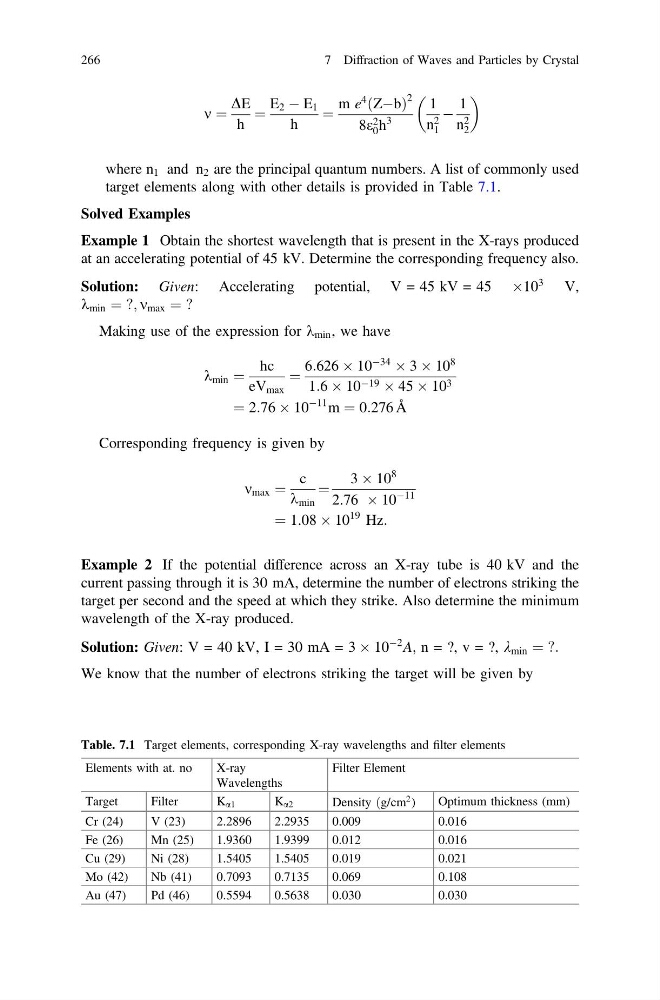
where n 1 and n 2 are the principal quantum numbers. A list of commonly used
target elements along with other details is provided in Table 7.1.
Solved Examples
Example 1 Obtain the shortest wavelength that is present in the X-rays produced
at an accelerating potential of 45 kV. Determine the corresponding frequency also.
Solution: Given: Accelerating potential, V = 45 kV = 45 Â10
3
V,
k min ¼ ?; m max ¼ ?
Making use of the expression for k min , we have
k min ¼
hc
eV max
¼
6:626 Â 10
À34
 3  10
8
1:6 Â 10 À19 Â 45 Â 10 3
¼ 2:76 Â 10
À11 m ¼ 0:276 ˚
A
Corresponding frequency is given by
m max ¼
c
k min
¼
3 Â 10
8
2.76 Â 10
À11
¼ 1.08 Â 10
19 Hz:
Example 2 If the potential difference across an X-ray tube is 40 kV and the
current passing through it is 30 mA, determine the number of electrons striking the
target per second and the speed at which they strike. Also determine the minimum
wavelength of the X-ray produced.
Solution: Given: V = 40 kV, I = 30 mA = 3 Â 10
À2
A; n = ?, v = ?, k min ¼ ?:
We know that the number of electrons striking the target will be given by
Table. 7.1 Target elements, corresponding X-ray wavelengths and filter elements
Elements with at. no
X-ray
Wavelengths
Filter Element
Target
Filter
K a1
K a2
Density ðg/cm
2 )
Optimum thickness (mm)
Cr (24)
V (23)
2.2896
2.2935
0.009
0.016
Fe (26)
Mn (25)
1.9360
1.9399
0.012
0.016
Cu (29)
Ni (28)
1.5405
1.5405
0.019
0.021
Mo (42)
Nb (41)
0.7093
0.7135
0.069
0.108
Au (47)
Pd (46)
0.5594
0.5638
0.030
0.030
266
7 Diffraction of Waves and Particles by Crystal
DE
h
¼
E 2 À E 1
h
¼
m e
4 ZÀb
ð
Þ
2
8e 2
0 h
3
1
n 2
1
À
1
n 2
2
where n 1 and n 2 are the principal quantum numbers. A list of commonly used
target elements along with other details is provided in Table 7.1.
Solved Examples
Example 1 Obtain the shortest wavelength that is present in the X-rays produced
at an accelerating potential of 45 kV. Determine the corresponding frequency also.
Solution: Given: Accelerating potential, V = 45 kV = 45 Â10
3
V,
k min ¼ ?; m max ¼ ?
Making use of the expression for k min , we have
k min ¼
hc
eV max
¼
6:626 Â 10
À34
 3  10
8
1:6 Â 10 À19 Â 45 Â 10 3
¼ 2:76 Â 10
À11 m ¼ 0:276 ˚
A
Corresponding frequency is given by
m max ¼
c
k min
¼
3 Â 10
8
2.76 Â 10
À11
¼ 1.08 Â 10
19 Hz:
Example 2 If the potential difference across an X-ray tube is 40 kV and the
current passing through it is 30 mA, determine the number of electrons striking the
target per second and the speed at which they strike. Also determine the minimum
wavelength of the X-ray produced.
Solution: Given: V = 40 kV, I = 30 mA = 3 Â 10
À2
A; n = ?, v = ?, k min ¼ ?:
We know that the number of electrons striking the target will be given by
Table. 7.1 Target elements, corresponding X-ray wavelengths and filter elements
Elements with at. no
X-ray
Wavelengths
Filter Element
Target
Filter
K a1
K a2
Density ðg/cm
2 )
Optimum thickness (mm)
Cr (24)
V (23)
2.2896
2.2935
0.009
0.016
Fe (26)
Mn (25)
1.9360
1.9399
0.012
0.016
Cu (29)
Ni (28)
1.5405
1.5405
0.019
0.021
Mo (42)
Nb (41)
0.7093
0.7135
0.069
0.108
Au (47)
Pd (46)
0.5594
0.5638
0.030
0.030
266
7 Diffraction of Waves and Particles by Crystal