

eV K = W K = hm K ¼
hc
k K
or k K ðaÞ¼
hc
eV K
¼
hc
E L À E K
where V K is the K excitation voltage and k K is the K absorption edge wavelength (in angstroms). On a similar line one can obtain
k K ðbÞ ¼
hc
eV K
¼
hc
E M À E K
where E K , E L and E M respectively, are energies corresponding to K, L and M
levels.
(c) According to Moseley, the characteristic frequency emitted by an element (in
each K, L, M and N series) is found to depend on its atomic number according
to the equation
ffiffi ffi
m
p / a(Z À b)
or m ¼ a Z À b
ð
Þ
½
2
where a and b are constants for a particular series (their values are different for
different series). The constant a is related to Rydberg constant, b is a small
number called the nuclear screening constant and (Z-b) is the effective mass
number of the element. For K-spectrum, b = 1.
(d) The Moseley’s law deduced from Bohr’s atomic model (taking into account the
two energy levels) is given by
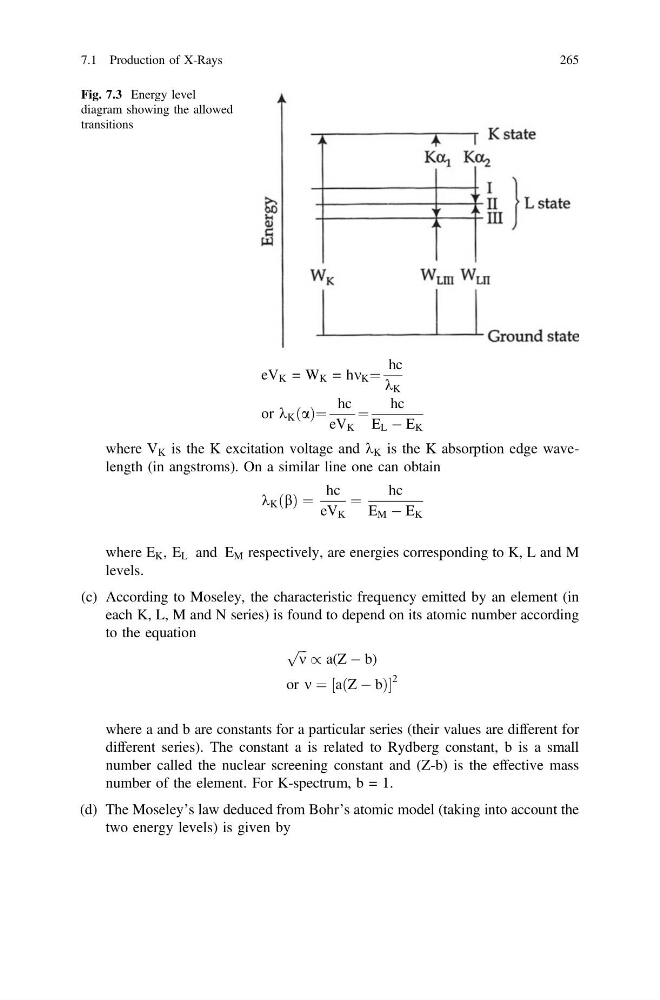
Fig. 7.3 Energy level
diagram showing the allowed
transitions
7.1 Production of X-Rays
265
hc
k K
or k K ðaÞ¼
hc
eV K
¼
hc
E L À E K
where V K is the K excitation voltage and k K is the K absorption edge wavelength (in angstroms). On a similar line one can obtain
k K ðbÞ ¼
hc
eV K
¼
hc
E M À E K
where E K , E L and E M respectively, are energies corresponding to K, L and M
levels.
(c) According to Moseley, the characteristic frequency emitted by an element (in
each K, L, M and N series) is found to depend on its atomic number according
to the equation
ffiffi ffi
m
p / a(Z À b)
or m ¼ a Z À b
ð
Þ
½
2
where a and b are constants for a particular series (their values are different for
different series). The constant a is related to Rydberg constant, b is a small
number called the nuclear screening constant and (Z-b) is the effective mass
number of the element. For K-spectrum, b = 1.
(d) The Moseley’s law deduced from Bohr’s atomic model (taking into account the
two energy levels) is given by
Fig. 7.3 Energy level
diagram showing the allowed
transitions
7.1 Production of X-Rays
265