

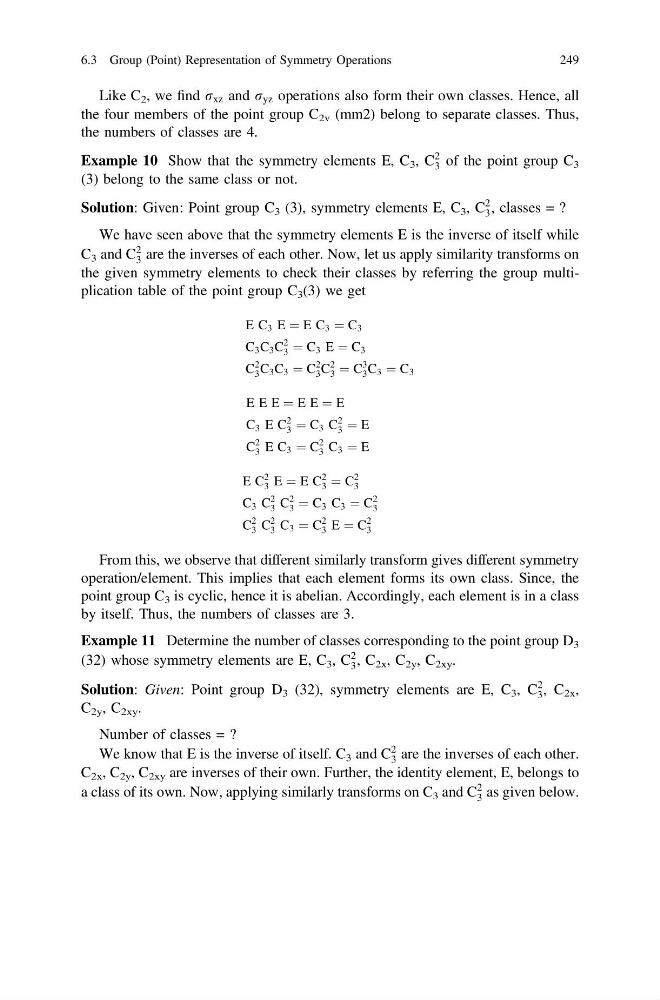
Like C 2 , we find r xz and r yz operations also form their own classes. Hence, all
the four members of the point group C 2v (mm2) belong to separate classes. Thus,
the numbers of classes are 4.
Example 10 Show that the symmetry elements E, C 3 , C
2
3 of the point group C 3
(3) belong to the same class or not.
Solution: Given: Point group C 3 (3), symmetry elements E, C 3 , C
2
3 , classes = ?
We have seen above that the symmetry elements E is the inverse of itself while
C 3 and C
2
3 are the inverses of each other. Now, let us apply similarity transforms on
the given symmetry elements to check their classes by referring the group multiplication table of the point group C 3 (3) we get
E C 3 E ¼ E C 3 ¼ C 3
C 3 C 3 C
2
3 ¼ C 3 E ¼ C 3
C
2
3 C 3 C 3 ¼ C
2
3 C
2
3 ¼ C
3
3 C 3 ¼ C 3
E E E ¼ E E ¼ E
C 3 E C
2
3 ¼ C 3 C
2
3 ¼ E
C
2
3 E C 3 ¼ C
2
3 C 3 ¼ E
E C
2
3 E ¼ E C
2
3 ¼ C
2
3
C 3 C
2
3 C
2
3 ¼ C 3 C 3 ¼ C
2
3
C
2
3 C
2
3 C 3 ¼ C
2
3 E ¼ C
2
3
From this, we observe that different similarly transform gives different symmetry
operation/element. This implies that each element forms its own class. Since, the
point group C 3 is cyclic, hence it is abelian. Accordingly, each element is in a class
by itself. Thus, the numbers of classes are 3.
Example 11 Determine the number of classes corresponding to the point group D 3
(32) whose symmetry elements are E, C 3 , C
2
3 , C 2x , C 2y , C 2xy .
Solution: Given: Point group D 3 (32), symmetry elements are E, C 3 , C
2
3 , C 2x ,
C 2y , C 2xy .
Number of classes = ?
We know that E is the inverse of itself. C 3 and C
2
3 are the inverses of each other.
C 2x , C 2y , C 2xy are inverses of their own. Further, the identity element, E, belongs to
a class of its own. Now, applying similarly transforms on C 3 and C
2
3 as given below.
6.3 Group (Point) Representation of Symmetry Operations
249
the four members of the point group C 2v (mm2) belong to separate classes. Thus,
the numbers of classes are 4.
Example 10 Show that the symmetry elements E, C 3 , C
2
3 of the point group C 3
(3) belong to the same class or not.
Solution: Given: Point group C 3 (3), symmetry elements E, C 3 , C
2
3 , classes = ?
We have seen above that the symmetry elements E is the inverse of itself while
C 3 and C
2
3 are the inverses of each other. Now, let us apply similarity transforms on
the given symmetry elements to check their classes by referring the group multiplication table of the point group C 3 (3) we get
E C 3 E ¼ E C 3 ¼ C 3
C 3 C 3 C
2
3 ¼ C 3 E ¼ C 3
C
2
3 C 3 C 3 ¼ C
2
3 C
2
3 ¼ C
3
3 C 3 ¼ C 3
E E E ¼ E E ¼ E
C 3 E C
2
3 ¼ C 3 C
2
3 ¼ E
C
2
3 E C 3 ¼ C
2
3 C 3 ¼ E
E C
2
3 E ¼ E C
2
3 ¼ C
2
3
C 3 C
2
3 C
2
3 ¼ C 3 C 3 ¼ C
2
3
C
2
3 C
2
3 C 3 ¼ C
2
3 E ¼ C
2
3
From this, we observe that different similarly transform gives different symmetry
operation/element. This implies that each element forms its own class. Since, the
point group C 3 is cyclic, hence it is abelian. Accordingly, each element is in a class
by itself. Thus, the numbers of classes are 3.
Example 11 Determine the number of classes corresponding to the point group D 3
(32) whose symmetry elements are E, C 3 , C
2
3 , C 2x , C 2y , C 2xy .
Solution: Given: Point group D 3 (32), symmetry elements are E, C 3 , C
2
3 , C 2x ,
C 2y , C 2xy .
Number of classes = ?
We know that E is the inverse of itself. C 3 and C
2
3 are the inverses of each other.
C 2x , C 2y , C 2xy are inverses of their own. Further, the identity element, E, belongs to
a class of its own. Now, applying similarly transforms on C 3 and C
2
3 as given below.
6.3 Group (Point) Representation of Symmetry Operations
249