

S
1
4 ¼ S 4
S
2
4 ¼ C
2
4 ðr h Þ
2 ¼ C
1
2 E = C 2
S
3
4 ¼ S
3
4
S
4
4 ¼ C
4
4 ðr h Þ
4 ¼ E r
2
h
À Á 2 ¼ ðEÞ
2 ¼ E
⟹ The symmetry elements are: E, C 2 ; S 4 and S
3
4 :
For n = 6, S
n
n ¼ S
6
6 gives S
1
6 ; S
2
6 ; S
3
6 ; S
4
6 ; S
5
6 and S
6
6 symmetry elements, where
S
1
6 ¼ S 6
S
2
6 ¼ C
2
6 ðr h Þ
2 ¼ C
1
3 E = C 3
S
3
6 ¼ C
3
6 r h
ð Þ
3 ¼ C
1
2 r h
ð Þ
2 r h ¼ C 2 :E:r h ¼ C 2 r h ¼ i
S
4
6 ¼ C
4
6 ðr h Þ
4 ¼ C
2
3 r
2
h
À Á 2 ¼ C
2
3 ðE)
2
¼ C
2
3
S
5
6 ¼ S
5
6
S
6
6 ¼ C
6
6 ðr h Þ
6 ¼ E r
2
h
À Á 3 ¼ E:ðE)
3
¼ E
⟹ The symmetry elements are: E, C 3 ; C
2
3 ; i, S 6 and S
5
6 .
Isomorphic Group
The two or more groups are said to be isomorphic if they obey the same group
multiplication table. This means that there is a one -to-one correspondence between
elements A, B, … of one group and those A′, B′, …. Of the other, such that AB = C
implies A’B’ = C’ and vice versa.
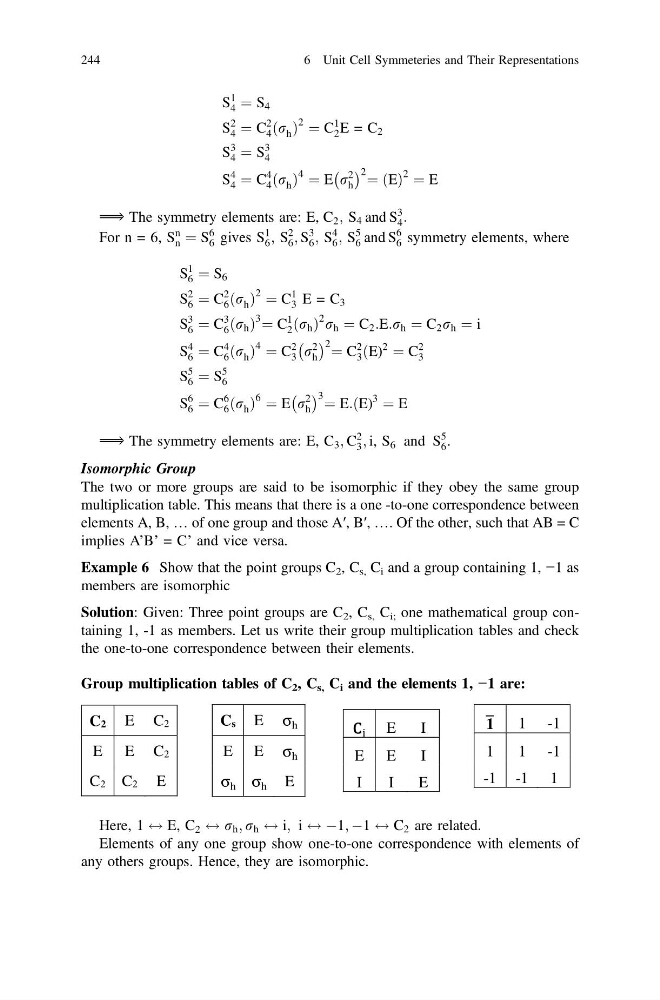
Example 6 Show that the point groups C 2 , C s, C i and a group containing 1, −1 as
members are isomorphic
Solution: Given: Three point groups are C 2 , C s, C i; one mathematical group containing 1, -1 as members. Let us write their group multiplication tables and check
the one-to-one correspondence between their elements.
Group multiplication tables of C 2 , C s, C i and the elements 1, −1 are:
Here, 1 $ E, C 2 $ r h ; r h $ i; i $ À1; À1 $ C 2 are related.
Elements of any one group show one-to-one correspondence with elements of
any others groups. Hence, they are isomorphic.
C2 E C2
E E C2
C2 C2 E
Cs E σ h
E E σ h
σ h σ h E
C C i E
I
E E
I
I
I
E
1
1 -1
1
−
1 -1
-1 -1 1
244
6 Unit Cell Symmeteries and Their Representations
1
4 ¼ S 4
S
2
4 ¼ C
2
4 ðr h Þ
2 ¼ C
1
2 E = C 2
S
3
4 ¼ S
3
4
S
4
4 ¼ C
4
4 ðr h Þ
4 ¼ E r
2
h
À Á 2 ¼ ðEÞ
2 ¼ E
⟹ The symmetry elements are: E, C 2 ; S 4 and S
3
4 :
For n = 6, S
n
n ¼ S
6
6 gives S
1
6 ; S
2
6 ; S
3
6 ; S
4
6 ; S
5
6 and S
6
6 symmetry elements, where
S
1
6 ¼ S 6
S
2
6 ¼ C
2
6 ðr h Þ
2 ¼ C
1
3 E = C 3
S
3
6 ¼ C
3
6 r h
ð Þ
3 ¼ C
1
2 r h
ð Þ
2 r h ¼ C 2 :E:r h ¼ C 2 r h ¼ i
S
4
6 ¼ C
4
6 ðr h Þ
4 ¼ C
2
3 r
2
h
À Á 2 ¼ C
2
3 ðE)
2
¼ C
2
3
S
5
6 ¼ S
5
6
S
6
6 ¼ C
6
6 ðr h Þ
6 ¼ E r
2
h
À Á 3 ¼ E:ðE)
3
¼ E
⟹ The symmetry elements are: E, C 3 ; C
2
3 ; i, S 6 and S
5
6 .
Isomorphic Group
The two or more groups are said to be isomorphic if they obey the same group
multiplication table. This means that there is a one -to-one correspondence between
elements A, B, … of one group and those A′, B′, …. Of the other, such that AB = C
implies A’B’ = C’ and vice versa.
Example 6 Show that the point groups C 2 , C s, C i and a group containing 1, −1 as
members are isomorphic
Solution: Given: Three point groups are C 2 , C s, C i; one mathematical group containing 1, -1 as members. Let us write their group multiplication tables and check
the one-to-one correspondence between their elements.
Group multiplication tables of C 2 , C s, C i and the elements 1, −1 are:
Here, 1 $ E, C 2 $ r h ; r h $ i; i $ À1; À1 $ C 2 are related.
Elements of any one group show one-to-one correspondence with elements of
any others groups. Hence, they are isomorphic.
C2 E C2
E E C2
C2 C2 E
Cs E σ h
E E σ h
σ h σ h E
C C i E
I
E E
I
I
I
E
1
1 -1
1
−
1 -1
-1 -1 1
244
6 Unit Cell Symmeteries and Their Representations