

S 3 : S
6
3 ð¼ EÞ; S
5
3 ; S
4
3 ¼ C 3
ð
Þ; S
3
3 ¼ r h
ð
Þ; S
2
3 ; ¼ C
2
3
À
Á ; S 3
S 4 : S
4
4 ð¼ EÞ; S
3
4 ; S
2
4 ¼ C 2
ð
Þ; S 4
S 6 : S
6
6 ð¼ EÞ; S
5
6 ; S
4
6 ¼ C
2
3
À
Á ; S
3
6 ð¼ iÞ; S
2
6 ¼ C 3
ð
Þ; S 6
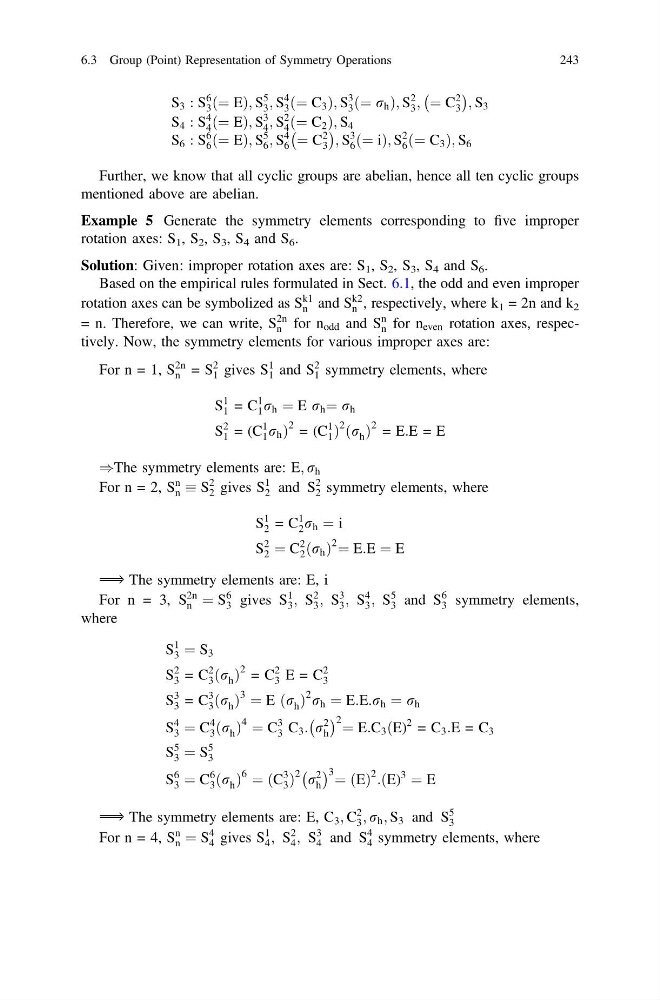
Further, we know that all cyclic groups are abelian, hence all ten cyclic groups
mentioned above are abelian.
Example 5 Generate the symmetry elements corresponding to five improper
rotation axes: S 1 , S 2 , S 3 , S 4 and S 6 .
Solution: Given: improper rotation axes are: S 1 , S 2 , S 3 , S 4 and S 6 .
Based on the empirical rules formulated in Sect. 6.1, the odd and even improper
rotation axes can be symbolized as S
k1
n and S
k2
n , respectively, where k 1 = 2n and k 2
= n. Therefore, we can write, S
2n
n for n odd and S
n
n for n even rotation axes, respectively. Now, the symmetry elements for various improper axes are:
For n = 1, S
2n
n = S
2
1 gives S
1
1 and S
2
1 symmetry elements, where
S
1
1 = C
1
1 r h ¼ E r h ¼ r h
S
2
1 = (C
1
1 r h Þ
2 = (C
1
1 Þ
2 ðr h Þ
2 = E:E = E
)The symmetry elements are: E; r h
For n = 2, S
n
n S
2
2 gives S
1
2 and S
2
2 symmetry elements, where
S
1
2 = C
1
2 r h ¼ i
S
2
2 ¼ C
2
2 r h
ð Þ
2 ¼ E:E ¼ E
⟹ The symmetry elements are: E, i
For n = 3, S
2n
n ¼ S
6
3 gives S
1
3 ; S
2
3 ; S
3
3 ; S
4
3 ; S
5
3 and S
6
3 symmetry elements,
where
S
1
3 ¼ S 3
S
2
3 = C
2
3 ðr h Þ
2 = C
2
3 E = C
2
3
S
3
3 = C
3
3 ðr h Þ
3 ¼ E ðr h Þ
2 r h ¼ E:E:r h ¼ r h
S
4
3 ¼ C
4
3 ðr h Þ
4 ¼ C
3
3 C 3 : r
2
h
À Á 2 ¼ E:C 3 ðE)
2 = C 3 :E = C 3
S
5
3 ¼ S
5
3
S
6
3 ¼ C
6
3 ðr h Þ
6 ¼ ðC
3
3 Þ
2 r
2
h
À Á 3 ¼ ðEÞ
2 :ðE)
3
¼ E
⟹ The symmetry elements are: E, C 3 ; C
2
3 ; r h ; S 3 and S
5
3
For n = 4, S
n
n ¼ S
4
4 gives S
1
4 ; S
2
4 ; S
3
4 and S
4
4 symmetry elements, where
6.3 Group (Point) Representation of Symmetry Operations
243
6
3 ð¼ EÞ; S
5
3 ; S
4
3 ¼ C 3
ð
Þ; S
3
3 ¼ r h
ð
Þ; S
2
3 ; ¼ C
2
3
À
Á ; S 3
S 4 : S
4
4 ð¼ EÞ; S
3
4 ; S
2
4 ¼ C 2
ð
Þ; S 4
S 6 : S
6
6 ð¼ EÞ; S
5
6 ; S
4
6 ¼ C
2
3
À
Á ; S
3
6 ð¼ iÞ; S
2
6 ¼ C 3
ð
Þ; S 6
Further, we know that all cyclic groups are abelian, hence all ten cyclic groups
mentioned above are abelian.
Example 5 Generate the symmetry elements corresponding to five improper
rotation axes: S 1 , S 2 , S 3 , S 4 and S 6 .
Solution: Given: improper rotation axes are: S 1 , S 2 , S 3 , S 4 and S 6 .
Based on the empirical rules formulated in Sect. 6.1, the odd and even improper
rotation axes can be symbolized as S
k1
n and S
k2
n , respectively, where k 1 = 2n and k 2
= n. Therefore, we can write, S
2n
n for n odd and S
n
n for n even rotation axes, respectively. Now, the symmetry elements for various improper axes are:
For n = 1, S
2n
n = S
2
1 gives S
1
1 and S
2
1 symmetry elements, where
S
1
1 = C
1
1 r h ¼ E r h ¼ r h
S
2
1 = (C
1
1 r h Þ
2 = (C
1
1 Þ
2 ðr h Þ
2 = E:E = E
)The symmetry elements are: E; r h
For n = 2, S
n
n S
2
2 gives S
1
2 and S
2
2 symmetry elements, where
S
1
2 = C
1
2 r h ¼ i
S
2
2 ¼ C
2
2 r h
ð Þ
2 ¼ E:E ¼ E
⟹ The symmetry elements are: E, i
For n = 3, S
2n
n ¼ S
6
3 gives S
1
3 ; S
2
3 ; S
3
3 ; S
4
3 ; S
5
3 and S
6
3 symmetry elements,
where
S
1
3 ¼ S 3
S
2
3 = C
2
3 ðr h Þ
2 = C
2
3 E = C
2
3
S
3
3 = C
3
3 ðr h Þ
3 ¼ E ðr h Þ
2 r h ¼ E:E:r h ¼ r h
S
4
3 ¼ C
4
3 ðr h Þ
4 ¼ C
3
3 C 3 : r
2
h
À Á 2 ¼ E:C 3 ðE)
2 = C 3 :E = C 3
S
5
3 ¼ S
5
3
S
6
3 ¼ C
6
3 ðr h Þ
6 ¼ ðC
3
3 Þ
2 r
2
h
À Á 3 ¼ ðEÞ
2 :ðE)
3
¼ E
⟹ The symmetry elements are: E, C 3 ; C
2
3 ; r h ; S 3 and S
5
3
For n = 4, S
n
n ¼ S
4
4 gives S
1
4 ; S
2
4 ; S
3
4 and S
4
4 symmetry elements, where
6.3 Group (Point) Representation of Symmetry Operations
243