

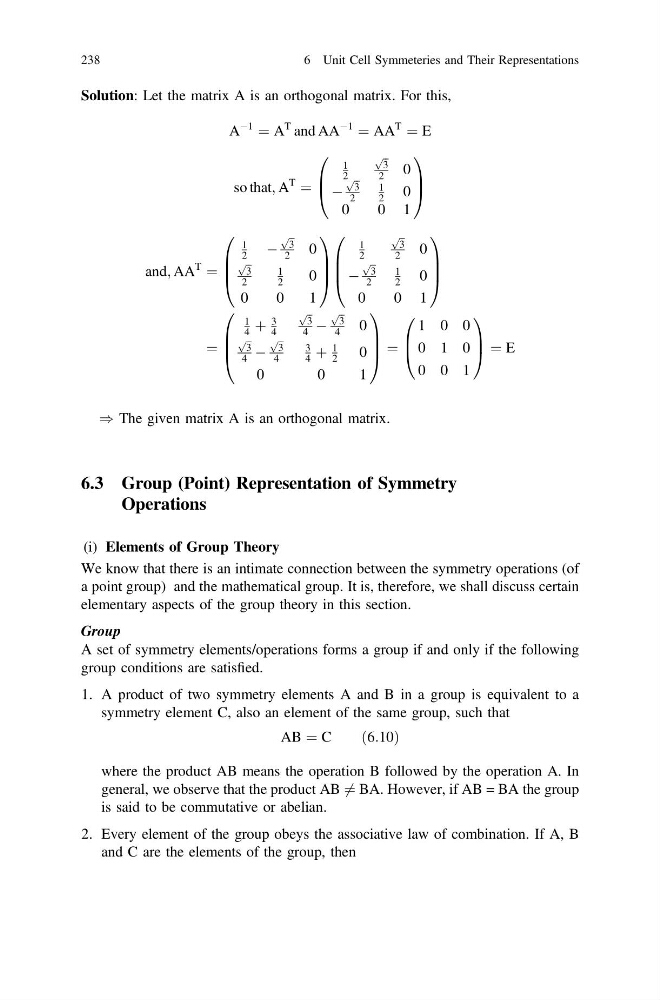
Solution: Let the matrix A is an orthogonal matrix. For this,
A
À1
¼ A
T and AA
À1
¼ AA
T
¼ E
so that; A
T
¼
1
2
ffiffi
3
p
2
0
À
ffiffi
3
p
2
1
2
0
0
0 1
0
B
@
1
C
A
and; AA
T
¼
1
2
À
ffiffi
3
p
2
0
ffiffi
3
p
2
1
2
0
0
0
1
0
B
B
@
1
C
C
A
1
2
ffiffi
3
p
2
0
À
ffiffi
3
p
2
1
2
0
0
0 1
0
B
B
@
1
C
C
A
¼
1
4 þ
3
4
ffiffi
3
p
4 À
ffiffi
3
p
4
0
ffiffi
3
p
4 À
ffiffi
3
p
4
3
4 þ
1
2
0
0
0
1
0
B
B
@
1
C
C
A ¼
1 0 0
0 1 0
0 0 1
0
B
@
1
C
A ¼ E
) The given matrix A is an orthogonal matrix.
6.3 Group (Point) Representation of Symmetry
Operations
(i) Elements of Group Theory
We know that there is an intimate connection between the symmetry operations (of
a point group) and the mathematical group. It is, therefore, we shall discuss certain
elementary aspects of the group theory in this section.
Group
A set of symmetry elements/operations forms a group if and only if the following
group conditions are satisfied.
1. A product of two symmetry elements A and B in a group is equivalent to a
symmetry element C, also an element of the same group, such that
AB ¼ C
ð6:10Þ
where the product AB means the operation B followed by the operation A. In
general, we observe that the product AB 6 ¼ BA. However, if AB = BA the group
is said to be commutative or abelian.
2. Every element of the group obeys the associative law of combination. If A, B
and C are the elements of the group, then
238
6 Unit Cell Symmeteries and Their Representations
A
À1
¼ A
T and AA
À1
¼ AA
T
¼ E
so that; A
T
¼
1
2
ffiffi
3
p
2
0
À
ffiffi
3
p
2
1
2
0
0
0 1
0
B
@
1
C
A
and; AA
T
¼
1
2
À
ffiffi
3
p
2
0
ffiffi
3
p
2
1
2
0
0
0
1
0
B
B
@
1
C
C
A
1
2
ffiffi
3
p
2
0
À
ffiffi
3
p
2
1
2
0
0
0 1
0
B
B
@
1
C
C
A
¼
1
4 þ
3
4
ffiffi
3
p
4 À
ffiffi
3
p
4
0
ffiffi
3
p
4 À
ffiffi
3
p
4
3
4 þ
1
2
0
0
0
1
0
B
B
@
1
C
C
A ¼
1 0 0
0 1 0
0 0 1
0
B
@
1
C
A ¼ E
) The given matrix A is an orthogonal matrix.
6.3 Group (Point) Representation of Symmetry
Operations
(i) Elements of Group Theory
We know that there is an intimate connection between the symmetry operations (of
a point group) and the mathematical group. It is, therefore, we shall discuss certain
elementary aspects of the group theory in this section.
Group
A set of symmetry elements/operations forms a group if and only if the following
group conditions are satisfied.
1. A product of two symmetry elements A and B in a group is equivalent to a
symmetry element C, also an element of the same group, such that
AB ¼ C
ð6:10Þ
where the product AB means the operation B followed by the operation A. In
general, we observe that the product AB 6 ¼ BA. However, if AB = BA the group
is said to be commutative or abelian.
2. Every element of the group obeys the associative law of combination. If A, B
and C are the elements of the group, then
238
6 Unit Cell Symmeteries and Their Representations