

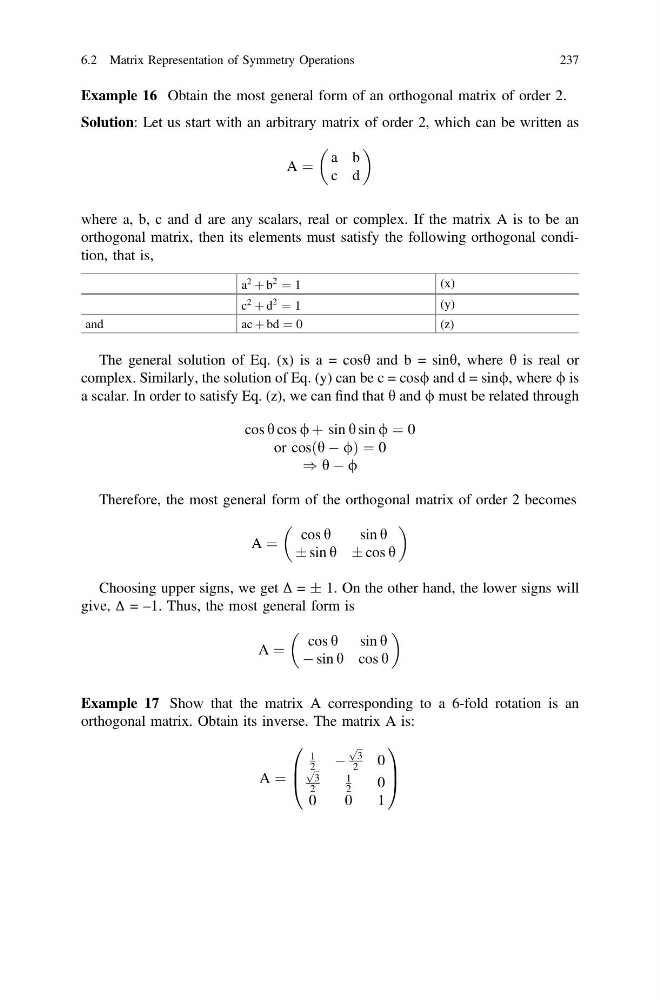
Example 16 Obtain the most general form of an orthogonal matrix of order 2.
Solution: Let us start with an arbitrary matrix of order 2, which can be written as
A ¼
a b
c d
where a, b, c and d are any scalars, real or complex. If the matrix A is to be an
orthogonal matrix, then its elements must satisfy the following orthogonal condition, that is,
a
2 þ b
2 ¼ 1
(x)
c
2 þ d
2 ¼ 1
(y)
and
ac þ bd ¼ 0
(z)
The general solution of Eq. (x) is a = cosh and b = sinh, where h is real or
complex. Similarly, the solution of Eq. (y) can be c = cos/ and d = sin/, where / is
a scalar. In order to satisfy Eq. (z), we can find that h and / must be related through
cos h cos / þ sin h sin / ¼ 0
or cosðh À /Þ ¼ 0
) h À /
Therefore, the most general form of the orthogonal matrix of order 2 becomes
A ¼
cos h
sin h
Æ sin h Æ cos h
Choosing upper signs, we get Δ = ± 1. On the other hand, the lower signs will
give, Δ = –1. Thus, the most general form is
A ¼
cos h sin h
À sin h cos h
Example 17 Show that the matrix A corresponding to a 6-fold rotation is an
orthogonal matrix. Obtain its inverse. The matrix A is:
A ¼
1
2
À
ffiffi
3
p
2
0
ffiffi
3
p
2
1
2
0
0
0
1
0
B
@
1
C
A
6.2 Matrix Representation of Symmetry Operations
237
Solution: Let us start with an arbitrary matrix of order 2, which can be written as
A ¼
a b
c d
where a, b, c and d are any scalars, real or complex. If the matrix A is to be an
orthogonal matrix, then its elements must satisfy the following orthogonal condition, that is,
a
2 þ b
2 ¼ 1
(x)
c
2 þ d
2 ¼ 1
(y)
and
ac þ bd ¼ 0
(z)
The general solution of Eq. (x) is a = cosh and b = sinh, where h is real or
complex. Similarly, the solution of Eq. (y) can be c = cos/ and d = sin/, where / is
a scalar. In order to satisfy Eq. (z), we can find that h and / must be related through
cos h cos / þ sin h sin / ¼ 0
or cosðh À /Þ ¼ 0
) h À /
Therefore, the most general form of the orthogonal matrix of order 2 becomes
A ¼
cos h
sin h
Æ sin h Æ cos h
Choosing upper signs, we get Δ = ± 1. On the other hand, the lower signs will
give, Δ = –1. Thus, the most general form is
A ¼
cos h sin h
À sin h cos h
Example 17 Show that the matrix A corresponding to a 6-fold rotation is an
orthogonal matrix. Obtain its inverse. The matrix A is:
A ¼
1
2
À
ffiffi
3
p
2
0
ffiffi
3
p
2
1
2
0
0
0
1
0
B
@
1
C
A
6.2 Matrix Representation of Symmetry Operations
237