

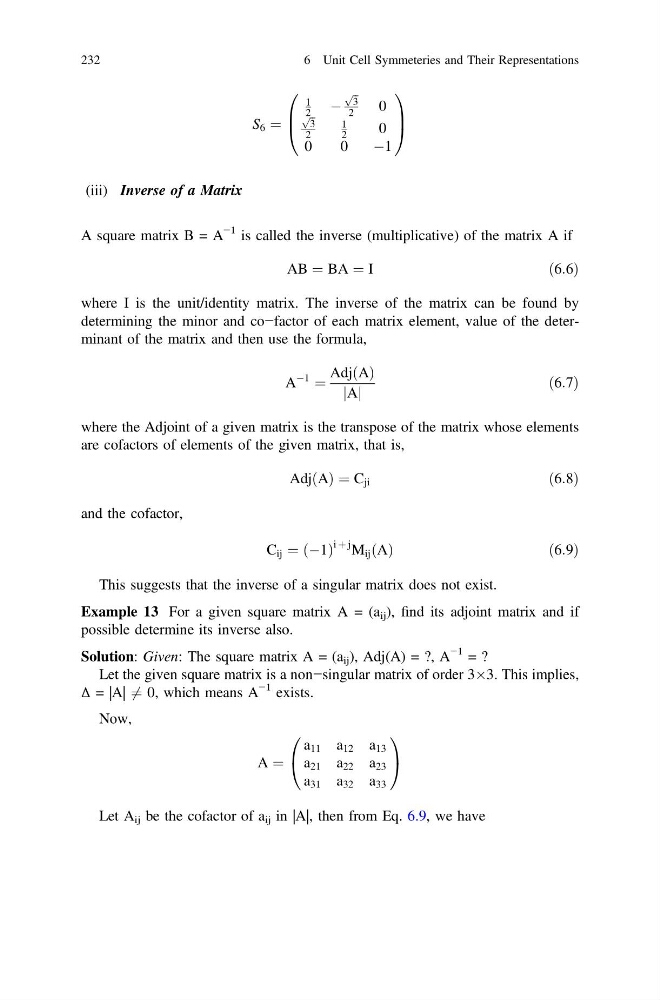
S 6 ¼
1
2
À
ffiffi
3
p
2
0
ffiffi
3
p
2
1
2
0
0
0
À1
0
B
@
1
C
A
(iii) Inverse of a Matrix
A square matrix B = A
−1 is called the inverse (multiplicative) of the matrix A if
AB ¼ BA ¼ I
ð6:6Þ
where I is the unit/identity matrix. The inverse of the matrix can be found by
determining the minor and co−factor of each matrix element, value of the determinant of the matrix and then use the formula,
A
À1
¼
AdjðAÞ
A
j j
ð6:7Þ
where the Adjoint of a given matrix is the transpose of the matrix whose elements
are cofactors of elements of the given matrix, that is,
AdjðAÞ ¼ C ji
ð6:8Þ
and the cofactor,
C ij ¼ ðÀ1Þ
i þ j M ij ðAÞ
ð 6:9Þ
This suggests that the inverse of a singular matrix does not exist.
Example 13 For a given square matrix A = (a ij ), find its adjoint matrix and if
possible determine its inverse also.
Solution: Given: The square matrix A = (a ij ), Adj(A) = ?, A
−1 = ?
Let the given square matrix is a non−singular matrix of order 3Â3. This implies,
Δ = |A| 6 ¼ 0, which means A
−1 exists.
Now,
A ¼
a 11 a 12 a 13
a 21 a 22 a 23
a 31 a 32 a 33
0
@
1
A
Let A ij be the cofactor of a ij in |A|, then from Eq. 6.9, we have
232
6 Unit Cell Symmeteries and Their Representations
1
2
À
ffiffi
3
p
2
0
ffiffi
3
p
2
1
2
0
0
0
À1
0
B
@
1
C
A
(iii) Inverse of a Matrix
A square matrix B = A
−1 is called the inverse (multiplicative) of the matrix A if
AB ¼ BA ¼ I
ð6:6Þ
where I is the unit/identity matrix. The inverse of the matrix can be found by
determining the minor and co−factor of each matrix element, value of the determinant of the matrix and then use the formula,
A
À1
¼
AdjðAÞ
A
j j
ð6:7Þ
where the Adjoint of a given matrix is the transpose of the matrix whose elements
are cofactors of elements of the given matrix, that is,
AdjðAÞ ¼ C ji
ð6:8Þ
and the cofactor,
C ij ¼ ðÀ1Þ
i þ j M ij ðAÞ
ð 6:9Þ
This suggests that the inverse of a singular matrix does not exist.
Example 13 For a given square matrix A = (a ij ), find its adjoint matrix and if
possible determine its inverse also.
Solution: Given: The square matrix A = (a ij ), Adj(A) = ?, A
−1 = ?
Let the given square matrix is a non−singular matrix of order 3Â3. This implies,
Δ = |A| 6 ¼ 0, which means A
−1 exists.
Now,
A ¼
a 11 a 12 a 13
a 21 a 22 a 23
a 31 a 32 a 33
0
@
1
A
Let A ij be the cofactor of a ij in |A|, then from Eq. 6.9, we have
232
6 Unit Cell Symmeteries and Their Representations