

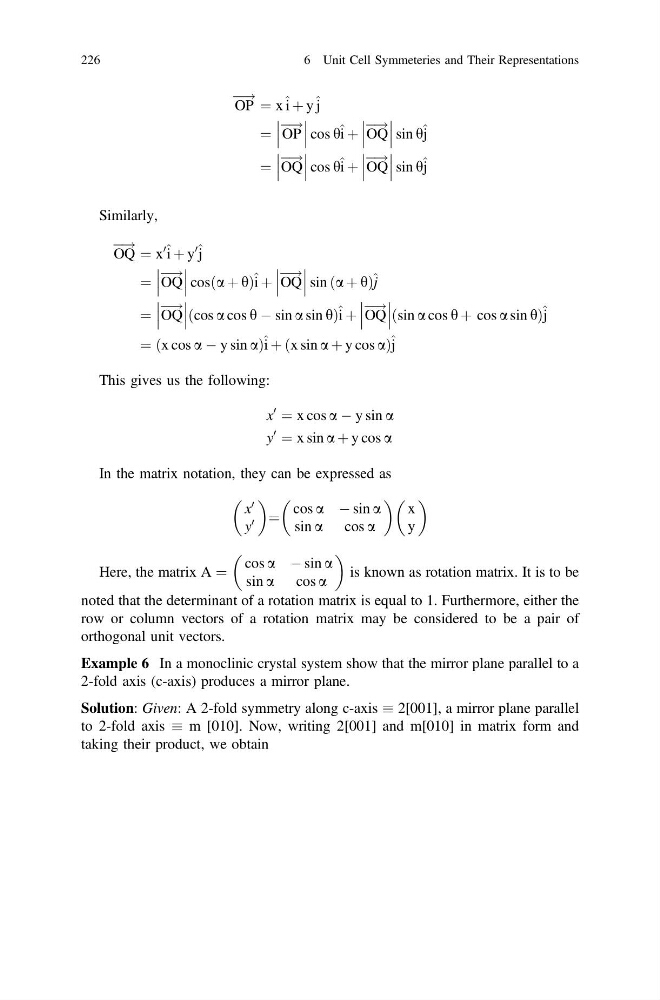
OP
! ¼ x ^ i þ y ^ j
¼ OP
!
cos h ^ i þ OQ
!
sin h ^ j
¼ OQ
!
cos h ^ i þ OQ
!
sin h ^ j
Similarly,
OQ
! ¼ x
0 ^ i þ y
0 ^ j
¼ OQ
!
cos a þ h
ð
Þ ^ i þ OQ
!
sin ða þ hÞ ^ j
¼ OQ
!
cos a cos h À sin a sin h
ð
Þ ^ i þ OQ
!
sin a cos h þ cos a sin h
ð
Þ ^ j
¼ x cos a À y sin a
ð
Þ ^ i þ x sin a þ y cos a
ð
Þ ^ j
This gives us the following:
x
0
¼ x cos a À y sin a
y
0
¼ x sin a þ y cos a
In the matrix notation, they can be expressed as
x
0
y
0
¼
cos a À sin a
sin a cos a
x
y
Here, the matrix A ¼
cos a À sin a
sin a cos a
is known as rotation matrix. It is to be
noted that the determinant of a rotation matrix is equal to 1. Furthermore, either the
row or column vectors of a rotation matrix may be considered to be a pair of
orthogonal unit vectors.
Example 6 In a monoclinic crystal system show that the mirror plane parallel to a
2-fold axis (c-axis) produces a mirror plane.
Solution: Given: A 2-fold symmetry along c-axis 2[001], a mirror plane parallel
to 2-fold axis m [010]. Now, writing 2[001] and m[010] in matrix form and
taking their product, we obtain
226
6 Unit Cell Symmeteries and Their Representations
! ¼ x ^ i þ y ^ j
¼ OP
!
cos h ^ i þ OQ
!
sin h ^ j
¼ OQ
!
cos h ^ i þ OQ
!
sin h ^ j
Similarly,
OQ
! ¼ x
0 ^ i þ y
0 ^ j
¼ OQ
!
cos a þ h
ð
Þ ^ i þ OQ
!
sin ða þ hÞ ^ j
¼ OQ
!
cos a cos h À sin a sin h
ð
Þ ^ i þ OQ
!
sin a cos h þ cos a sin h
ð
Þ ^ j
¼ x cos a À y sin a
ð
Þ ^ i þ x sin a þ y cos a
ð
Þ ^ j
This gives us the following:
x
0
¼ x cos a À y sin a
y
0
¼ x sin a þ y cos a
In the matrix notation, they can be expressed as
x
0
y
0
¼
cos a À sin a
sin a cos a
x
y
Here, the matrix A ¼
cos a À sin a
sin a cos a
is known as rotation matrix. It is to be
noted that the determinant of a rotation matrix is equal to 1. Furthermore, either the
row or column vectors of a rotation matrix may be considered to be a pair of
orthogonal unit vectors.
Example 6 In a monoclinic crystal system show that the mirror plane parallel to a
2-fold axis (c-axis) produces a mirror plane.
Solution: Given: A 2-fold symmetry along c-axis 2[001], a mirror plane parallel
to 2-fold axis m [010]. Now, writing 2[001] and m[010] in matrix form and
taking their product, we obtain
226
6 Unit Cell Symmeteries and Their Representations