

Example 3 Show that neither 5-fold nor 8-fold rotational symmetries can exist in a
crystal lattice.
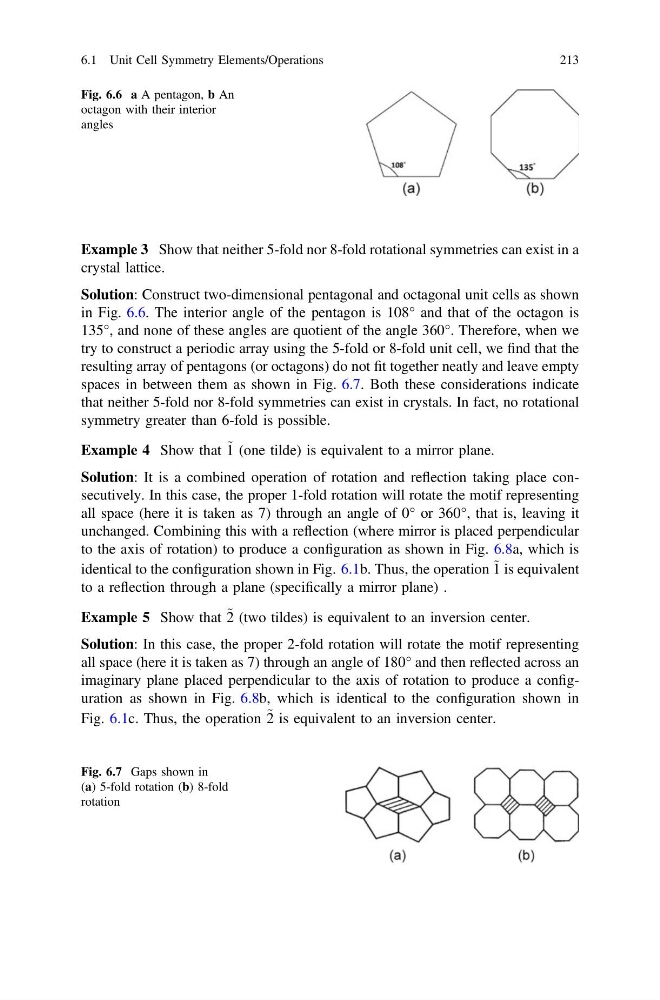
Solution: Construct two-dimensional pentagonal and octagonal unit cells as shown
in Fig. 6.6. The interior angle of the pentagon is 108° and that of the octagon is
135°, and none of these angles are quotient of the angle 360°. Therefore, when we
try to construct a periodic array using the 5-fold or 8-fold unit cell, we find that the
resulting array of pentagons (or octagons) do not fit together neatly and leave empty
spaces in between them as shown in Fig. 6.7. Both these considerations indicate
that neither 5-fold nor 8-fold symmetries can exist in crystals. In fact, no rotational
symmetry greater than 6-fold is possible.
Example 4 Show that ~ 1 (one tilde) is equivalent to a mirror plane.
Solution: It is a combined operation of rotation and reflection taking place consecutively. In this case, the proper 1-fold rotation will rotate the motif representing
all space (here it is taken as 7) through an angle of 0° or 360°, that is, leaving it
unchanged. Combining this with a reflection (where mirror is placed perpendicular
to the axis of rotation) to produce a configuration as shown in Fig. 6.8a, which is
identical to the configuration shown in Fig. 6.1b. Thus, the operation ~ 1 is equivalent
to a reflection through a plane (specifically a mirror plane) .
Example 5 Show that ~ 2 (two tildes) is equivalent to an inversion center.
Solution: In this case, the proper 2-fold rotation will rotate the motif representing
all space (here it is taken as 7) through an angle of 180° and then reflected across an
imaginary plane placed perpendicular to the axis of rotation to produce a configuration as shown in Fig. 6.8b, which is identical to the configuration shown in
Fig. 6.1c. Thus, the operation ~ 2 is equivalent to an inversion center.
Fig. 6.6 a A pentagon, b An
octagon with their interior
angles
Fig. 6.7 Gaps shown in
(a) 5-fold rotation (b) 8-fold
rotation
6.1 Unit Cell Symmetry Elements/Operations
213
crystal lattice.
Solution: Construct two-dimensional pentagonal and octagonal unit cells as shown
in Fig. 6.6. The interior angle of the pentagon is 108° and that of the octagon is
135°, and none of these angles are quotient of the angle 360°. Therefore, when we
try to construct a periodic array using the 5-fold or 8-fold unit cell, we find that the
resulting array of pentagons (or octagons) do not fit together neatly and leave empty
spaces in between them as shown in Fig. 6.7. Both these considerations indicate
that neither 5-fold nor 8-fold symmetries can exist in crystals. In fact, no rotational
symmetry greater than 6-fold is possible.
Example 4 Show that ~ 1 (one tilde) is equivalent to a mirror plane.
Solution: It is a combined operation of rotation and reflection taking place consecutively. In this case, the proper 1-fold rotation will rotate the motif representing
all space (here it is taken as 7) through an angle of 0° or 360°, that is, leaving it
unchanged. Combining this with a reflection (where mirror is placed perpendicular
to the axis of rotation) to produce a configuration as shown in Fig. 6.8a, which is
identical to the configuration shown in Fig. 6.1b. Thus, the operation ~ 1 is equivalent
to a reflection through a plane (specifically a mirror plane) .
Example 5 Show that ~ 2 (two tildes) is equivalent to an inversion center.
Solution: In this case, the proper 2-fold rotation will rotate the motif representing
all space (here it is taken as 7) through an angle of 180° and then reflected across an
imaginary plane placed perpendicular to the axis of rotation to produce a configuration as shown in Fig. 6.8b, which is identical to the configuration shown in
Fig. 6.1c. Thus, the operation ~ 2 is equivalent to an inversion center.
Fig. 6.6 a A pentagon, b An
octagon with their interior
angles
Fig. 6.7 Gaps shown in
(a) 5-fold rotation (b) 8-fold
rotation
6.1 Unit Cell Symmetry Elements/Operations
213