

These relationships are valid for all other face-centered and their corresponding
primitive lattices.
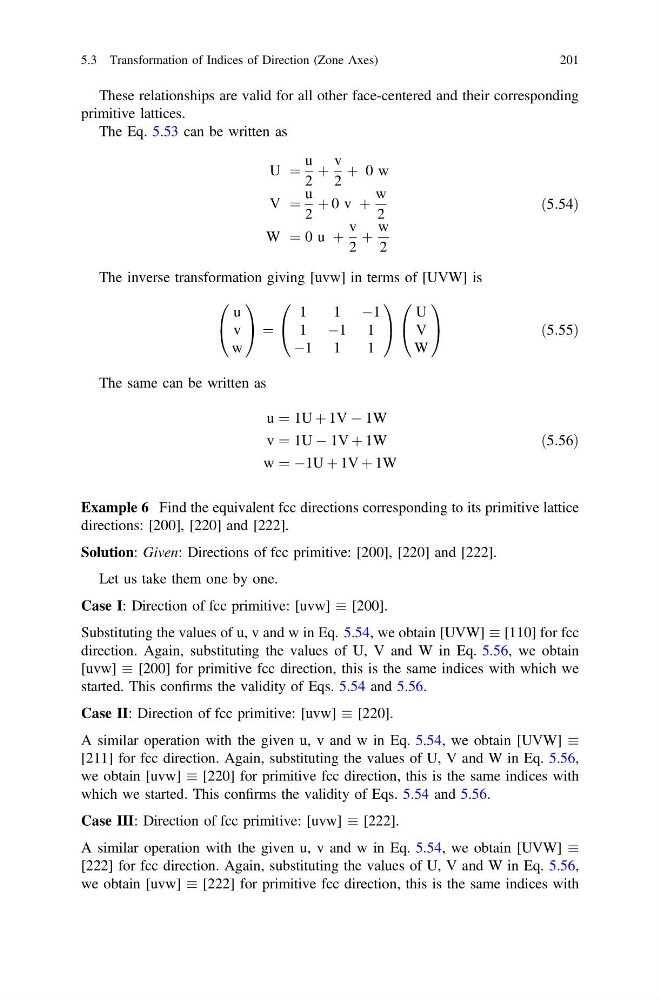
The Eq. 5.53 can be written as
U ¼
u
2
þ
v
2
þ 0 w
V ¼
u
2
þ 0 v þ
w
2
W ¼ 0 u þ
v
2
þ
w
2
ð5:54Þ
The inverse transformation giving [uvw] in terms of [UVW] is
u
v
w
0
@
1
A ¼
1
1 À1
1 À1 1
À1 1
1
0
@
1
A
U
V
W
0
@
1
A
ð5:55Þ
The same can be written as
u ¼ 1U þ 1V À 1W
v ¼ 1U À 1V þ 1W
w ¼ À1U þ 1V þ 1W
ð5:56Þ
Example 6 Find the equivalent fcc directions corresponding to its primitive lattice
directions: [200], [220] and [222].
Solution: Given: Directions of fcc primitive: [200], [220] and [222].
Let us take them one by one.
Case I: Direction of fcc primitive: [uvw] [200].
Substituting the values of u, v and w in Eq. 5.54, we obtain [UVW] [110] for fcc
direction. Again, substituting the values of U, V and W in Eq. 5.56, we obtain
[uvw] [200] for primitive fcc direction, this is the same indices with which we
started. This confirms the validity of Eqs. 5.54 and 5.56.
Case II: Direction of fcc primitive: [uvw] [220].
A similar operation with the given u, v and w in Eq. 5.54, we obtain [UVW]
[211] for fcc direction. Again, substituting the values of U, V and W in Eq. 5.56,
we obtain [uvw] [220] for primitive fcc direction, this is the same indices with
which we started. This confirms the validity of Eqs. 5.54 and 5.56.
Case III: Direction of fcc primitive: [uvw] [222].
A similar operation with the given u, v and w in Eq. 5.54, we obtain [UVW]
[222] for fcc direction. Again, substituting the values of U, V and W in Eq. 5.56,
we obtain [uvw] [222] for primitive fcc direction, this is the same indices with
5.3 Transformation of Indices of Direction (Zone Axes)
201
primitive lattices.
The Eq. 5.53 can be written as
U ¼
u
2
þ
v
2
þ 0 w
V ¼
u
2
þ 0 v þ
w
2
W ¼ 0 u þ
v
2
þ
w
2
ð5:54Þ
The inverse transformation giving [uvw] in terms of [UVW] is
u
v
w
0
@
1
A ¼
1
1 À1
1 À1 1
À1 1
1
0
@
1
A
U
V
W
0
@
1
A
ð5:55Þ
The same can be written as
u ¼ 1U þ 1V À 1W
v ¼ 1U À 1V þ 1W
w ¼ À1U þ 1V þ 1W
ð5:56Þ
Example 6 Find the equivalent fcc directions corresponding to its primitive lattice
directions: [200], [220] and [222].
Solution: Given: Directions of fcc primitive: [200], [220] and [222].
Let us take them one by one.
Case I: Direction of fcc primitive: [uvw] [200].
Substituting the values of u, v and w in Eq. 5.54, we obtain [UVW] [110] for fcc
direction. Again, substituting the values of U, V and W in Eq. 5.56, we obtain
[uvw] [200] for primitive fcc direction, this is the same indices with which we
started. This confirms the validity of Eqs. 5.54 and 5.56.
Case II: Direction of fcc primitive: [uvw] [220].
A similar operation with the given u, v and w in Eq. 5.54, we obtain [UVW]
[211] for fcc direction. Again, substituting the values of U, V and W in Eq. 5.56,
we obtain [uvw] [220] for primitive fcc direction, this is the same indices with
which we started. This confirms the validity of Eqs. 5.54 and 5.56.
Case III: Direction of fcc primitive: [uvw] [222].
A similar operation with the given u, v and w in Eq. 5.54, we obtain [UVW]
[222] for fcc direction. Again, substituting the values of U, V and W in Eq. 5.56,
we obtain [uvw] [222] for primitive fcc direction, this is the same indices with
5.3 Transformation of Indices of Direction (Zone Axes)
201