

u ¼ 1U þ 1V þ 0W
v ¼ 0U þ 1V þ 1W
w ¼ 1U þ 0V þ 1W
ð5:52Þ
Example 5 Find the equivalent bcc directions corresponding to its primitive lattice
directions: [200], [220] and [222].
Solution: Given: Directions of bcc primitive: [200], [220] and [222].
Let us take them one by one.
Case I: Direction of bcc primitive: [uvw] [200].
Substituting the values of u, v and w in Eq. 5.50, we obtain [UVW] ½11 1 for bcc
plane. Again, substituting the values of U, V and W in Eq. 5.52, we obtain [uvw]
[200] for primitive bcc direction, this is the same indices with which we started.
This confirms the validity of Eqs. 5.50 and 5.52.
Case II: Direction of bcc primitive: [uvw] [220].
A similar operation with the given u, v and w in Eq. 5.50, we obtain [UVW]
[020] for bcc plane. Again, substituting the values of U, V and W in Eq. 5.52, we
obtain [uvw] [220] for primitive bcc direction, this is the same indices with
which we started. This confirms the validity of Eqs. 5.50 and 5.52.
Case III: Direction of bcc primitive: [uvw] [222].
A similar operation with the given u, v and w in Eq. 5.50, we obtain [UVW]
[111] for bcc plane. Again, substituting the values of U, V and W in Eq. 5.52, we
obtain [uvw] [222] for primitive bcc direction, this is the same indices with
which we started. This confirms the validity of Eqs. 5.50 and 5.52. Using these
equations, a one to one correspondence of other Miller indices can be obtained.
6. FCC and Primitive (For All Lattices)
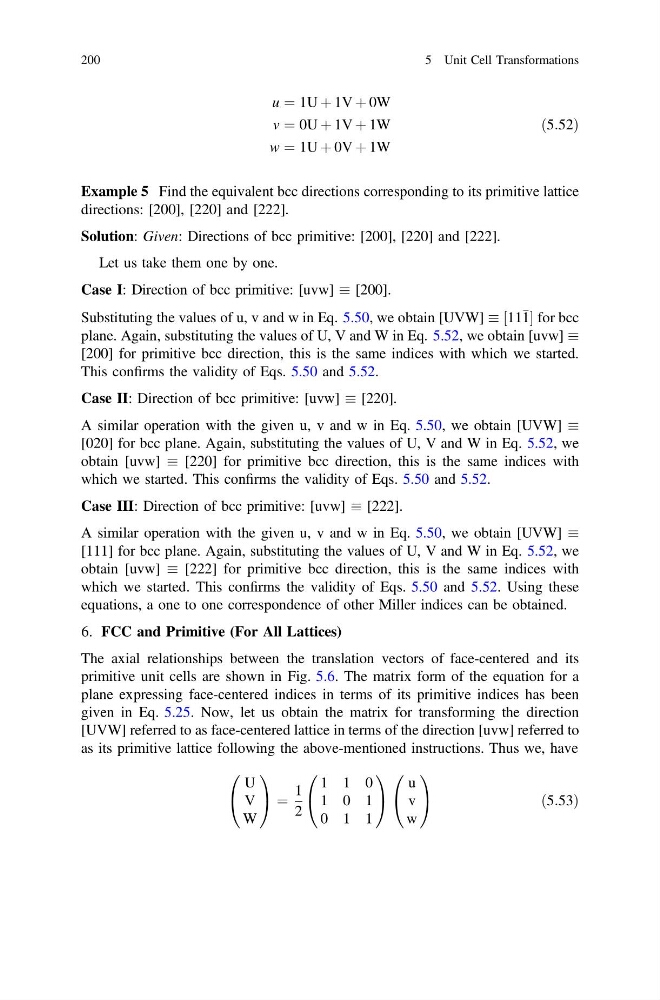
The axial relationships between the translation vectors of face-centered and its
primitive unit cells are shown in Fig. 5.6. The matrix form of the equation for a
plane expressing face-centered indices in terms of its primitive indices has been
given in Eq. 5.25. Now, let us obtain the matrix for transforming the direction
[UVW] referred to as face-centered lattice in terms of the direction [uvw] referred to
as its primitive lattice following the above-mentioned instructions. Thus we, have
U
V
W
0
@
1
A ¼
1
2
1 1 0
1 0 1
0 1 1
0
@
1
A
u
v
w
0
@
1
A
ð5:53Þ
200
5 Unit Cell Transformations
v ¼ 0U þ 1V þ 1W
w ¼ 1U þ 0V þ 1W
ð5:52Þ
Example 5 Find the equivalent bcc directions corresponding to its primitive lattice
directions: [200], [220] and [222].
Solution: Given: Directions of bcc primitive: [200], [220] and [222].
Let us take them one by one.
Case I: Direction of bcc primitive: [uvw] [200].
Substituting the values of u, v and w in Eq. 5.50, we obtain [UVW] ½11 1 for bcc
plane. Again, substituting the values of U, V and W in Eq. 5.52, we obtain [uvw]
[200] for primitive bcc direction, this is the same indices with which we started.
This confirms the validity of Eqs. 5.50 and 5.52.
Case II: Direction of bcc primitive: [uvw] [220].
A similar operation with the given u, v and w in Eq. 5.50, we obtain [UVW]
[020] for bcc plane. Again, substituting the values of U, V and W in Eq. 5.52, we
obtain [uvw] [220] for primitive bcc direction, this is the same indices with
which we started. This confirms the validity of Eqs. 5.50 and 5.52.
Case III: Direction of bcc primitive: [uvw] [222].
A similar operation with the given u, v and w in Eq. 5.50, we obtain [UVW]
[111] for bcc plane. Again, substituting the values of U, V and W in Eq. 5.52, we
obtain [uvw] [222] for primitive bcc direction, this is the same indices with
which we started. This confirms the validity of Eqs. 5.50 and 5.52. Using these
equations, a one to one correspondence of other Miller indices can be obtained.
6. FCC and Primitive (For All Lattices)
The axial relationships between the translation vectors of face-centered and its
primitive unit cells are shown in Fig. 5.6. The matrix form of the equation for a
plane expressing face-centered indices in terms of its primitive indices has been
given in Eq. 5.25. Now, let us obtain the matrix for transforming the direction
[UVW] referred to as face-centered lattice in terms of the direction [uvw] referred to
as its primitive lattice following the above-mentioned instructions. Thus we, have
U
V
W
0
@
1
A ¼
1
2
1 1 0
1 0 1
0 1 1
0
@
1
A
u
v
w
0
@
1
A
ð5:53Þ
200
5 Unit Cell Transformations