

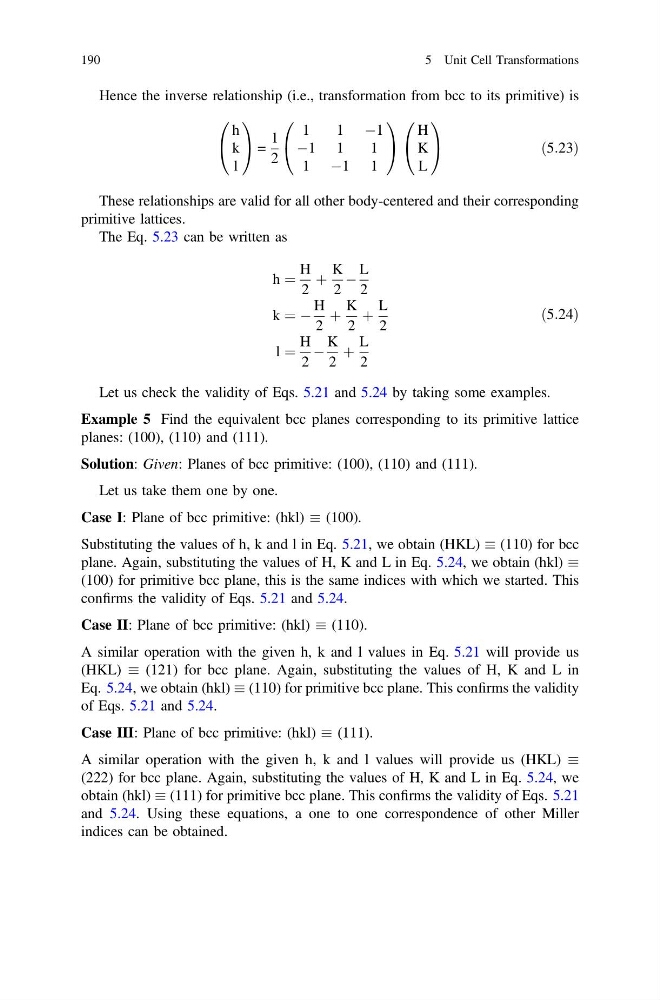
Hence the inverse relationship (i.e., transformation from bcc to its primitive) is
h
k
l
0
@
1
A =
1
2
1
1 À1
À1 1
1
1 À1 1
0
@
1
A
H
K
L
0
@
1
A
ð5:23Þ
These relationships are valid for all other body-centered and their corresponding
primitive lattices.
The Eq. 5.23 can be written as
h ¼
H
2
þ
K
2
À
L
2
k ¼ À
H
2
þ
K
2
þ
L
2
l ¼
H
2
À
K
2
þ
L
2
ð5:24Þ
Let us check the validity of Eqs. 5.21 and 5.24 by taking some examples.
Example 5 Find the equivalent bcc planes corresponding to its primitive lattice
planes: (100), (110) and (111).
Solution: Given: Planes of bcc primitive: (100), (110) and (111).
Let us take them one by one.
Case I: Plane of bcc primitive: (hkl) (100).
Substituting the values of h, k and l in Eq. 5.21, we obtain (HKL) (110) for bcc
plane. Again, substituting the values of H, K and L in Eq. 5.24, we obtain (hkl)
(100) for primitive bcc plane, this is the same indices with which we started. This
confirms the validity of Eqs. 5.21 and 5.24.
Case II: Plane of bcc primitive: (hkl) (110).
A similar operation with the given h, k and l values in Eq. 5.21 will provide us
(HKL) (121) for bcc plane. Again, substituting the values of H, K and L in
Eq. 5.24, we obtain (hkl) (110) for primitive bcc plane. This confirms the validity
of Eqs. 5.21 and 5.24.
Case III: Plane of bcc primitive: (hkl) (111).
A similar operation with the given h, k and l values will provide us (HKL)
(222) for bcc plane. Again, substituting the values of H, K and L in Eq. 5.24, we
obtain (hkl) (111) for primitive bcc plane. This confirms the validity of Eqs. 5.21
and 5.24. Using these equations, a one to one correspondence of other Miller
indices can be obtained.
190
5 Unit Cell Transformations
h
k
l
0
@
1
A =
1
2
1
1 À1
À1 1
1
1 À1 1
0
@
1
A
H
K
L
0
@
1
A
ð5:23Þ
These relationships are valid for all other body-centered and their corresponding
primitive lattices.
The Eq. 5.23 can be written as
h ¼
H
2
þ
K
2
À
L
2
k ¼ À
H
2
þ
K
2
þ
L
2
l ¼
H
2
À
K
2
þ
L
2
ð5:24Þ
Let us check the validity of Eqs. 5.21 and 5.24 by taking some examples.
Example 5 Find the equivalent bcc planes corresponding to its primitive lattice
planes: (100), (110) and (111).
Solution: Given: Planes of bcc primitive: (100), (110) and (111).
Let us take them one by one.
Case I: Plane of bcc primitive: (hkl) (100).
Substituting the values of h, k and l in Eq. 5.21, we obtain (HKL) (110) for bcc
plane. Again, substituting the values of H, K and L in Eq. 5.24, we obtain (hkl)
(100) for primitive bcc plane, this is the same indices with which we started. This
confirms the validity of Eqs. 5.21 and 5.24.
Case II: Plane of bcc primitive: (hkl) (110).
A similar operation with the given h, k and l values in Eq. 5.21 will provide us
(HKL) (121) for bcc plane. Again, substituting the values of H, K and L in
Eq. 5.24, we obtain (hkl) (110) for primitive bcc plane. This confirms the validity
of Eqs. 5.21 and 5.24.
Case III: Plane of bcc primitive: (hkl) (111).
A similar operation with the given h, k and l values will provide us (HKL)
(222) for bcc plane. Again, substituting the values of H, K and L in Eq. 5.24, we
obtain (hkl) (111) for primitive bcc plane. This confirms the validity of Eqs. 5.21
and 5.24. Using these equations, a one to one correspondence of other Miller
indices can be obtained.
190
5 Unit Cell Transformations