

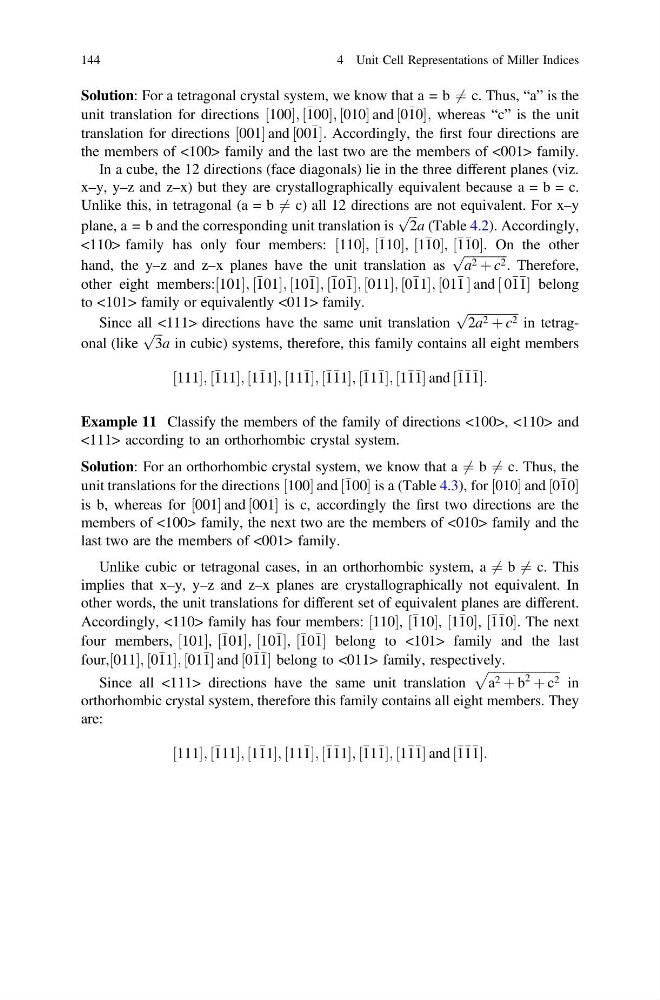
Solution: For a tetragonal crystal system, we know that a = b 6 ¼ c. Thus, “a” is the
unit translation for directions 100
½ ; 100
½
; 010
½
and 0 10
½ ; whereas “c” is the unit
translation for directions 001
½
and 00 1
½ : Accordingly, the first four directions are
the members of <100> family and the last two are the members of <001> family.
In a cube, the 12 directions (face diagonals) lie in the three different planes (viz.
x–y, y–z and z–x) but they are crystallographically equivalent because a = b = c.
Unlike this, in tetragonal (a = b 6 ¼ c) all 12 directions are not equivalent. For x–y
plane, a = b and the corresponding unit translation is
ffiffi ffi
2
p a (Table 4.2). Accordingly,
<110> family has only four members: 110
½
, 110
½ , 1 10
½ , 1 10
½ . On the other
hand, the y–z and z–x planes have the unit translation as
ffiffiffiffiffiffiffiffiffiffiffiffiffiffi
a 2 þ c 2
p
. Therefore,
other eight members: 101
½
; 101
½ ; 10 1
½
; 10 1
½ ; 011
½
; 0 11
½
; 01 1
½
and 0 1 1
½
belong
to <101> family or equivalently <011> family.
Since all <111> directions have the same unit translation
ffiffiffiffiffiffiffiffiffiffiffiffiffiffiffiffi ffi
2a 2 þ c 2
p
in tetragonal (like
ffiffi ffi
3
p a in cubic) systems, therefore, this family contains all eight members
111
½ ; 111
½
; 1 11
½
; 11 1
½
; 1 11
½
; 11 1
½
; 1 1 1
½
and 1 1 1
½
:
Example 11 Classify the members of the family of directions <100>, <110> and
<111> according to an orthorhombic crystal system.
Solution: For an orthorhombic crystal system, we know that a 6 ¼ b 6 ¼ c. Thus, the
unit translations for the directions 100
½ and 100
½
is a (Table 4.3), for 010
½
and 0 10
½
is b, whereas for 001
½
and 00 1
½
is c, accordingly the first two directions are the
members of <100> family, the next two are the members of <010> family and the
last two are the members of <001> family.
Unlike cubic or tetragonal cases, in an orthorhombic system, a 6 ¼ b 6 ¼ c. This
implies that x–y, y–z and z–x planes are crystallographically not equivalent. In
other words, the unit translations for different set of equivalent planes are different.
Accordingly, <110> family has four members: 110
½
, 110
½
, 1 10
½
, 1 10
½ . The next
four members, 101
½ , 101
½ , 10 1
½
, 10 1
½
belong to <101> family and the last
four, 011
½
; 0 11
½
; 01 1
½ and 0 1 1
½
belong to <011> family, respectively.
Since all <111> directions have the same unit translation
ffiffiffiffiffiffiffiffiffiffiffiffiffiffiffiffiffiffiffiffiffiffiffi
a 2 þ b
2
þ c 2
p
in
orthorhombic crystal system, therefore this family contains all eight members. They
are:
111
½ ; 111
½
; 1 11
½
; 11 1
½
; 1 11
½
; 11 1
½
; 1 1 1
½
and 1 1 1
½
:
144
4 Unit Cell Representations of Miller Indices
unit translation for directions 100
½ ; 100
½
; 010
½
and 0 10
½ ; whereas “c” is the unit
translation for directions 001
½
and 00 1
½ : Accordingly, the first four directions are
the members of <100> family and the last two are the members of <001> family.
In a cube, the 12 directions (face diagonals) lie in the three different planes (viz.
x–y, y–z and z–x) but they are crystallographically equivalent because a = b = c.
Unlike this, in tetragonal (a = b 6 ¼ c) all 12 directions are not equivalent. For x–y
plane, a = b and the corresponding unit translation is
ffiffi ffi
2
p a (Table 4.2). Accordingly,
<110> family has only four members: 110
½
, 110
½ , 1 10
½ , 1 10
½ . On the other
hand, the y–z and z–x planes have the unit translation as
ffiffiffiffiffiffiffiffiffiffiffiffiffiffi
a 2 þ c 2
p
. Therefore,
other eight members: 101
½
; 101
½ ; 10 1
½
; 10 1
½ ; 011
½
; 0 11
½
; 01 1
½
and 0 1 1
½
belong
to <101> family or equivalently <011> family.
Since all <111> directions have the same unit translation
ffiffiffiffiffiffiffiffiffiffiffiffiffiffiffiffi ffi
2a 2 þ c 2
p
in tetragonal (like
ffiffi ffi
3
p a in cubic) systems, therefore, this family contains all eight members
111
½ ; 111
½
; 1 11
½
; 11 1
½
; 1 11
½
; 11 1
½
; 1 1 1
½
and 1 1 1
½
:
Example 11 Classify the members of the family of directions <100>, <110> and
<111> according to an orthorhombic crystal system.
Solution: For an orthorhombic crystal system, we know that a 6 ¼ b 6 ¼ c. Thus, the
unit translations for the directions 100
½ and 100
½
is a (Table 4.3), for 010
½
and 0 10
½
is b, whereas for 001
½
and 00 1
½
is c, accordingly the first two directions are the
members of <100> family, the next two are the members of <010> family and the
last two are the members of <001> family.
Unlike cubic or tetragonal cases, in an orthorhombic system, a 6 ¼ b 6 ¼ c. This
implies that x–y, y–z and z–x planes are crystallographically not equivalent. In
other words, the unit translations for different set of equivalent planes are different.
Accordingly, <110> family has four members: 110
½
, 110
½
, 1 10
½
, 1 10
½ . The next
four members, 101
½ , 101
½ , 10 1
½
, 10 1
½
belong to <101> family and the last
four, 011
½
; 0 11
½
; 01 1
½ and 0 1 1
½
belong to <011> family, respectively.
Since all <111> directions have the same unit translation
ffiffiffiffiffiffiffiffiffiffiffiffiffiffiffiffiffiffiffiffiffiffiffi
a 2 þ b
2
þ c 2
p
in
orthorhombic crystal system, therefore this family contains all eight members. They
are:
111
½ ; 111
½
; 1 11
½
; 11 1
½
; 1 11
½
; 11 1
½
; 1 1 1
½
and 1 1 1
½
:
144
4 Unit Cell Representations of Miller Indices