

68
L. Rondoni
that leads to:
A
−
δ
f
(0)
(()d =
A
+
δ
f
(0)
(i S
τ X ) e
0,τ (X ) dX =
A
+
δ
f
(0)
(X ) e
−
(0)
0,τ (X ) dX = e
−[A+(A,δ,τ )]τ
A
+
δ
f
(0)
(X )dX
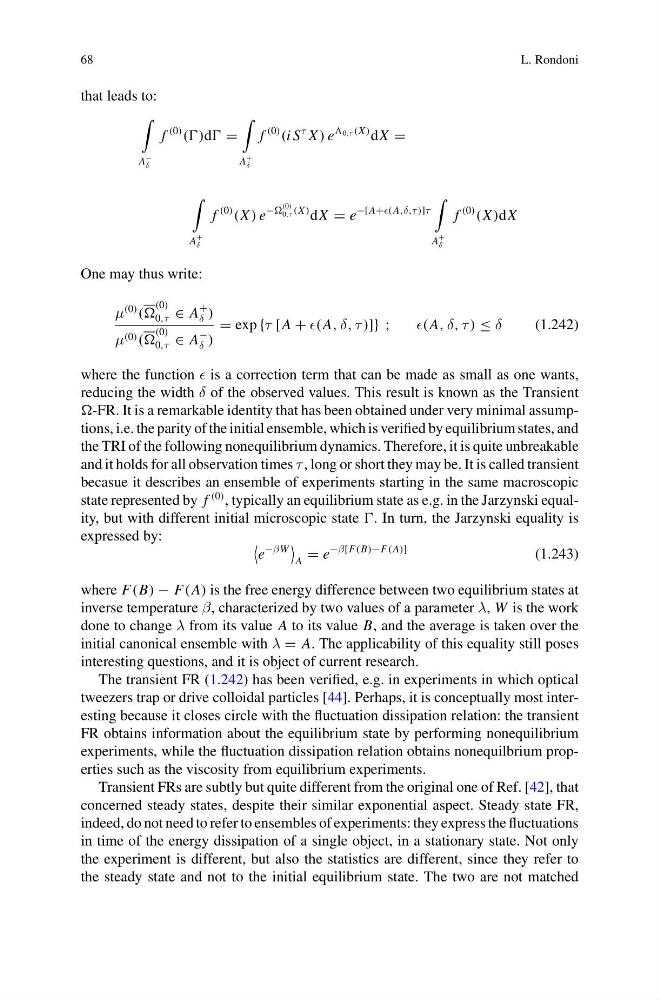
One may thus write:
μ
(0)
(
(0)
0,τ ∈ A
+
δ )
μ (0) (
(0)
0,τ ∈ A
−
δ )
= exp {τ [A + (A, δ, τ )]} ;
(A, δ, τ ) ≤ δ
(1.242)
where the function is a correction term that can be made as small as one wants,
reducing the width δ of the observed values. This result is known as the Transient
-FR. It is a remarkable identity that has been obtained under very minimal assumptions, i.e. the parity of the initial ensemble, which is verified by equilibrium states, and
the TRI of the following nonequilibrium dynamics. Therefore, it is quite unbreakable
and it holds for all observation times τ , long or short they may be. It is called transient
becasue it describes an ensemble of experiments starting in the same macroscopic
state represented by f
(0) , typically an equilibrium state as e.g. in the Jarzynski equality, but with different initial microscopic state . In turn, the Jarzynski equality is
expressed by:
e
−βW
A
= e
−β[F(B)−F(A)]
(1.243)
where F(B) − F(A) is the free energy difference between two equilibrium states at
inverse temperature β, characterized by two values of a parameter λ, W is the work
done to change λ from its value A to its value B, and the average is taken over the
initial canonical ensemble with λ = A. The applicability of this equality still poses
interesting questions, and it is object of current research.
The transient FR (1.242) has been verified, e.g. in experiments in which optical
tweezers trap or drive colloidal particles [44]. Perhaps, it is conceptually most interesting because it closes circle with the fluctuation dissipation relation: the transient
FR obtains information about the equilibrium state by performing nonequilibrium
experiments, while the fluctuation dissipation relation obtains nonequilbrium properties such as the viscosity from equilibrium experiments.
Transient FRs are subtly but quite different from the original one of Ref. [42], that
concerned steady states, despite their similar exponential aspect. Steady state FR,
indeed, do not need to refer to ensembles of experiments: they express the fluctuations
in time of the energy dissipation of a single object, in a stationary state. Not only
the experiment is different, but also the statistics are different, since they refer to
the steady state and not to the initial equilibrium state. The two are not matched
L. Rondoni
that leads to:
A
−
δ
f
(0)
(()d =
A
+
δ
f
(0)
(i S
τ X ) e
0,τ (X ) dX =
A
+
δ
f
(0)
(X ) e
−
(0)
0,τ (X ) dX = e
−[A+(A,δ,τ )]τ
A
+
δ
f
(0)
(X )dX
One may thus write:
μ
(0)
(
(0)
0,τ ∈ A
+
δ )
μ (0) (
(0)
0,τ ∈ A
−
δ )
= exp {τ [A + (A, δ, τ )]} ;
(A, δ, τ ) ≤ δ
(1.242)
where the function is a correction term that can be made as small as one wants,
reducing the width δ of the observed values. This result is known as the Transient
-FR. It is a remarkable identity that has been obtained under very minimal assumptions, i.e. the parity of the initial ensemble, which is verified by equilibrium states, and
the TRI of the following nonequilibrium dynamics. Therefore, it is quite unbreakable
and it holds for all observation times τ , long or short they may be. It is called transient
becasue it describes an ensemble of experiments starting in the same macroscopic
state represented by f
(0) , typically an equilibrium state as e.g. in the Jarzynski equality, but with different initial microscopic state . In turn, the Jarzynski equality is
expressed by:
e
−βW
A
= e
−β[F(B)−F(A)]
(1.243)
where F(B) − F(A) is the free energy difference between two equilibrium states at
inverse temperature β, characterized by two values of a parameter λ, W is the work
done to change λ from its value A to its value B, and the average is taken over the
initial canonical ensemble with λ = A. The applicability of this equality still poses
interesting questions, and it is object of current research.
The transient FR (1.242) has been verified, e.g. in experiments in which optical
tweezers trap or drive colloidal particles [44]. Perhaps, it is conceptually most interesting because it closes circle with the fluctuation dissipation relation: the transient
FR obtains information about the equilibrium state by performing nonequilibrium
experiments, while the fluctuation dissipation relation obtains nonequilbrium properties such as the viscosity from equilibrium experiments.
Transient FRs are subtly but quite different from the original one of Ref. [42], that
concerned steady states, despite their similar exponential aspect. Steady state FR,
indeed, do not need to refer to ensembles of experiments: they express the fluctuations
in time of the energy dissipation of a single object, in a stationary state. Not only
the experiment is different, but also the statistics are different, since they refer to
the steady state and not to the initial equilibrium state. The two are not matched