

1 Introduction to Nonequilibrium Statistical Physics and Its Foundations
67
dynamics framework, the FR was subsequently confirmed in the stochastic frameworks of Master and Langevin equations, but it is far from a generic property of
physical systems. Below, we summarize the derivation given in Ref. [43]. As done
in Section 1.6, for a dynamical system
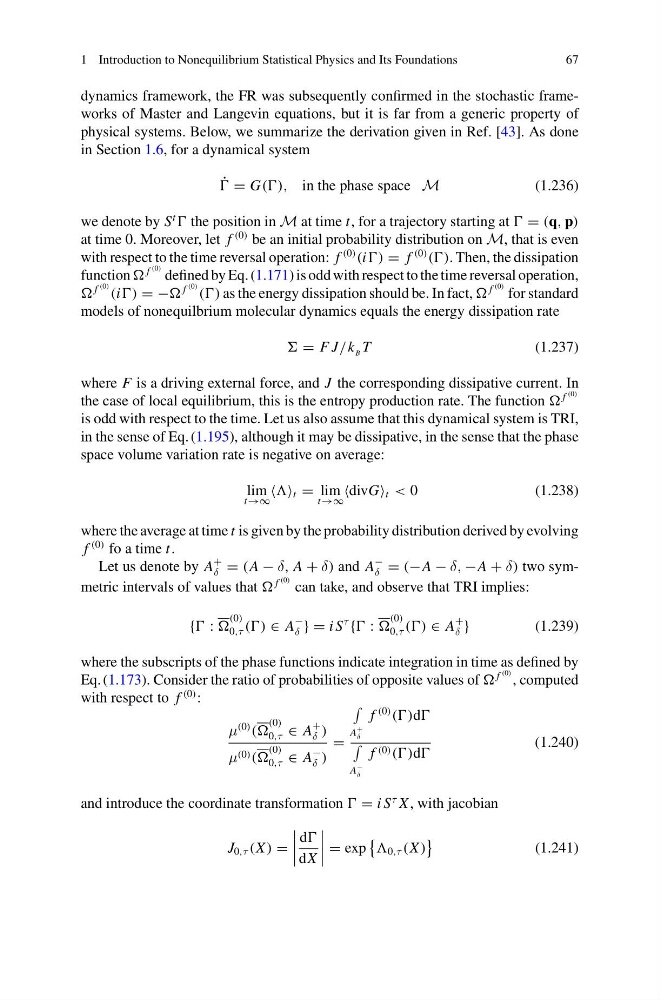
˙
= G((), in the phase space M
(1.236)
we denote by S
t
the position in M at time t, for a trajectory starting at = (q, p)
at time 0. Moreover, let f
(0) be an initial probability distribution on M, that is even
with respect to the time reversal operation: f
(0)
(i) = f
(0)
((). Then, the dissipation
function
f
(0) defined by Eq. (1.171) is odd with respect to the time reversal operation,
f
(0) (i) = −
f
(0) (() as the energy dissipation should be. In fact,
f
(0) for standard
models of nonequilbrium molecular dynamics equals the energy dissipation rate
= F J/k B T
(1.237)
where F is a driving external force, and J the corresponding dissipative current. In
the case of local equilibrium, this is the entropy production rate. The function
f
(0)
is odd with respect to the time. Let us also assume that this dynamical system is TRI,
in the sense of Eq. (1.195), although it may be dissipative, in the sense that the phase
space volume variation rate is negative on average:
lim
t→∞
t = lim
t→∞
divG t < 0
(1.238)
where the average at time t is given by the probability distribution derived by evolving
f
(0) fo a time t.
Let us denote by A
+
δ = (A − δ, A + δ) and A
−
δ = (−A − δ, −A + δ) two symmetric intervals of values that
f
(0) can take, and observe that TRI implies:
{ :
(0)
0,τ (() ∈ A
−
δ } = i S
τ
{ :
(0)
0,τ (() ∈ A
+
δ }
(1.239)
where the subscripts of the phase functions indicate integration in time as defined by
Eq. (1.173). Consider the ratio of probabilities of opposite values of
f
(0) , computed
with respect to f
(0) :
μ
(0)
(
(0)
0,τ ∈ A
+
δ )
μ (0) (
(0)
0,τ ∈ A
−
δ )
=
A
+
δ
f
(0)
(()d
A
−
δ
f (0) (()d
(1.240)
and introduce the coordinate transformation = i S
τ X , with jacobian
J 0,τ (X ) =
d
dX
= exp
0,τ (X )
(1.241)
67
dynamics framework, the FR was subsequently confirmed in the stochastic frameworks of Master and Langevin equations, but it is far from a generic property of
physical systems. Below, we summarize the derivation given in Ref. [43]. As done
in Section 1.6, for a dynamical system
˙
= G((), in the phase space M
(1.236)
we denote by S
t
the position in M at time t, for a trajectory starting at = (q, p)
at time 0. Moreover, let f
(0) be an initial probability distribution on M, that is even
with respect to the time reversal operation: f
(0)
(i) = f
(0)
((). Then, the dissipation
function
f
(0) defined by Eq. (1.171) is odd with respect to the time reversal operation,
f
(0) (i) = −
f
(0) (() as the energy dissipation should be. In fact,
f
(0) for standard
models of nonequilbrium molecular dynamics equals the energy dissipation rate
= F J/k B T
(1.237)
where F is a driving external force, and J the corresponding dissipative current. In
the case of local equilibrium, this is the entropy production rate. The function
f
(0)
is odd with respect to the time. Let us also assume that this dynamical system is TRI,
in the sense of Eq. (1.195), although it may be dissipative, in the sense that the phase
space volume variation rate is negative on average:
lim
t→∞
t = lim
t→∞
divG t < 0
(1.238)
where the average at time t is given by the probability distribution derived by evolving
f
(0) fo a time t.
Let us denote by A
+
δ = (A − δ, A + δ) and A
−
δ = (−A − δ, −A + δ) two symmetric intervals of values that
f
(0) can take, and observe that TRI implies:
{ :
(0)
0,τ (() ∈ A
−
δ } = i S
τ
{ :
(0)
0,τ (() ∈ A
+
δ }
(1.239)
where the subscripts of the phase functions indicate integration in time as defined by
Eq. (1.173). Consider the ratio of probabilities of opposite values of
f
(0) , computed
with respect to f
(0) :
μ
(0)
(
(0)
0,τ ∈ A
+
δ )
μ (0) (
(0)
0,τ ∈ A
−
δ )
=
A
+
δ
f
(0)
(()d
A
−
δ
f (0) (()d
(1.240)
and introduce the coordinate transformation = i S
τ X , with jacobian
J 0,τ (X ) =
d
dX
= exp
0,τ (X )
(1.241)