

1 Introduction to Nonequilibrium Statistical Physics and Its Foundations
65
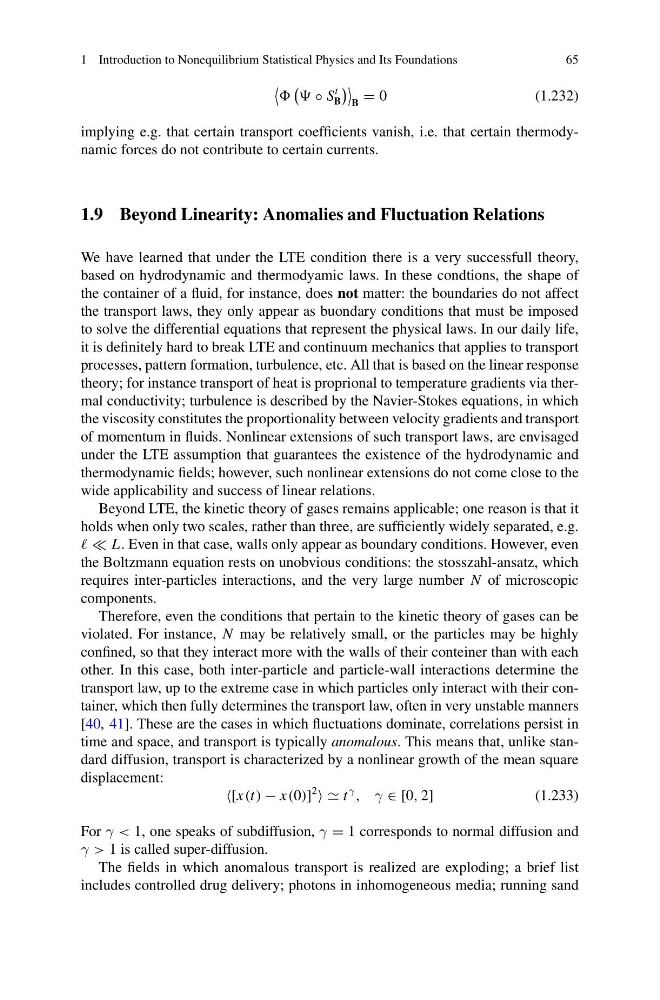
◦ S
t
B
B
= 0
(1.232)
implying e.g. that certain transport coefficients vanish, i.e. that certain thermodynamic forces do not contribute to certain currents.
1.9 Beyond Linearity: Anomalies and Fluctuation Relations
We have learned that under the LTE condition there is a very successfull theory,
based on hydrodynamic and thermodyamic laws. In these condtions, the shape of
the container of a fluid, for instance, does not matter: the boundaries do not affect
the transport laws, they only appear as buondary conditions that must be imposed
to solve the differential equations that represent the physical laws. In our daily life,
it is definitely hard to break LTE and continuum mechanics that applies to transport
processes, pattern formation, turbulence, etc. All that is based on the linear response
theory; for instance transport of heat is proprional to temperature gradients via thermal conductivity; turbulence is described by the Navier-Stokes equations, in which
the viscosity constitutes the proportionality between velocity gradients and transport
of momentum in fluids. Nonlinear extensions of such transport laws, are envisaged
under the LTE assumption that guarantees the existence of the hydrodynamic and
thermodynamic fields; however, such nonlinear extensions do not come close to the
wide applicability and success of linear relations.
Beyond LTE, the kinetic theory of gases remains applicable; one reason is that it
holds when only two scales, rather than three, are sufficiently widely separated, e.g.
L. Even in that case, walls only appear as boundary conditions. However, even
the Boltzmann equation rests on unobvious conditions: the stosszahl-ansatz, which
requires inter-particles interactions, and the very large number N of microscopic
components.
Therefore, even the conditions that pertain to the kinetic theory of gases can be
violated. For instance, N may be relatively small, or the particles may be highly
confined, so that they interact more with the walls of their conteiner than with each
other. In this case, both inter-particle and particle-wall interactions determine the
transport law, up to the extreme case in which particles only interact with their container, which then fully determines the transport law, often in very unstable manners
[40, 41]. These are the cases in which fluctuations dominate, correlations persist in
time and space, and transport is typically anomalous. This means that, unlike standard diffusion, transport is characterized by a nonlinear growth of the mean square
displacement:
[x(t) − x(0)]
2
t
γ
, γ ∈ [0, 2]
(1.233)
For γ < 1, one speaks of subdiffusion, γ = 1 corresponds to normal diffusion and
γ > 1 is called super-diffusion.
The fields in which anomalous transport is realized are exploding; a brief list
includes controlled drug delivery; photons in inhomogeneous media; running sand
65
◦ S
t
B
B
= 0
(1.232)
implying e.g. that certain transport coefficients vanish, i.e. that certain thermodynamic forces do not contribute to certain currents.
1.9 Beyond Linearity: Anomalies and Fluctuation Relations
We have learned that under the LTE condition there is a very successfull theory,
based on hydrodynamic and thermodyamic laws. In these condtions, the shape of
the container of a fluid, for instance, does not matter: the boundaries do not affect
the transport laws, they only appear as buondary conditions that must be imposed
to solve the differential equations that represent the physical laws. In our daily life,
it is definitely hard to break LTE and continuum mechanics that applies to transport
processes, pattern formation, turbulence, etc. All that is based on the linear response
theory; for instance transport of heat is proprional to temperature gradients via thermal conductivity; turbulence is described by the Navier-Stokes equations, in which
the viscosity constitutes the proportionality between velocity gradients and transport
of momentum in fluids. Nonlinear extensions of such transport laws, are envisaged
under the LTE assumption that guarantees the existence of the hydrodynamic and
thermodynamic fields; however, such nonlinear extensions do not come close to the
wide applicability and success of linear relations.
Beyond LTE, the kinetic theory of gases remains applicable; one reason is that it
holds when only two scales, rather than three, are sufficiently widely separated, e.g.
L. Even in that case, walls only appear as boundary conditions. However, even
the Boltzmann equation rests on unobvious conditions: the stosszahl-ansatz, which
requires inter-particles interactions, and the very large number N of microscopic
components.
Therefore, even the conditions that pertain to the kinetic theory of gases can be
violated. For instance, N may be relatively small, or the particles may be highly
confined, so that they interact more with the walls of their conteiner than with each
other. In this case, both inter-particle and particle-wall interactions determine the
transport law, up to the extreme case in which particles only interact with their container, which then fully determines the transport law, often in very unstable manners
[40, 41]. These are the cases in which fluctuations dominate, correlations persist in
time and space, and transport is typically anomalous. This means that, unlike standard diffusion, transport is characterized by a nonlinear growth of the mean square
displacement:
[x(t) − x(0)]
2
t
γ
, γ ∈ [0, 2]
(1.233)
For γ < 1, one speaks of subdiffusion, γ = 1 corresponds to normal diffusion and
γ > 1 is called super-diffusion.
The fields in which anomalous transport is realized are exploding; a brief list
includes controlled drug delivery; photons in inhomogeneous media; running sand