

1 Introduction to Nonequilibrium Statistical Physics and Its Foundations
53
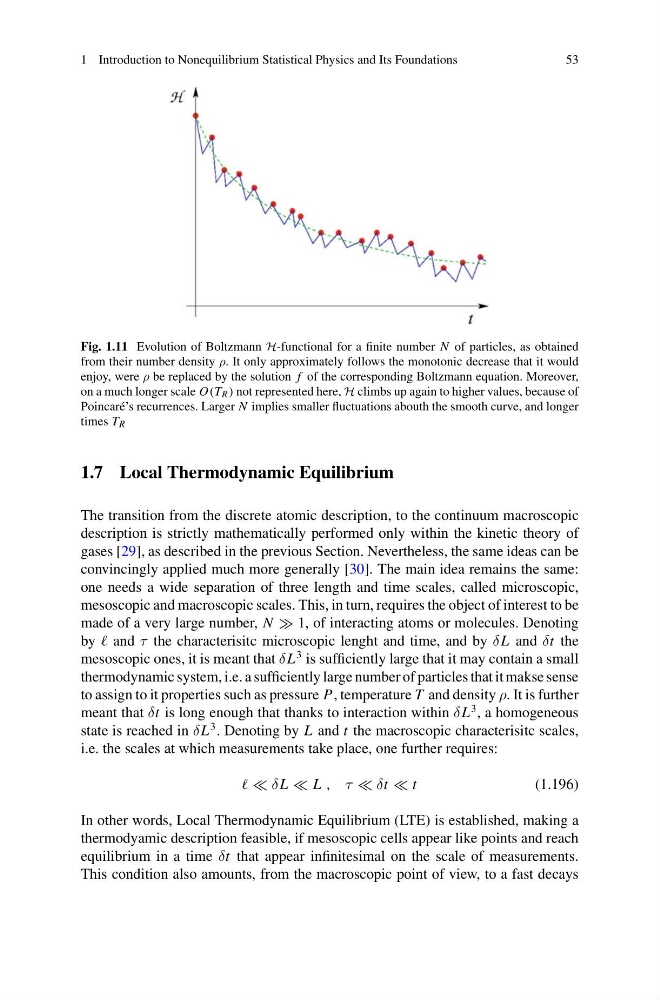
Fig. 1.11 Evolution of Boltzmann H-functional for a finite number N of particles, as obtained
from their number density ρ. It only approximately follows the monotonic decrease that it would
enjoy, were ρ be replaced by the solution f of the corresponding Boltzmann equation. Moreover,
on a much longer scale O(T R ) not represented here, H climbs up again to higher values, because of
Poincaré’s recurrences. Larger N implies smaller fluctuations abouth the smooth curve, and longer
times T R
1.7 Local Thermodynamic Equilibrium
The transition from the discrete atomic description, to the continuum macroscopic
description is strictly mathematically performed only within the kinetic theory of
gases [29], as described in the previous Section. Nevertheless, the same ideas can be
convincingly applied much more generally [30]. The main idea remains the same:
one needs a wide separation of three length and time scales, called microscopic,
mesoscopic and macroscopic scales. This, in turn, requires the object of interest to be
made of a very large number, N 1, of interacting atoms or molecules. Denoting
by and τ the characterisitc microscopic lenght and time, and by δL and δt the
mesoscopic ones, it is meant that δL
3 is sufficiently large that it may contain a small
thermodynamic system, i.e. a sufficiently large number of particles that it makse sense
to assign to it properties such as pressure P, temperature T and density ρ. It is further
meant that δt is long enough that thanks to interaction within δL
3 , a homogeneous
state is reached in δL
3 . Denoting by L and t the macroscopic characterisitc scales,
i.e. the scales at which measurements take place, one further requires:
δL L , τ δt t
(1.196)
In other words, Local Thermodynamic Equilibrium (LTE) is established, making a
thermodyamic description feasible, if mesoscopic cells appear like points and reach
equilibrium in a time δt that appear infinitesimal on the scale of measurements.
This condition also amounts, from the macroscopic point of view, to a fast decays
53
Fig. 1.11 Evolution of Boltzmann H-functional for a finite number N of particles, as obtained
from their number density ρ. It only approximately follows the monotonic decrease that it would
enjoy, were ρ be replaced by the solution f of the corresponding Boltzmann equation. Moreover,
on a much longer scale O(T R ) not represented here, H climbs up again to higher values, because of
Poincaré’s recurrences. Larger N implies smaller fluctuations abouth the smooth curve, and longer
times T R
1.7 Local Thermodynamic Equilibrium
The transition from the discrete atomic description, to the continuum macroscopic
description is strictly mathematically performed only within the kinetic theory of
gases [29], as described in the previous Section. Nevertheless, the same ideas can be
convincingly applied much more generally [30]. The main idea remains the same:
one needs a wide separation of three length and time scales, called microscopic,
mesoscopic and macroscopic scales. This, in turn, requires the object of interest to be
made of a very large number, N 1, of interacting atoms or molecules. Denoting
by and τ the characterisitc microscopic lenght and time, and by δL and δt the
mesoscopic ones, it is meant that δL
3 is sufficiently large that it may contain a small
thermodynamic system, i.e. a sufficiently large number of particles that it makse sense
to assign to it properties such as pressure P, temperature T and density ρ. It is further
meant that δt is long enough that thanks to interaction within δL
3 , a homogeneous
state is reached in δL
3 . Denoting by L and t the macroscopic characterisitc scales,
i.e. the scales at which measurements take place, one further requires:
δL L , τ δt t
(1.196)
In other words, Local Thermodynamic Equilibrium (LTE) is established, making a
thermodyamic description feasible, if mesoscopic cells appear like points and reach
equilibrium in a time δt that appear infinitesimal on the scale of measurements.
This condition also amounts, from the macroscopic point of view, to a fast decays