

52
L. Rondoni
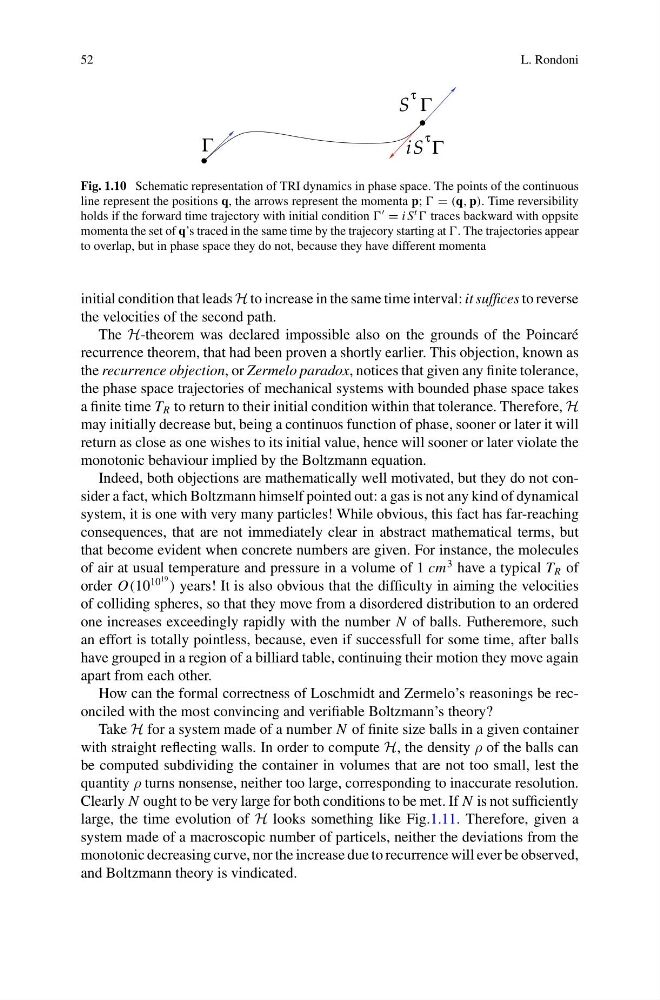
Fig. 1.10 Schematic representation of TRI dynamics in phase space. The points of the continuous
line represent the positions q, the arrows represent the momenta p; = (q, p). Time reversibility
holds if the forward time trajectory with initial condition = i S t traces backward with oppsite
momenta the set of q’s traced in the same time by the trajecory starting at The trajectories appear
to overlap, but in phase space they do not, because they have different momenta
initial condition that leads H to increase in the same time interval: it suffices to reverse
the velocities of the second path.
The H-theorem was declared impossible also on the grounds of the Poincaré
recurrence theorem, that had been proven a shortly earlier. This objection, known as
the recurrence objection, or Zermelo paradox, notices that given any finite tolerance,
the phase space trajectories of mechanical systems with bounded phase space takes
a finite time T R to return to their initial condition within that tolerance. Therefore, H
may initially decrease but, being a continuos function of phase, sooner or later it will
return as close as one wishes to its initial value, hence will sooner or later violate the
monotonic behaviour implied by the Boltzmann equation.
Indeed, both objections are mathematically well motivated, but they do not consider a fact, which Boltzmann himself pointed out: a gas is not any kind of dynamical
system, it is one with very many particles! While obvious, this fact has far-reaching
consequences, that are not immediately clear in abstract mathematical terms, but
that become evident when concrete numbers are given. For instance, the molecules
of air at usual temperature and pressure in a volume of 1 cm
3 have a typical T R of
order O(10
10
19 ) years! It is also obvious that the difficulty in aiming the velocities
of colliding spheres, so that they move from a disordered distribution to an ordered
one increases exceedingly rapidly with the number N of balls. Futheremore, such
an effort is totally pointless, because, even if successfull for some time, after balls
have grouped in a region of a billiard table, continuing their motion they move again
apart from each other.
How can the formal correctness of Loschmidt and Zermelo’s reasonings be reconciled with the most convincing and verifiable Boltzmann’s theory?
Take H for a system made of a number N of finite size balls in a given container
with straight reflecting walls. In order to compute H, the density ρ of the balls can
be computed subdividing the container in volumes that are not too small, lest the
quantity ρ turns nonsense, neither too large, corresponding to inaccurate resolution.
Clearly N ought to be very large for both conditions to be met. If N is not sufficiently
large, the time evolution of H looks something like Fig.1.11. Therefore, given a
system made of a macroscopic number of particels, neither the deviations from the
monotonic decreasing curve, nor the increase due to recurrence will ever be observed,
and Boltzmann theory is vindicated.
L. Rondoni
Fig. 1.10 Schematic representation of TRI dynamics in phase space. The points of the continuous
line represent the positions q, the arrows represent the momenta p; = (q, p). Time reversibility
holds if the forward time trajectory with initial condition = i S t traces backward with oppsite
momenta the set of q’s traced in the same time by the trajecory starting at The trajectories appear
to overlap, but in phase space they do not, because they have different momenta
initial condition that leads H to increase in the same time interval: it suffices to reverse
the velocities of the second path.
The H-theorem was declared impossible also on the grounds of the Poincaré
recurrence theorem, that had been proven a shortly earlier. This objection, known as
the recurrence objection, or Zermelo paradox, notices that given any finite tolerance,
the phase space trajectories of mechanical systems with bounded phase space takes
a finite time T R to return to their initial condition within that tolerance. Therefore, H
may initially decrease but, being a continuos function of phase, sooner or later it will
return as close as one wishes to its initial value, hence will sooner or later violate the
monotonic behaviour implied by the Boltzmann equation.
Indeed, both objections are mathematically well motivated, but they do not consider a fact, which Boltzmann himself pointed out: a gas is not any kind of dynamical
system, it is one with very many particles! While obvious, this fact has far-reaching
consequences, that are not immediately clear in abstract mathematical terms, but
that become evident when concrete numbers are given. For instance, the molecules
of air at usual temperature and pressure in a volume of 1 cm
3 have a typical T R of
order O(10
10
19 ) years! It is also obvious that the difficulty in aiming the velocities
of colliding spheres, so that they move from a disordered distribution to an ordered
one increases exceedingly rapidly with the number N of balls. Futheremore, such
an effort is totally pointless, because, even if successfull for some time, after balls
have grouped in a region of a billiard table, continuing their motion they move again
apart from each other.
How can the formal correctness of Loschmidt and Zermelo’s reasonings be reconciled with the most convincing and verifiable Boltzmann’s theory?
Take H for a system made of a number N of finite size balls in a given container
with straight reflecting walls. In order to compute H, the density ρ of the balls can
be computed subdividing the container in volumes that are not too small, lest the
quantity ρ turns nonsense, neither too large, corresponding to inaccurate resolution.
Clearly N ought to be very large for both conditions to be met. If N is not sufficiently
large, the time evolution of H looks something like Fig.1.11. Therefore, given a
system made of a macroscopic number of particels, neither the deviations from the
monotonic decreasing curve, nor the increase due to recurrence will ever be observed,
and Boltzmann theory is vindicated.