

42
L. Rondoni
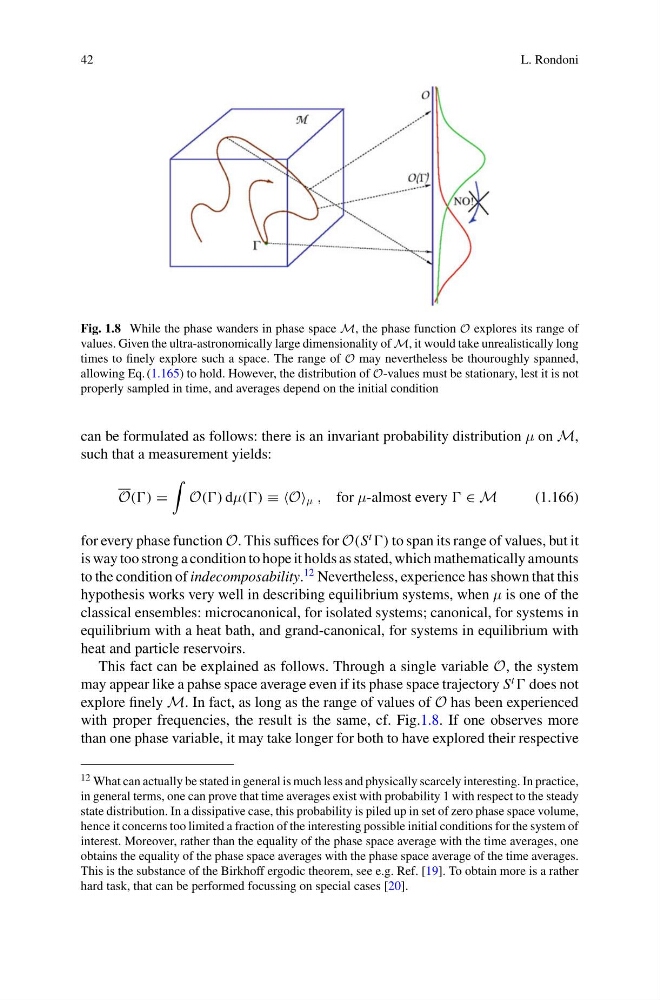
Fig. 1.8 While the phase wanders in phase space M, the phase function O explores its range of
values. Given the ultra-astronomically large dimensionality of M, it would take unrealistically long
times to finely explore such a space. The range of O may nevertheless be thouroughly spanned,
allowing Eq. (1.165) to hold. However, the distribution of O-values must be stationary, lest it is not
properly sampled in time, and averages depend on the initial condition
can be formulated as follows: there is an invariant probability distribution μ on M,
such that a measurement yields:
O(() =
O(() dμ(() ≡ ≡O μ , for μ-almost every ∈ M
(1.166)
for every phase function O. This suffices for O(S
t
) to span its range of values, but it
is way too strong a condition to hope it holds as stated, which mathematically amounts
to the condition of indecomposability.
12 Nevertheless, experience has shown that this
hypothesis works very well in describing equilibrium systems, when μ is one of the
classical ensembles: microcanonical, for isolated systems; canonical, for systems in
equilibrium with a heat bath, and grand-canonical, for systems in equilibrium with
heat and particle reservoirs.
This fact can be explained as follows. Through a single variable O, the system
may appear like a pahse space average even if its phase space trajectory S
t
does not
explore finely M. In fact, as long as the range of values of O has been experienced
with proper frequencies, the result is the same, cf. Fig.1.8. If one observes more
than one phase variable, it may take longer for both to have explored their respective
12 What can actually be stated in general is much less and physically scarcely interesting. In practice,
in general terms, one can prove that time averages exist with probability 1 with respect to the steady
state distribution. In a dissipative case, this probability is piled up in set of zero phase space volume,
hence it concerns too limited a fraction of the interesting possible initial conditions for the system of
interest. Moreover, rather than the equality of the phase space average with the time averages, one
obtains the equality of the phase space averages with the phase space average of the time averages.
This is the substance of the Birkhoff ergodic theorem, see e.g. Ref. [19]. To obtain more is a rather
hard task, that can be performed focussing on special cases [20].
L. Rondoni
Fig. 1.8 While the phase wanders in phase space M, the phase function O explores its range of
values. Given the ultra-astronomically large dimensionality of M, it would take unrealistically long
times to finely explore such a space. The range of O may nevertheless be thouroughly spanned,
allowing Eq. (1.165) to hold. However, the distribution of O-values must be stationary, lest it is not
properly sampled in time, and averages depend on the initial condition
can be formulated as follows: there is an invariant probability distribution μ on M,
such that a measurement yields:
O(() =
O(() dμ(() ≡ ≡O μ , for μ-almost every ∈ M
(1.166)
for every phase function O. This suffices for O(S
t
) to span its range of values, but it
is way too strong a condition to hope it holds as stated, which mathematically amounts
to the condition of indecomposability.
12 Nevertheless, experience has shown that this
hypothesis works very well in describing equilibrium systems, when μ is one of the
classical ensembles: microcanonical, for isolated systems; canonical, for systems in
equilibrium with a heat bath, and grand-canonical, for systems in equilibrium with
heat and particle reservoirs.
This fact can be explained as follows. Through a single variable O, the system
may appear like a pahse space average even if its phase space trajectory S
t
does not
explore finely M. In fact, as long as the range of values of O has been experienced
with proper frequencies, the result is the same, cf. Fig.1.8. If one observes more
than one phase variable, it may take longer for both to have explored their respective
12 What can actually be stated in general is much less and physically scarcely interesting. In practice,
in general terms, one can prove that time averages exist with probability 1 with respect to the steady
state distribution. In a dissipative case, this probability is piled up in set of zero phase space volume,
hence it concerns too limited a fraction of the interesting possible initial conditions for the system of
interest. Moreover, rather than the equality of the phase space average with the time averages, one
obtains the equality of the phase space averages with the phase space average of the time averages.
This is the substance of the Birkhoff ergodic theorem, see e.g. Ref. [19]. To obtain more is a rather
hard task, that can be performed focussing on special cases [20].