

1 Introduction to Nonequilibrium Statistical Physics and Its Foundations
41
If one accepts this picture, it follows that measurements depend on τ , hence are
subjective because different observers may choose different τ ’s, and on , hence
their result is a stochastic variable, because is unknown. However, this contradicts
Thermodynamics, that is an objective and deterministic theory, universally confirmed
by experimental tests. One possibility to accord Eq. (1.164) with experience is to
assume that τ is very large, virtually infinitely larger than the microscopic scales
concerning the evolution of , and that during such a long time, O has explored
many times its range of values, with proper frequencies, so that the initial condition
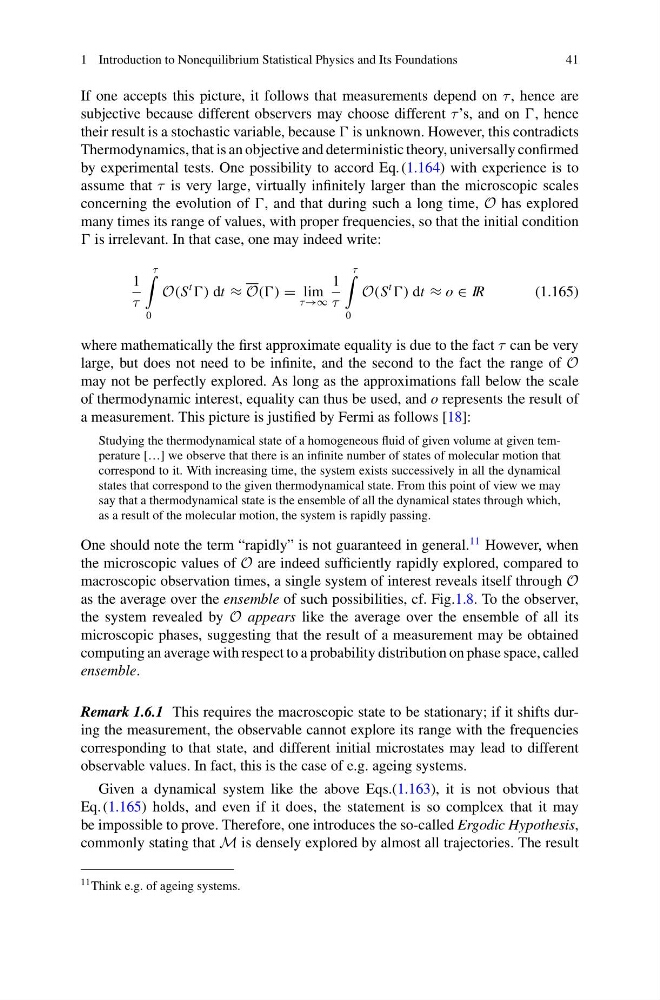
is irrelevant. In that case, one may indeed write:
1
τ
τ
0
O(S
t
) dt ≈ O(() = lim
τ →∞
1
τ
τ
0
O(S
t
) dt ≈ o ∈ IR
(1.165)
where mathematically the first approximate equality is due to the fact τ can be very
large, but does not need to be infinite, and the second to the fact the range of O
may not be perfectly explored. As long as the approximations fall below the scale
of thermodynamic interest, equality can thus be used, and o represents the result of
a measurement. This picture is justified by Fermi as follows [18]:
Studying the thermodynamical state of a homogeneous fluid of given volume at given temperature […] we observe that there is an infinite number of states of molecular motion that
correspond to it. With increasing time, the system exists successively in all the dynamical
states that correspond to the given thermodynamical state. From this point of view we may
say that a thermodynamical state is the ensemble of all the dynamical states through which,
as a result of the molecular motion, the system is rapidly passing.
One should note the term “rapidly” is not guaranteed in general.
11 However, when
the microscopic values of O are indeed sufficiently rapidly explored, compared to
macroscopic observation times, a single system of interest reveals itself through O
as the average over the ensemble of such possibilities, cf. Fig.1.8. To the observer,
the system revealed by O appears like the average over the ensemble of all its
microscopic phases, suggesting that the result of a measurement may be obtained
computing an average with respect to a probability distribution on phase space, called
ensemble.
Remark 1.6.1 This requires the macroscopic state to be stationary; if it shifts during the measurement, the observable cannot explore its range with the frequencies
corresponding to that state, and different initial microstates may lead to different
observable values. In fact, this is the case of e.g. ageing systems.
Given a dynamical system like the above Eqs.(1.163), it is not obvious that
Eq. (1.165) holds, and even if it does, the statement is so complcex that it may
be impossible to prove. Therefore, one introduces the so-called Ergodic Hypothesis,
commonly stating that M is densely explored by almost all trajectories. The result
11 Think e.g. of ageing systems.
41
If one accepts this picture, it follows that measurements depend on τ , hence are
subjective because different observers may choose different τ ’s, and on , hence
their result is a stochastic variable, because is unknown. However, this contradicts
Thermodynamics, that is an objective and deterministic theory, universally confirmed
by experimental tests. One possibility to accord Eq. (1.164) with experience is to
assume that τ is very large, virtually infinitely larger than the microscopic scales
concerning the evolution of , and that during such a long time, O has explored
many times its range of values, with proper frequencies, so that the initial condition
is irrelevant. In that case, one may indeed write:
1
τ
τ
0
O(S
t
) dt ≈ O(() = lim
τ →∞
1
τ
τ
0
O(S
t
) dt ≈ o ∈ IR
(1.165)
where mathematically the first approximate equality is due to the fact τ can be very
large, but does not need to be infinite, and the second to the fact the range of O
may not be perfectly explored. As long as the approximations fall below the scale
of thermodynamic interest, equality can thus be used, and o represents the result of
a measurement. This picture is justified by Fermi as follows [18]:
Studying the thermodynamical state of a homogeneous fluid of given volume at given temperature […] we observe that there is an infinite number of states of molecular motion that
correspond to it. With increasing time, the system exists successively in all the dynamical
states that correspond to the given thermodynamical state. From this point of view we may
say that a thermodynamical state is the ensemble of all the dynamical states through which,
as a result of the molecular motion, the system is rapidly passing.
One should note the term “rapidly” is not guaranteed in general.
11 However, when
the microscopic values of O are indeed sufficiently rapidly explored, compared to
macroscopic observation times, a single system of interest reveals itself through O
as the average over the ensemble of such possibilities, cf. Fig.1.8. To the observer,
the system revealed by O appears like the average over the ensemble of all its
microscopic phases, suggesting that the result of a measurement may be obtained
computing an average with respect to a probability distribution on phase space, called
ensemble.
Remark 1.6.1 This requires the macroscopic state to be stationary; if it shifts during the measurement, the observable cannot explore its range with the frequencies
corresponding to that state, and different initial microstates may lead to different
observable values. In fact, this is the case of e.g. ageing systems.
Given a dynamical system like the above Eqs.(1.163), it is not obvious that
Eq. (1.165) holds, and even if it does, the statement is so complcex that it may
be impossible to prove. Therefore, one introduces the so-called Ergodic Hypothesis,
commonly stating that M is densely explored by almost all trajectories. The result
11 Think e.g. of ageing systems.