

1 Introduction to Nonequilibrium Statistical Physics and Its Foundations
39
˜
γ(ω) =
m
k B T
∞
0
dte
−iωt
E [(0))(t)]
(1.159)
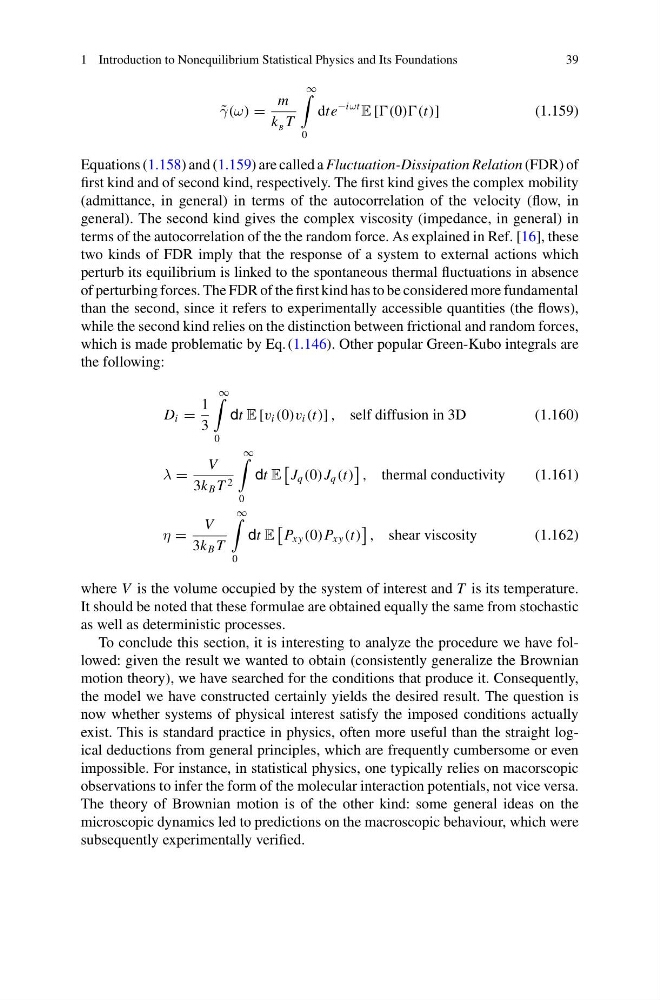
Equations (1.158) and (1.159) are called a Fluctuation-Dissipation Relation (FDR) of
first kind and of second kind, respectively. The first kind gives the complex mobility
(admittance, in general) in terms of the autocorrelation of the velocity (flow, in
general). The second kind gives the complex viscosity (impedance, in general) in
terms of the autocorrelation of the the random force. As explained in Ref. [16], these
two kinds of FDR imply that the response of a system to external actions which
perturb its equilibrium is linked to the spontaneous thermal fluctuations in absence
of perturbing forces. The FDR of the first kind has to be considered more fundamental
than the second, since it refers to experimentally accessible quantities (the flows),
while the second kind relies on the distinction between frictional and random forces,
which is made problematic by Eq. (1.146). Other popular Green-Kubo integrals are
the following:
D i =
1
3
∞
0
dt E [v i (0)v i (t)] , self diffusion in 3D
(1.160)
λ =
V
3k B T 2
∞
0
dt E
J q (0)J q (t)
, thermal conductivity
(1.161)
η =
V
3k B T
∞
0
dt E
P xy (0)P xy (t)
, shear viscosity
(1.162)
where V is the volume occupied by the system of interest and T is its temperature.
It should be noted that these formulae are obtained equally the same from stochastic
as well as deterministic processes.
To conclude this section, it is interesting to analyze the procedure we have followed: given the result we wanted to obtain (consistently generalize the Brownian
motion theory), we have searched for the conditions that produce it. Consequently,
the model we have constructed certainly yields the desired result. The question is
now whether systems of physical interest satisfy the imposed conditions actually
exist. This is standard practice in physics, often more useful than the straight logical deductions from general principles, which are frequently cumbersome or even
impossible. For instance, in statistical physics, one typically relies on macorscopic
observations to infer the form of the molecular interaction potentials, not vice versa.
The theory of Brownian motion is of the other kind: some general ideas on the
microscopic dynamics led to predictions on the macroscopic behaviour, which were
subsequently experimentally verified.
39
˜
γ(ω) =
m
k B T
∞
0
dte
−iωt
E [(0))(t)]
(1.159)
Equations (1.158) and (1.159) are called a Fluctuation-Dissipation Relation (FDR) of
first kind and of second kind, respectively. The first kind gives the complex mobility
(admittance, in general) in terms of the autocorrelation of the velocity (flow, in
general). The second kind gives the complex viscosity (impedance, in general) in
terms of the autocorrelation of the the random force. As explained in Ref. [16], these
two kinds of FDR imply that the response of a system to external actions which
perturb its equilibrium is linked to the spontaneous thermal fluctuations in absence
of perturbing forces. The FDR of the first kind has to be considered more fundamental
than the second, since it refers to experimentally accessible quantities (the flows),
while the second kind relies on the distinction between frictional and random forces,
which is made problematic by Eq. (1.146). Other popular Green-Kubo integrals are
the following:
D i =
1
3
∞
0
dt E [v i (0)v i (t)] , self diffusion in 3D
(1.160)
λ =
V
3k B T 2
∞
0
dt E
J q (0)J q (t)
, thermal conductivity
(1.161)
η =
V
3k B T
∞
0
dt E
P xy (0)P xy (t)
, shear viscosity
(1.162)
where V is the volume occupied by the system of interest and T is its temperature.
It should be noted that these formulae are obtained equally the same from stochastic
as well as deterministic processes.
To conclude this section, it is interesting to analyze the procedure we have followed: given the result we wanted to obtain (consistently generalize the Brownian
motion theory), we have searched for the conditions that produce it. Consequently,
the model we have constructed certainly yields the desired result. The question is
now whether systems of physical interest satisfy the imposed conditions actually
exist. This is standard practice in physics, often more useful than the straight logical deductions from general principles, which are frequently cumbersome or even
impossible. For instance, in statistical physics, one typically relies on macorscopic
observations to infer the form of the molecular interaction potentials, not vice versa.
The theory of Brownian motion is of the other kind: some general ideas on the
microscopic dynamics led to predictions on the macroscopic behaviour, which were
subsequently experimentally verified.