

38
L. Rondoni
requires φ v (t) to decay in time faster than t
−2 . This constraint is sufficient, not
necessary; it remains that a sufficiently fast correlations decay is required for the
transport coefficients to exist.
The expression (1.151) of μ is one example of Green-Kubo integral; there is one
such Green-Kubo integral for every linear transport coefficient, obtained from the
autocorrelation of the current of interest. A transport process is called normal if that
autocorrelation decays sufficiently fast in time, that the integral, hence the transport
coefficient, exists.
Observing that the integral (1.151) is a kind of Fourier transform at zero frequency,
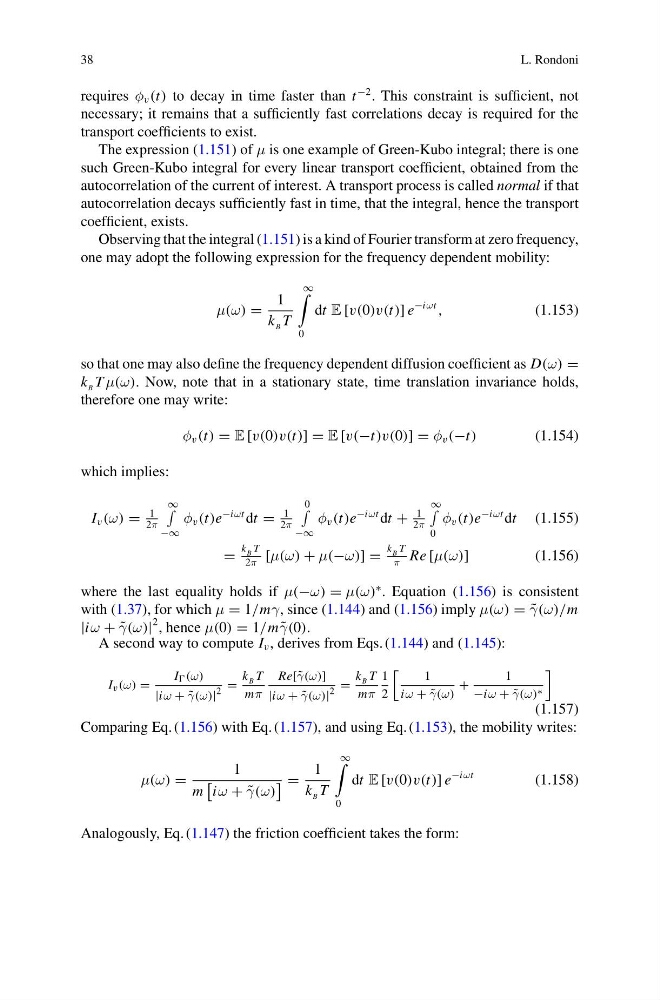
one may adopt the following expression for the frequency dependent mobility:
μ(ω) =
1
k B T
∞
0
dt E [v(0)v(t)] e
−iωt
,
(1.153)
so that one may also define the frequency dependent diffusion coefficient as D(ω) =
k B T μ(ω). Now, note that in a stationary state, time translation invariance holds,
therefore one may write:
φ v (t) = E [v(0)v(t)] = E [v(−t)v(0)] = φ v (−t)
(1.154)
which implies:
I v (ω) =
1
2π
∞
−∞
φ v (t)e
−iωt dt =
1
2π
0
−∞
φ v (t)e
−iωt dt +
1
2π
∞
0
φ v (t)e
−iωt dt (1.155)
=
k B T
2π
[μ(ω) + μ(−ω)] =
k B T
π
Re [μ(ω)]
(1.156)
where the last equality holds if μ(−ω) = μ(ω)
∗ . Equation (1.156) is consistent
with (1.37), for which μ = 1/mγ, since (1.144) and (1.156) imply μ(ω) = ˜
γ(ω)/m
|iω + ˜
γ(ω)|
2 , hence μ(0) = 1/m ˜
γ(0).
A second way to compute I v , derives from Eqs. (1.144) and (1.145):
I v (ω) =
I (ω)
|iω + ˜
γ(ω)|
2
=
k B T
mπ
Re[ ˜
γ(ω)]
|iω + ˜
γ(ω)|
2
=
k B T
mπ
1
2
1
iω + ˜
γ(ω)
+
1
−iω + ˜
γ(ω) ∗
(1.157)
Comparing Eq. (1.156) with Eq. (1.157), and using Eq. (1.153), the mobility writes:
μ(ω) =
1
m
iω + ˜
γ(ω)
=
1
k B T
∞
0
dt E [v(0)v(t)] e
−iωt
(1.158)
Analogously, Eq. (1.147) the friction coefficient takes the form:
L. Rondoni
requires φ v (t) to decay in time faster than t
−2 . This constraint is sufficient, not
necessary; it remains that a sufficiently fast correlations decay is required for the
transport coefficients to exist.
The expression (1.151) of μ is one example of Green-Kubo integral; there is one
such Green-Kubo integral for every linear transport coefficient, obtained from the
autocorrelation of the current of interest. A transport process is called normal if that
autocorrelation decays sufficiently fast in time, that the integral, hence the transport
coefficient, exists.
Observing that the integral (1.151) is a kind of Fourier transform at zero frequency,
one may adopt the following expression for the frequency dependent mobility:
μ(ω) =
1
k B T
∞
0
dt E [v(0)v(t)] e
−iωt
,
(1.153)
so that one may also define the frequency dependent diffusion coefficient as D(ω) =
k B T μ(ω). Now, note that in a stationary state, time translation invariance holds,
therefore one may write:
φ v (t) = E [v(0)v(t)] = E [v(−t)v(0)] = φ v (−t)
(1.154)
which implies:
I v (ω) =
1
2π
∞
−∞
φ v (t)e
−iωt dt =
1
2π
0
−∞
φ v (t)e
−iωt dt +
1
2π
∞
0
φ v (t)e
−iωt dt (1.155)
=
k B T
2π
[μ(ω) + μ(−ω)] =
k B T
π
Re [μ(ω)]
(1.156)
where the last equality holds if μ(−ω) = μ(ω)
∗ . Equation (1.156) is consistent
with (1.37), for which μ = 1/mγ, since (1.144) and (1.156) imply μ(ω) = ˜
γ(ω)/m
|iω + ˜
γ(ω)|
2 , hence μ(0) = 1/m ˜
γ(0).
A second way to compute I v , derives from Eqs. (1.144) and (1.145):
I v (ω) =
I (ω)
|iω + ˜
γ(ω)|
2
=
k B T
mπ
Re[ ˜
γ(ω)]
|iω + ˜
γ(ω)|
2
=
k B T
mπ
1
2
1
iω + ˜
γ(ω)
+
1
−iω + ˜
γ(ω) ∗
(1.157)
Comparing Eq. (1.156) with Eq. (1.157), and using Eq. (1.153), the mobility writes:
μ(ω) =
1
m
iω + ˜
γ(ω)
=
1
k B T
∞
0
dt E [v(0)v(t)] e
−iωt
(1.158)
Analogously, Eq. (1.147) the friction coefficient takes the form: