

8 Fréedericksz-Like Positional Transition Triggered by An External Electric Field
335
electric field in Fig. 8.5d. Obviously, the results indicate that the critical electric
field for a positional transition to occur for a microparticle suspended in a NLC cell
remains unchanged for different microparticle sizes and densities.
Moreover, by comparing the numerical calculation results with the Fréedericksz
effect curve (π
√
4π/|
√
K /L) in Fig. 8.5c and d, it is surprising to find that the
slope difference between them is by a factor of ∼3
√ π . The additional energy contribution coming from the surface energy due to the introduction of microparticle is
proportional to π (surface area). While on the other hand, the energy contribution
made by external field is proportional to E
2 , and that gives a critical value of external field proportional to
√ π , if the transition comes from the competition between
equivalent surface energy due to the introduction of microparticle, and the Coulomb
interaction due to the application of external field. More specifically, an explicit
expression (where F denotes the Fréedericksz effect)
E c 3
√ π F −
1
5
= 6π
2
K
|ε|L 2 −
1
5
(8.26)
for critical electric field can be proposed as a theoretical prediction. Such a prediction, as shown by straight line (red) in Fig. 8.5c and d, agrees very well for
different radii (2.2, 2.35, 2.5, and 3.0 µm) and densities (0.99, 1.0 and 1.03 g · cm
−3 )
of microparticle. This once again verifies the conclusion that the critical electric
field is independent of microparticle size and density. The reason might lie in that in
the present theoretical model, the microparticle is treated as a dipole in the far field
expansion approximation.
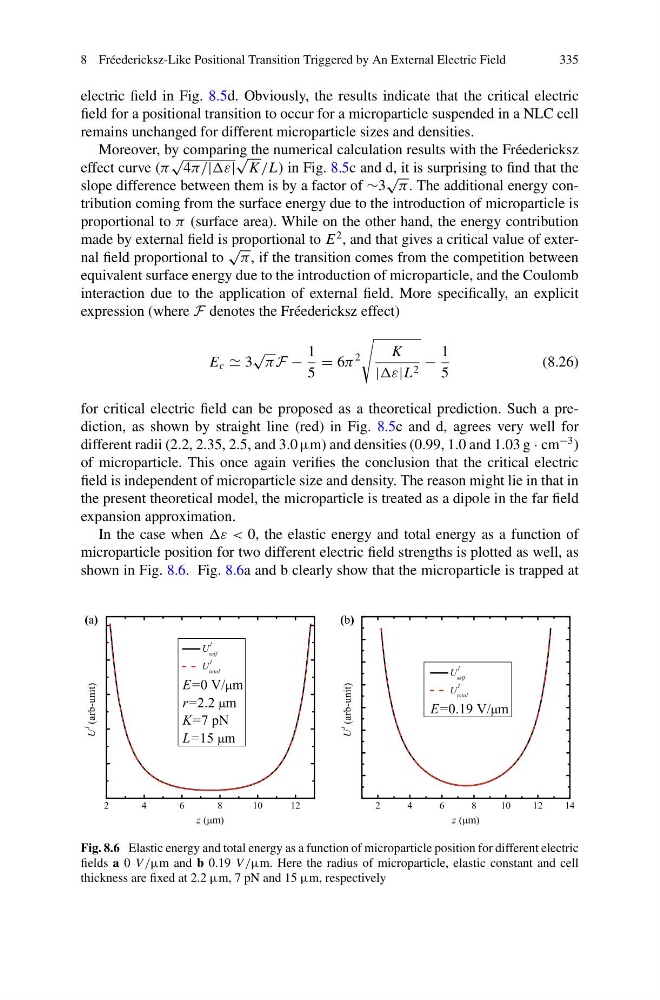
In the case when ε < 0, the elastic energy and total energy as a function of
microparticle position for two different electric field strengths is plotted as well, as
shown in Fig. 8.6. Fig. 8.6a and b clearly show that the microparticle is trapped at
Fig. 8.6 Elastic energy and total energy as a function of microparticle position for different electric
fields a 0 V /µm and b 0.19 V /µm. Here the radius of microparticle, elastic constant and cell
thickness are fixed at 2.2 µm, 7 pN and 15 µm, respectively
335
electric field in Fig. 8.5d. Obviously, the results indicate that the critical electric
field for a positional transition to occur for a microparticle suspended in a NLC cell
remains unchanged for different microparticle sizes and densities.
Moreover, by comparing the numerical calculation results with the Fréedericksz
effect curve (π
√
4π/|
√
K /L) in Fig. 8.5c and d, it is surprising to find that the
slope difference between them is by a factor of ∼3
√ π . The additional energy contribution coming from the surface energy due to the introduction of microparticle is
proportional to π (surface area). While on the other hand, the energy contribution
made by external field is proportional to E
2 , and that gives a critical value of external field proportional to
√ π , if the transition comes from the competition between
equivalent surface energy due to the introduction of microparticle, and the Coulomb
interaction due to the application of external field. More specifically, an explicit
expression (where F denotes the Fréedericksz effect)
E c 3
√ π F −
1
5
= 6π
2
K
|ε|L 2 −
1
5
(8.26)
for critical electric field can be proposed as a theoretical prediction. Such a prediction, as shown by straight line (red) in Fig. 8.5c and d, agrees very well for
different radii (2.2, 2.35, 2.5, and 3.0 µm) and densities (0.99, 1.0 and 1.03 g · cm
−3 )
of microparticle. This once again verifies the conclusion that the critical electric
field is independent of microparticle size and density. The reason might lie in that in
the present theoretical model, the microparticle is treated as a dipole in the far field
expansion approximation.
In the case when ε < 0, the elastic energy and total energy as a function of
microparticle position for two different electric field strengths is plotted as well, as
shown in Fig. 8.6. Fig. 8.6a and b clearly show that the microparticle is trapped at
Fig. 8.6 Elastic energy and total energy as a function of microparticle position for different electric
fields a 0 V /µm and b 0.19 V /µm. Here the radius of microparticle, elastic constant and cell
thickness are fixed at 2.2 µm, 7 pN and 15 µm, respectively