

8 Fréedericksz-Like Positional Transition Triggered by An External Electric Field
327
where θ is the angle between the director and z axis, satisfying the boundary condition
θ(0) = θ(L) = 0 due to the surface anchoring. The total free energy is then
F total =
1
2
dz
(K 11 cos
2
θ(z) + K 33 sin
2
θ(z))(
dθ(z)
dz
)
2
− χ H
2 sin
2
θ(z)
.
(8.7)
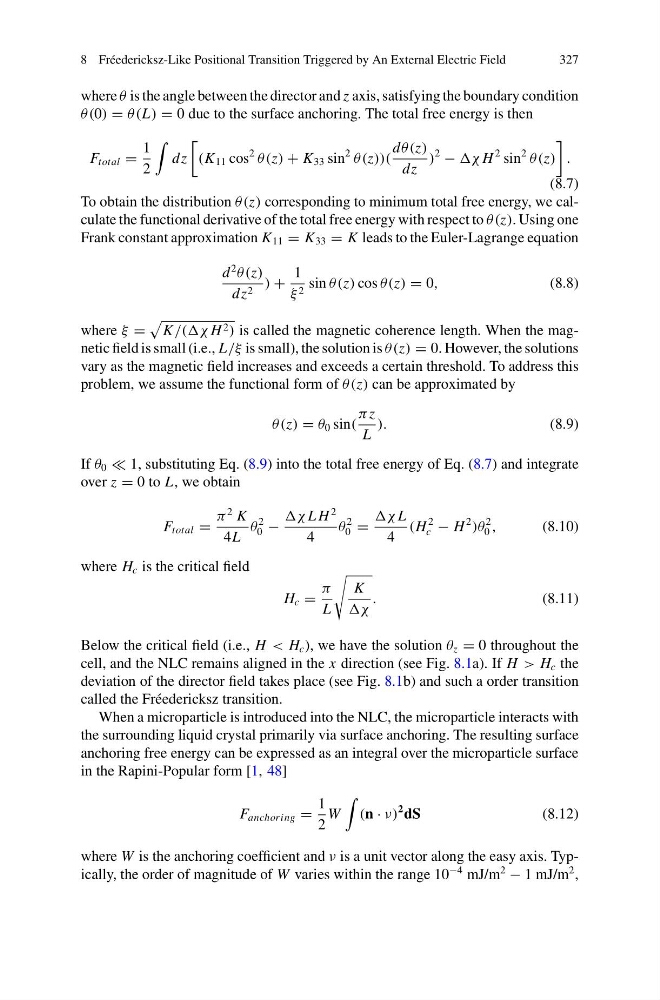
To obtain the distribution θ(z) corresponding to minimum total free energy, we calculate the functional derivative of the total free energy with respect to θ(z). Using one
Frank constant approximation K 11 = K 33 = K leads to the Euler-Lagrange equation
d
2
θ(z)
dz 2 ) +
1
ξ 2 sin θ(z) cos θ(z) = 0,
(8.8)
where ξ =
K /((χ H 2 ) is called the magnetic coherence length. When the magnetic field is small (i.e., L/ξ is small), the solution is θ(z) = 0. However, the solutions
vary as the magnetic field increases and exceeds a certain threshold. To address this
problem, we assume the functional form of θ(z) can be approximated by
θ(z) = θ 0 sin(
π z
L
).
(8.9)
If θ 0 1, substituting Eq. (8.9) into the total free energy of Eq. (8.7) and integrate
over z = 0 to L, we obtain
F total =
π
2 K
4L
θ
2
0 −
χ L H
2
4
θ
2
0 =
χ L
4
(H
2
c − H
2
)θ
2
0 ,
(8.10)
where H c is the critical field
H c =
π
L
K
χ
.
(8.11)
Below the critical field (i.e., H < H c ), we have the solution θ z = 0 throughout the
cell, and the NLC remains aligned in the x direction (see Fig. 8.1a). If H > H c the
deviation of the director field takes place (see Fig. 8.1b) and such a order transition
called the Fréedericksz transition.
When a microparticle is introduced into the NLC, the microparticle interacts with
the surrounding liquid crystal primarily via surface anchoring. The resulting surface
anchoring free energy can be expressed as an integral over the microparticle surface
in the Rapini-Popular form [1, 48]
F anchoring =
1
2
W
(n · ν)
2 dS
(8.12)
where W is the anchoring coefficient and ν is a unit vector along the easy axis. Typically, the order of magnitude of W varies within the range 10
−4 mJ/m
2
− 1 mJ/m
2 ,
327
where θ is the angle between the director and z axis, satisfying the boundary condition
θ(0) = θ(L) = 0 due to the surface anchoring. The total free energy is then
F total =
1
2
dz
(K 11 cos
2
θ(z) + K 33 sin
2
θ(z))(
dθ(z)
dz
)
2
− χ H
2 sin
2
θ(z)
.
(8.7)
To obtain the distribution θ(z) corresponding to minimum total free energy, we calculate the functional derivative of the total free energy with respect to θ(z). Using one
Frank constant approximation K 11 = K 33 = K leads to the Euler-Lagrange equation
d
2
θ(z)
dz 2 ) +
1
ξ 2 sin θ(z) cos θ(z) = 0,
(8.8)
where ξ =
K /((χ H 2 ) is called the magnetic coherence length. When the magnetic field is small (i.e., L/ξ is small), the solution is θ(z) = 0. However, the solutions
vary as the magnetic field increases and exceeds a certain threshold. To address this
problem, we assume the functional form of θ(z) can be approximated by
θ(z) = θ 0 sin(
π z
L
).
(8.9)
If θ 0 1, substituting Eq. (8.9) into the total free energy of Eq. (8.7) and integrate
over z = 0 to L, we obtain
F total =
π
2 K
4L
θ
2
0 −
χ L H
2
4
θ
2
0 =
χ L
4
(H
2
c − H
2
)θ
2
0 ,
(8.10)
where H c is the critical field
H c =
π
L
K
χ
.
(8.11)
Below the critical field (i.e., H < H c ), we have the solution θ z = 0 throughout the
cell, and the NLC remains aligned in the x direction (see Fig. 8.1a). If H > H c the
deviation of the director field takes place (see Fig. 8.1b) and such a order transition
called the Fréedericksz transition.
When a microparticle is introduced into the NLC, the microparticle interacts with
the surrounding liquid crystal primarily via surface anchoring. The resulting surface
anchoring free energy can be expressed as an integral over the microparticle surface
in the Rapini-Popular form [1, 48]
F anchoring =
1
2
W
(n · ν)
2 dS
(8.12)
where W is the anchoring coefficient and ν is a unit vector along the easy axis. Typically, the order of magnitude of W varies within the range 10
−4 mJ/m
2
− 1 mJ/m
2 ,