

326
K. Xiao and C.-X. Wu
f H = −
1
2
χ (H · n)
2
,
(8.4)
where H is the magnetic field and χ = χ − χ ⊥ is the diamagnetic anisotropy of
the NLC, which can be positive or negative. Here χ and χ ⊥ are the two components
of magnetic susceptibility for liquid crystal molecules when the magnetic field is
applied. If χ > 0, the molecules tend to align parallel to the direction of H, while
if < 0, the molecules tend to align perpendicularly to the field direction. Analogously, if the external field is an electric one, then alternatively the additional free
energy becomes
f E = −
1
8π
· n)
2
,
(8.5)
where E is the electric field and ε = ε − ε ⊥ is the dielectric anisotropy of the NLC,
which can be positive or negative as well. Here ε and ε ⊥ are the dielectric susceptibilities of the liquid crystal molecule parallel and perpendicular to the molecular
long axis respectively. To illustrate how external fields alter the interactions of liquid
crystal molecules, let us consider an NLC with thickness L sandwiched between two
cell walls, and we choose the coordinate z axis normal to the cell walls where LC
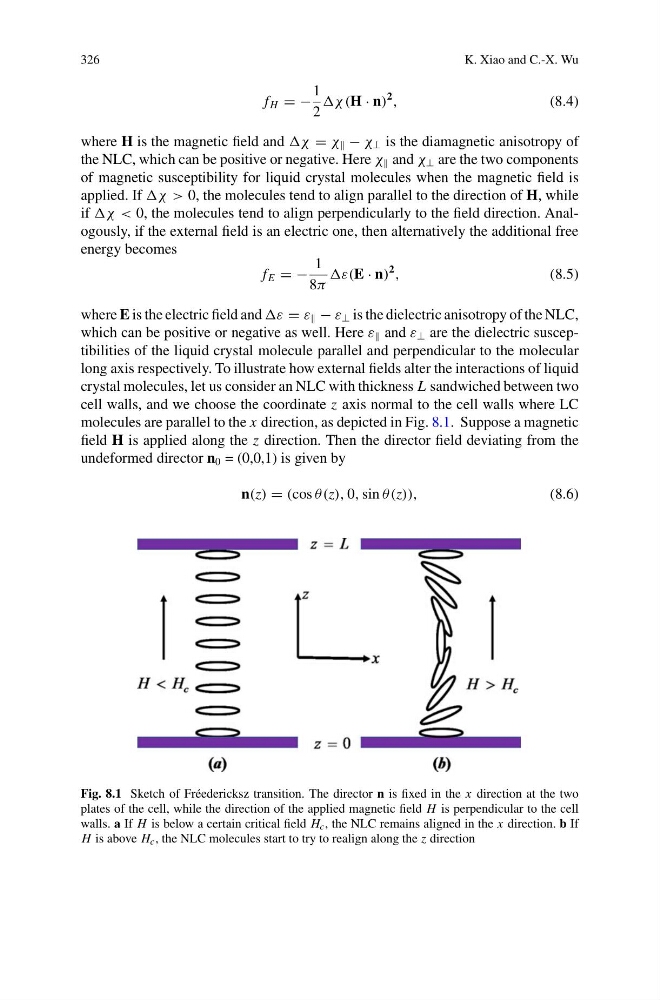
molecules are parallel to the x direction, as depicted in Fig. 8.1. Suppose a magnetic
field H is applied along the z direction. Then the director field deviating from the
undeformed director n 0 = (0,0,1) is given by
n(z) = (cos θ(z), 0, sin θ(z)),
(8.6)
Fig. 8.1 Sketch of Fréedericksz transition. The director n is fixed in the x direction at the two
plates of the cell, while the direction of the applied magnetic field H is perpendicular to the cell
walls. a If H is below a certain critical field H c , the NLC remains aligned in the x direction. b If
H is above H c , the NLC molecules start to try to realign along the z direction
K. Xiao and C.-X. Wu
f H = −
1
2
χ (H · n)
2
,
(8.4)
where H is the magnetic field and χ = χ − χ ⊥ is the diamagnetic anisotropy of
the NLC, which can be positive or negative. Here χ and χ ⊥ are the two components
of magnetic susceptibility for liquid crystal molecules when the magnetic field is
applied. If χ > 0, the molecules tend to align parallel to the direction of H, while
if < 0, the molecules tend to align perpendicularly to the field direction. Analogously, if the external field is an electric one, then alternatively the additional free
energy becomes
f E = −
1
8π
· n)
2
,
(8.5)
where E is the electric field and ε = ε − ε ⊥ is the dielectric anisotropy of the NLC,
which can be positive or negative as well. Here ε and ε ⊥ are the dielectric susceptibilities of the liquid crystal molecule parallel and perpendicular to the molecular
long axis respectively. To illustrate how external fields alter the interactions of liquid
crystal molecules, let us consider an NLC with thickness L sandwiched between two
cell walls, and we choose the coordinate z axis normal to the cell walls where LC
molecules are parallel to the x direction, as depicted in Fig. 8.1. Suppose a magnetic
field H is applied along the z direction. Then the director field deviating from the
undeformed director n 0 = (0,0,1) is given by
n(z) = (cos θ(z), 0, sin θ(z)),
(8.6)
Fig. 8.1 Sketch of Fréedericksz transition. The director n is fixed in the x direction at the two
plates of the cell, while the direction of the applied magnetic field H is perpendicular to the cell
walls. a If H is below a certain critical field H c , the NLC remains aligned in the x direction. b If
H is above H c , the NLC molecules start to try to realign along the z direction