

308
R. G. Weiss
7.6 Experimental Determination of What Is and Is Not
a Gel
A simple and preliminary (but sometimes inaccurate) method to determine what is
and what is not a gel is ‘the inverse flow method’ [63] in which a sample consisting
of a liquid and a small fraction of solid is inverted with respect to gravity. If no flow
is observed after a protracted period, the sample may be assumed to be a gel. A
more accurate and detailed assessment of the gel status of a sample is available from
measurements of endotherms and exotherms in differential scanning calorimetry
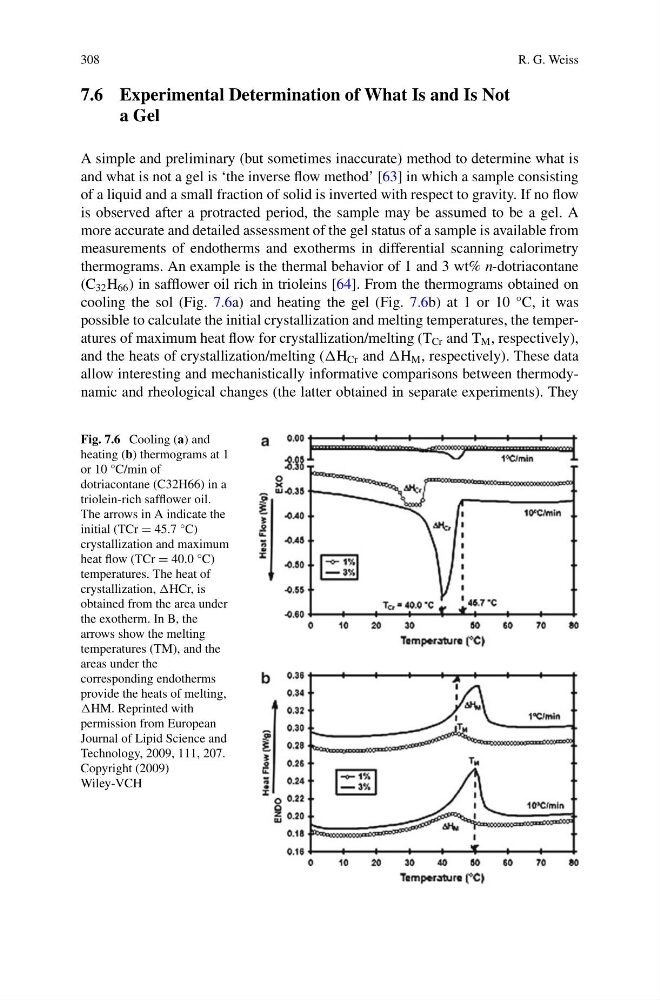
thermograms. An example is the thermal behavior of 1 and 3 wt% n-dotriacontane
(C 32 H 66 ) in safflower oil rich in trioleins [64]. From the thermograms obtained on
cooling the sol (Fig. 7.6a) and heating the gel (Fig. 7.6b) at 1 or 10 °C, it was
possible to calculate the initial crystallization and melting temperatures, the temperatures of maximum heat flow for crystallization/melting (T Cr and T M , respectively),
and the heats of crystallization/melting (H Cr and H M , respectively). These data
allow interesting and mechanistically informative comparisons between thermodynamic and rheological changes (the latter obtained in separate experiments). They
Fig. 7.6 Cooling (a) and
heating (b) thermograms at 1
or 10 °C/min of
dotriacontane (C32H66) in a
triolein-rich safflower oil.
The arrows in A indicate the
initial (TCr = 45.7 °C)
crystallization and maximum
heat flow (TCr = 40.0 °C)
temperatures. The heat of
crystallization, HCr, is
obtained from the area under
the exotherm. In B, the
arrows show the melting
temperatures (TM), and the
areas under the
corresponding endotherms
provide the heats of melting,
HM. Reprinted with
permission from European
Journal of Lipid Science and
Technology, 2009, 111, 207.
Copyright (2009)
Wiley-VCH
R. G. Weiss
7.6 Experimental Determination of What Is and Is Not
a Gel
A simple and preliminary (but sometimes inaccurate) method to determine what is
and what is not a gel is ‘the inverse flow method’ [63] in which a sample consisting
of a liquid and a small fraction of solid is inverted with respect to gravity. If no flow
is observed after a protracted period, the sample may be assumed to be a gel. A
more accurate and detailed assessment of the gel status of a sample is available from
measurements of endotherms and exotherms in differential scanning calorimetry
thermograms. An example is the thermal behavior of 1 and 3 wt% n-dotriacontane
(C 32 H 66 ) in safflower oil rich in trioleins [64]. From the thermograms obtained on
cooling the sol (Fig. 7.6a) and heating the gel (Fig. 7.6b) at 1 or 10 °C, it was
possible to calculate the initial crystallization and melting temperatures, the temperatures of maximum heat flow for crystallization/melting (T Cr and T M , respectively),
and the heats of crystallization/melting (H Cr and H M , respectively). These data
allow interesting and mechanistically informative comparisons between thermodynamic and rheological changes (the latter obtained in separate experiments). They
Fig. 7.6 Cooling (a) and
heating (b) thermograms at 1
or 10 °C/min of
dotriacontane (C32H66) in a
triolein-rich safflower oil.
The arrows in A indicate the
initial (TCr = 45.7 °C)
crystallization and maximum
heat flow (TCr = 40.0 °C)
temperatures. The heat of
crystallization, HCr, is
obtained from the area under
the exotherm. In B, the
arrows show the melting
temperatures (TM), and the
areas under the
corresponding endotherms
provide the heats of melting,
HM. Reprinted with
permission from European
Journal of Lipid Science and
Technology, 2009, 111, 207.
Copyright (2009)
Wiley-VCH