

7 A Primer on Gels (with an Emphasis on Molecular Gels)
307
initiating host-guest complexation, effecting redox processes, applying magnetic
fields, and inducing in situ reversible or irreversible chemical reactions [52].
7.5 How Do Aggregation and Growth of Molecular Gelator
Networks Occur?
The actual shapes of the micron-scale objects constituting the gelator network depend
on the shape, chirality [53], and solubility of the gelator molecules [54] and kinetic
factors (such as the rate of super-cooling) [10, 55], along the kinetic pathway leading
to aggregates and their epitaxial growth into axially symmetric objects with large
aspect ratios. The objects may have uniform or poly-disperse cross-sections as rods,
straight or helically twisted tapes and fibers, tubules, spherulites, etc. In fact, helically
twisted tapes can be produced even by achiral molecular gelators [56]! Several types
of gelator networks, including those comprised of tetraoctadecylphosphonium salts,
have been used as templates to make silicate objects [57] with tetraethyl orthosilicate
(TEOS) precursors [58].
In fact, one can envision several mechanisms by which small molecules in sol
phases aggregate into the 3D networks requisite for gel formation. A cartoon representation of one possible mode from a sol phase is shown in Fig. 7.3. The bulletshaped molecules prefer to associate along one axis, leading to preferential 1D growth
of rod-like objects shown in C. A macroscopic analogy is how Lego blocks interact
preferentially along only their crenelated surfaces. Rather empirical treatments of
the formation and structures of gel networks based on kinetic parameters have been
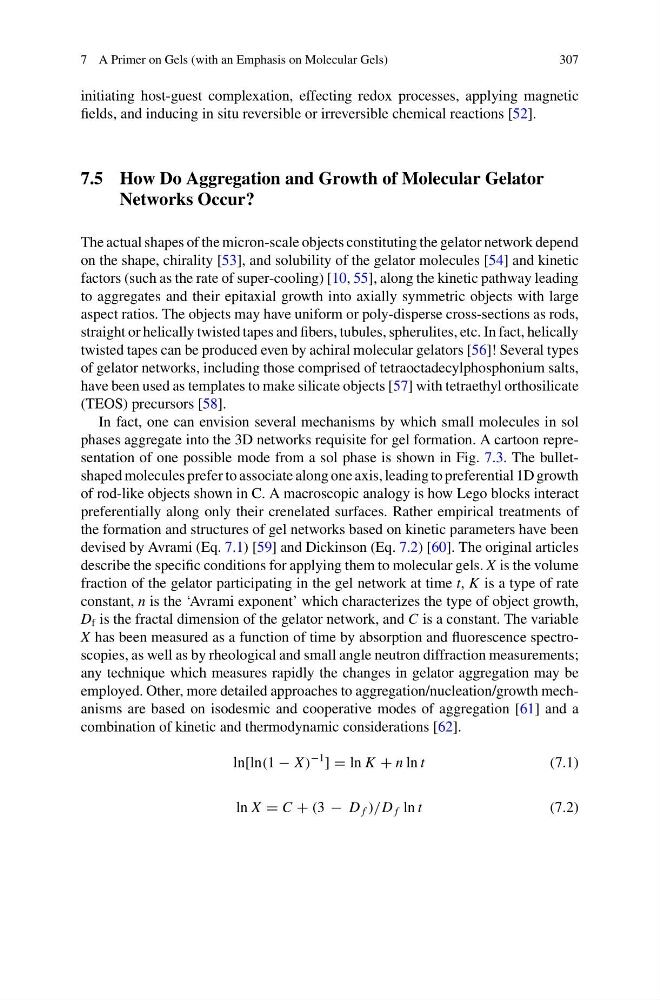
devised by Avrami (Eq. 7.1) [59] and Dickinson (Eq. 7.2) [60]. The original articles
describe the specific conditions for applying them to molecular gels. X is the volume
fraction of the gelator participating in the gel network at time t, K is a type of rate
constant, n is the ‘Avrami exponent’ which characterizes the type of object growth,
D f is the fractal dimension of the gelator network, and C is a constant. The variable
X has been measured as a function of time by absorption and fluorescence spectroscopies, as well as by rheological and small angle neutron diffraction measurements;
any technique which measures rapidly the changes in gelator aggregation may be
employed. Other, more detailed approaches to aggregation/nucleation/growth mechanisms are based on isodesmic and cooperative modes of aggregation [61] and a
combination of kinetic and thermodynamic considerations [62].
ln[ln(1 − X )
−1
] = ln K + n ln t
(7.1)
ln X = C + (3 − D f )/D f ln t
(7.2)
307
initiating host-guest complexation, effecting redox processes, applying magnetic
fields, and inducing in situ reversible or irreversible chemical reactions [52].
7.5 How Do Aggregation and Growth of Molecular Gelator
Networks Occur?
The actual shapes of the micron-scale objects constituting the gelator network depend
on the shape, chirality [53], and solubility of the gelator molecules [54] and kinetic
factors (such as the rate of super-cooling) [10, 55], along the kinetic pathway leading
to aggregates and their epitaxial growth into axially symmetric objects with large
aspect ratios. The objects may have uniform or poly-disperse cross-sections as rods,
straight or helically twisted tapes and fibers, tubules, spherulites, etc. In fact, helically
twisted tapes can be produced even by achiral molecular gelators [56]! Several types
of gelator networks, including those comprised of tetraoctadecylphosphonium salts,
have been used as templates to make silicate objects [57] with tetraethyl orthosilicate
(TEOS) precursors [58].
In fact, one can envision several mechanisms by which small molecules in sol
phases aggregate into the 3D networks requisite for gel formation. A cartoon representation of one possible mode from a sol phase is shown in Fig. 7.3. The bulletshaped molecules prefer to associate along one axis, leading to preferential 1D growth
of rod-like objects shown in C. A macroscopic analogy is how Lego blocks interact
preferentially along only their crenelated surfaces. Rather empirical treatments of
the formation and structures of gel networks based on kinetic parameters have been
devised by Avrami (Eq. 7.1) [59] and Dickinson (Eq. 7.2) [60]. The original articles
describe the specific conditions for applying them to molecular gels. X is the volume
fraction of the gelator participating in the gel network at time t, K is a type of rate
constant, n is the ‘Avrami exponent’ which characterizes the type of object growth,
D f is the fractal dimension of the gelator network, and C is a constant. The variable
X has been measured as a function of time by absorption and fluorescence spectroscopies, as well as by rheological and small angle neutron diffraction measurements;
any technique which measures rapidly the changes in gelator aggregation may be
employed. Other, more detailed approaches to aggregation/nucleation/growth mechanisms are based on isodesmic and cooperative modes of aggregation [61] and a
combination of kinetic and thermodynamic considerations [62].
ln[ln(1 − X )
−1
] = ln K + n ln t
(7.1)
ln X = C + (3 − D f )/D f ln t
(7.2)