

6 Cocoon Silk: From Mesoscopic Materials Design …
277
Here, q = 4π sinθ /λ is the scattering wave vector, θ is the scattering angle, λ is the
X-ray wavelength, and l c is the correlation length, which can be determined from the
intercept and slope of a plot of I
−2/3 versus q
2 . To determine the level of scattering
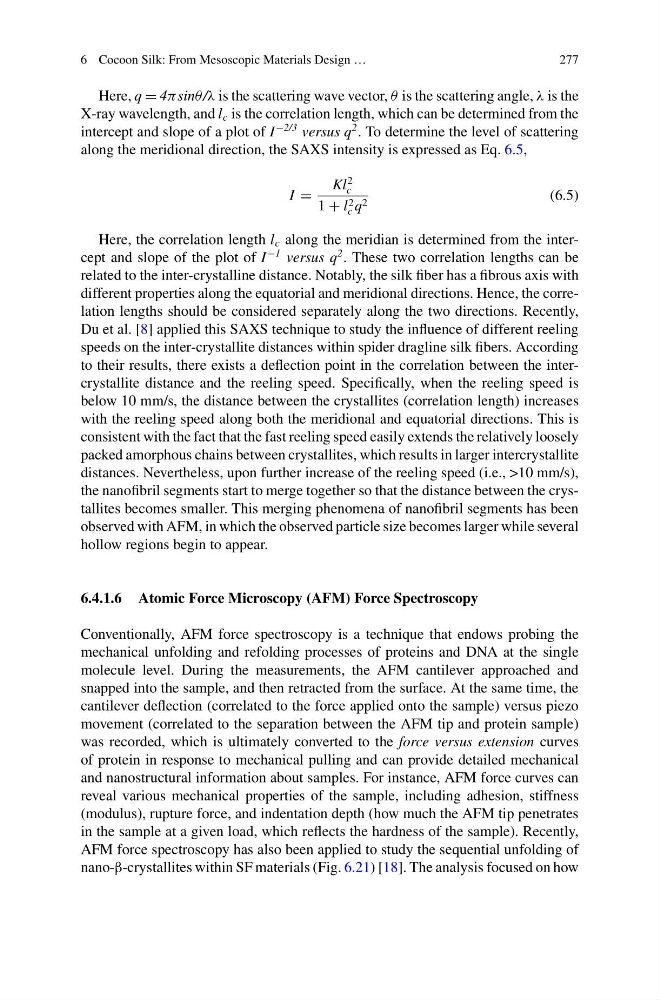
along the meridional direction, the SAXS intensity is expressed as Eq. 6.5,
I =
Kl
2
c
1 + l 2
c q 2
(6.5)
Here, the correlation length l c along the meridian is determined from the intercept and slope of the plot of I
−1 versus q
2 . These two correlation lengths can be
related to the inter-crystalline distance. Notably, the silk fiber has a fibrous axis with
different properties along the equatorial and meridional directions. Hence, the correlation lengths should be considered separately along the two directions. Recently,
Du et al. [8] applied this SAXS technique to study the influence of different reeling
speeds on the inter-crystallite distances within spider dragline silk fibers. According
to their results, there exists a deflection point in the correlation between the intercrystallite distance and the reeling speed. Specifically, when the reeling speed is
below 10 mm/s, the distance between the crystallites (correlation length) increases
with the reeling speed along both the meridional and equatorial directions. This is
consistent with the fact that the fast reeling speed easily extends the relatively loosely
packed amorphous chains between crystallites, which results in larger intercrystallite
distances. Nevertheless, upon further increase of the reeling speed (i.e., >10 mm/s),
the nanofibril segments start to merge together so that the distance between the crystallites becomes smaller. This merging phenomena of nanofibril segments has been
observed with AFM, in which the observed particle size becomes larger while several
hollow regions begin to appear.
6.4.1.6 Atomic Force Microscopy (AFM) Force Spectroscopy
Conventionally, AFM force spectroscopy is a technique that endows probing the
mechanical unfolding and refolding processes of proteins and DNA at the single
molecule level. During the measurements, the AFM cantilever approached and
snapped into the sample, and then retracted from the surface. At the same time, the
cantilever deflection (correlated to the force applied onto the sample) versus piezo
movement (correlated to the separation between the AFM tip and protein sample)
was recorded, which is ultimately converted to the force versus extension curves
of protein in response to mechanical pulling and can provide detailed mechanical
and nanostructural information about samples. For instance, AFM force curves can
reveal various mechanical properties of the sample, including adhesion, stiffness
(modulus), rupture force, and indentation depth (how much the AFM tip penetrates
in the sample at a given load, which reflects the hardness of the sample). Recently,
AFM force spectroscopy has also been applied to study the sequential unfolding of
nano-β-crystallites within SF materials (Fig. 6.21) [18]. The analysis focused on how
277
Here, q = 4π sinθ /λ is the scattering wave vector, θ is the scattering angle, λ is the
X-ray wavelength, and l c is the correlation length, which can be determined from the
intercept and slope of a plot of I
−2/3 versus q
2 . To determine the level of scattering
along the meridional direction, the SAXS intensity is expressed as Eq. 6.5,
I =
Kl
2
c
1 + l 2
c q 2
(6.5)
Here, the correlation length l c along the meridian is determined from the intercept and slope of the plot of I
−1 versus q
2 . These two correlation lengths can be
related to the inter-crystalline distance. Notably, the silk fiber has a fibrous axis with
different properties along the equatorial and meridional directions. Hence, the correlation lengths should be considered separately along the two directions. Recently,
Du et al. [8] applied this SAXS technique to study the influence of different reeling
speeds on the inter-crystallite distances within spider dragline silk fibers. According
to their results, there exists a deflection point in the correlation between the intercrystallite distance and the reeling speed. Specifically, when the reeling speed is
below 10 mm/s, the distance between the crystallites (correlation length) increases
with the reeling speed along both the meridional and equatorial directions. This is
consistent with the fact that the fast reeling speed easily extends the relatively loosely
packed amorphous chains between crystallites, which results in larger intercrystallite
distances. Nevertheless, upon further increase of the reeling speed (i.e., >10 mm/s),
the nanofibril segments start to merge together so that the distance between the crystallites becomes smaller. This merging phenomena of nanofibril segments has been
observed with AFM, in which the observed particle size becomes larger while several
hollow regions begin to appear.
6.4.1.6 Atomic Force Microscopy (AFM) Force Spectroscopy
Conventionally, AFM force spectroscopy is a technique that endows probing the
mechanical unfolding and refolding processes of proteins and DNA at the single
molecule level. During the measurements, the AFM cantilever approached and
snapped into the sample, and then retracted from the surface. At the same time, the
cantilever deflection (correlated to the force applied onto the sample) versus piezo
movement (correlated to the separation between the AFM tip and protein sample)
was recorded, which is ultimately converted to the force versus extension curves
of protein in response to mechanical pulling and can provide detailed mechanical
and nanostructural information about samples. For instance, AFM force curves can
reveal various mechanical properties of the sample, including adhesion, stiffness
(modulus), rupture force, and indentation depth (how much the AFM tip penetrates
in the sample at a given load, which reflects the hardness of the sample). Recently,
AFM force spectroscopy has also been applied to study the sequential unfolding of
nano-β-crystallites within SF materials (Fig. 6.21) [18]. The analysis focused on how