

6 Cocoon Silk: From Mesoscopic Materials Design …
275
be applied. SAXS is ideal for obtaining the structural information of larger crystalline molecules with dimensions between 1 and 100 nm and of repeat distances
in partially ordered systems with a length of up to 150 nm. Because silk materials
belong to semi-crystalline macromolecular materials, WAXS has been developed as
a powerful method for studying the size and orientation of crystallites as well as the
crystalline content (crystallinity) within the crystal network of silk materials. The
SAXS technique was applied to measure the inter-crystallite distances within the
crystal network inside silkworm silk and spider dragline silk fibers [8]. The detailed
analysis methods are described below.
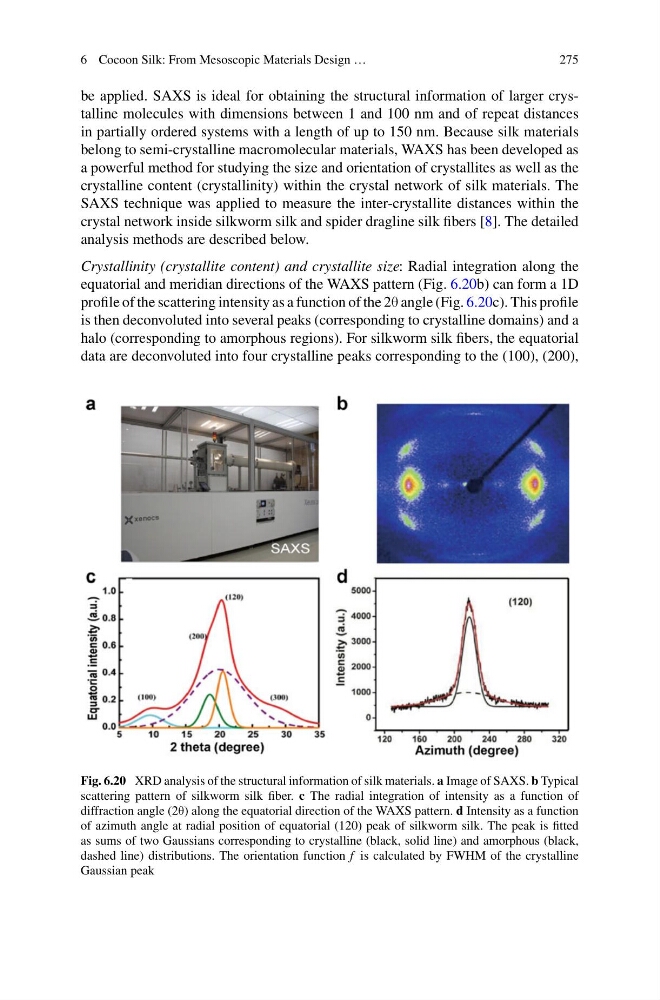
Crystallinity (crystallite content) and crystallite size: Radial integration along the
equatorial and meridian directions of the WAXS pattern (Fig. 6.20b) can form a 1D
profile of the scattering intensity as a function of the 2θ angle (Fig. 6.20c). This profile
is then deconvoluted into several peaks (corresponding to crystalline domains) and a
halo (corresponding to amorphous regions). For silkworm silk fibers, the equatorial
data are deconvoluted into four crystalline peaks corresponding to the (100), (200),
Fig. 6.20 XRD analysis of the structural information of silk materials. a Image of SAXS. b Typical
scattering pattern of silkworm silk fiber. c The radial integration of intensity as a function of
diffraction angle (2θ) along the equatorial direction of the WAXS pattern. d Intensity as a function
of azimuth angle at radial position of equatorial (120) peak of silkworm silk. The peak is fitted
as sums of two Gaussians corresponding to crystalline (black, solid line) and amorphous (black,
dashed line) distributions. The orientation function f is calculated by FWHM of the crystalline
Gaussian peak
275
be applied. SAXS is ideal for obtaining the structural information of larger crystalline molecules with dimensions between 1 and 100 nm and of repeat distances
in partially ordered systems with a length of up to 150 nm. Because silk materials
belong to semi-crystalline macromolecular materials, WAXS has been developed as
a powerful method for studying the size and orientation of crystallites as well as the
crystalline content (crystallinity) within the crystal network of silk materials. The
SAXS technique was applied to measure the inter-crystallite distances within the
crystal network inside silkworm silk and spider dragline silk fibers [8]. The detailed
analysis methods are described below.
Crystallinity (crystallite content) and crystallite size: Radial integration along the
equatorial and meridian directions of the WAXS pattern (Fig. 6.20b) can form a 1D
profile of the scattering intensity as a function of the 2θ angle (Fig. 6.20c). This profile
is then deconvoluted into several peaks (corresponding to crystalline domains) and a
halo (corresponding to amorphous regions). For silkworm silk fibers, the equatorial
data are deconvoluted into four crystalline peaks corresponding to the (100), (200),
Fig. 6.20 XRD analysis of the structural information of silk materials. a Image of SAXS. b Typical
scattering pattern of silkworm silk fiber. c The radial integration of intensity as a function of
diffraction angle (2θ) along the equatorial direction of the WAXS pattern. d Intensity as a function
of azimuth angle at radial position of equatorial (120) peak of silkworm silk. The peak is fitted
as sums of two Gaussians corresponding to crystalline (black, solid line) and amorphous (black,
dashed line) distributions. The orientation function f is calculated by FWHM of the crystalline
Gaussian peak