

6 Cocoon Silk: From Mesoscopic Materials Design …
267
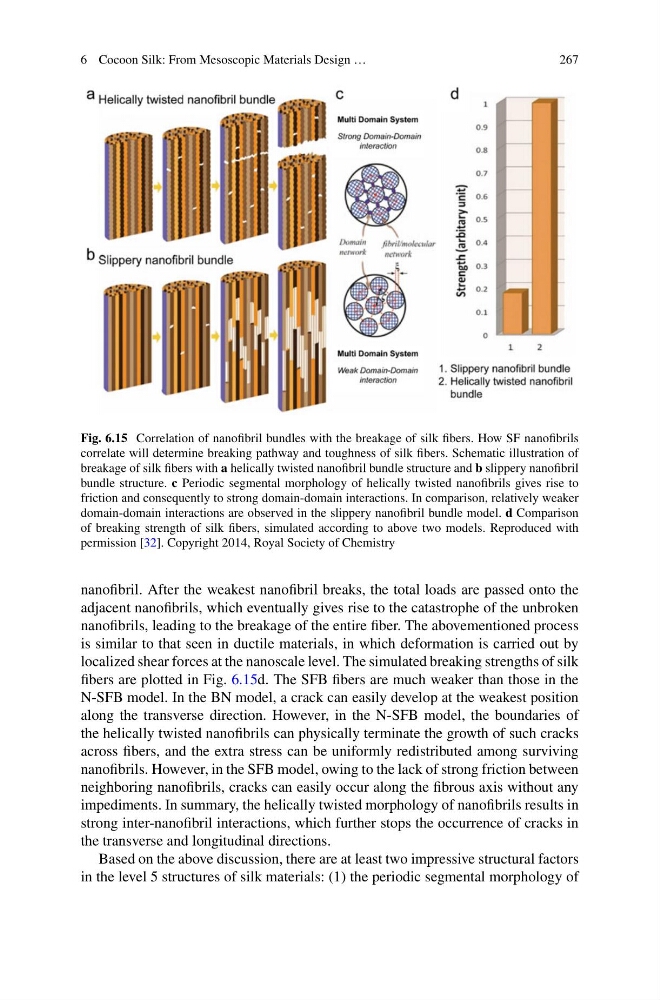
Fig. 6.15 Correlation of nanofibril bundles with the breakage of silk fibers. How SF nanofibrils
correlate will determine breaking pathway and toughness of silk fibers. Schematic illustration of
breakage of silk fibers with a helically twisted nanofibril bundle structure and b slippery nanofibril
bundle structure. c Periodic segmental morphology of helically twisted nanofibrils gives rise to
friction and consequently to strong domain-domain interactions. In comparison, relatively weaker
domain-domain interactions are observed in the slippery nanofibril bundle model. d Comparison
of breaking strength of silk fibers, simulated according to above two models. Reproduced with
permission [32]. Copyright 2014, Royal Society of Chemistry
nanofibril. After the weakest nanofibril breaks, the total loads are passed onto the
adjacent nanofibrils, which eventually gives rise to the catastrophe of the unbroken
nanofibrils, leading to the breakage of the entire fiber. The abovementioned process
is similar to that seen in ductile materials, in which deformation is carried out by
localized shear forces at the nanoscale level. The simulated breaking strengths of silk
fibers are plotted in Fig. 6.15d. The SFB fibers are much weaker than those in the
N-SFB model. In the BN model, a crack can easily develop at the weakest position
along the transverse direction. However, in the N-SFB model, the boundaries of
the helically twisted nanofibrils can physically terminate the growth of such cracks
across fibers, and the extra stress can be uniformly redistributed among surviving
nanofibrils. However, in the SFB model, owing to the lack of strong friction between
neighboring nanofibrils, cracks can easily occur along the fibrous axis without any
impediments. In summary, the helically twisted morphology of nanofibrils results in
strong inter-nanofibril interactions, which further stops the occurrence of cracks in
the transverse and longitudinal directions.
Based on the above discussion, there are at least two impressive structural factors
in the level 5 structures of silk materials: (1) the periodic segmental morphology of
267
Fig. 6.15 Correlation of nanofibril bundles with the breakage of silk fibers. How SF nanofibrils
correlate will determine breaking pathway and toughness of silk fibers. Schematic illustration of
breakage of silk fibers with a helically twisted nanofibril bundle structure and b slippery nanofibril
bundle structure. c Periodic segmental morphology of helically twisted nanofibrils gives rise to
friction and consequently to strong domain-domain interactions. In comparison, relatively weaker
domain-domain interactions are observed in the slippery nanofibril bundle model. d Comparison
of breaking strength of silk fibers, simulated according to above two models. Reproduced with
permission [32]. Copyright 2014, Royal Society of Chemistry
nanofibril. After the weakest nanofibril breaks, the total loads are passed onto the
adjacent nanofibrils, which eventually gives rise to the catastrophe of the unbroken
nanofibrils, leading to the breakage of the entire fiber. The abovementioned process
is similar to that seen in ductile materials, in which deformation is carried out by
localized shear forces at the nanoscale level. The simulated breaking strengths of silk
fibers are plotted in Fig. 6.15d. The SFB fibers are much weaker than those in the
N-SFB model. In the BN model, a crack can easily develop at the weakest position
along the transverse direction. However, in the N-SFB model, the boundaries of
the helically twisted nanofibrils can physically terminate the growth of such cracks
across fibers, and the extra stress can be uniformly redistributed among surviving
nanofibrils. However, in the SFB model, owing to the lack of strong friction between
neighboring nanofibrils, cracks can easily occur along the fibrous axis without any
impediments. In summary, the helically twisted morphology of nanofibrils results in
strong inter-nanofibril interactions, which further stops the occurrence of cracks in
the transverse and longitudinal directions.
Based on the above discussion, there are at least two impressive structural factors
in the level 5 structures of silk materials: (1) the periodic segmental morphology of