

266
W. Qiu and X.-Y. Liu
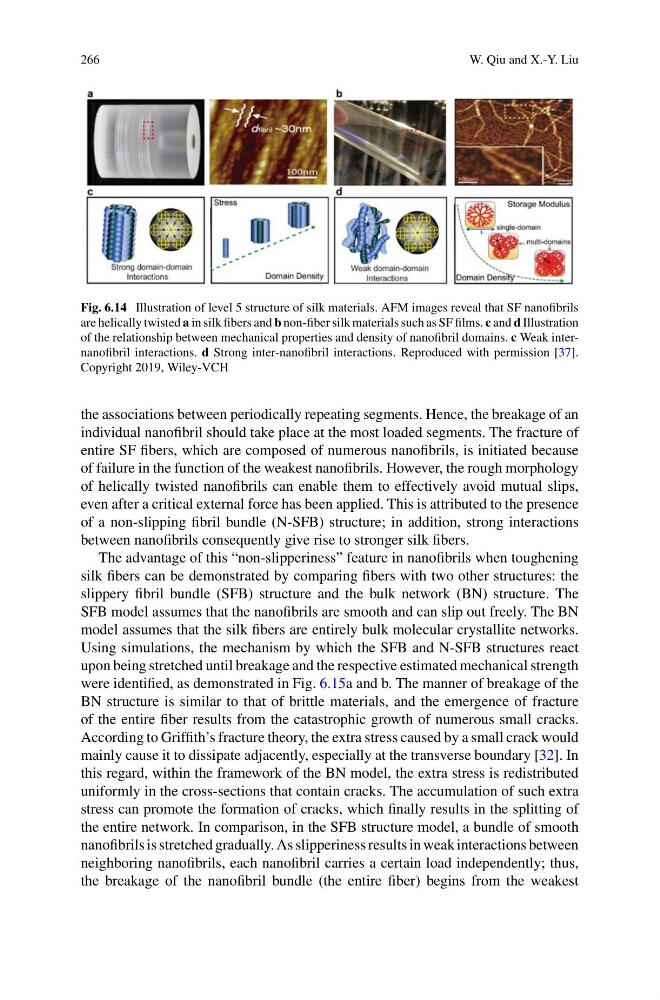
Fig. 6.14 Illustration of level 5 structure of silk materials. AFM images reveal that SF nanofibrils
are helically twisted a in silk fibers and b non-fiber silk materials such as SF films. c and d Illustration
of the relationship between mechanical properties and density of nanofibril domains. c Weak internanofibril interactions. d Strong inter-nanofibril interactions. Reproduced with permission [37].
Copyright 2019, Wiley-VCH
the associations between periodically repeating segments. Hence, the breakage of an
individual nanofibril should take place at the most loaded segments. The fracture of
entire SF fibers, which are composed of numerous nanofibrils, is initiated because
of failure in the function of the weakest nanofibrils. However, the rough morphology
of helically twisted nanofibrils can enable them to effectively avoid mutual slips,
even after a critical external force has been applied. This is attributed to the presence
of a non-slipping fibril bundle (N-SFB) structure; in addition, strong interactions
between nanofibrils consequently give rise to stronger silk fibers.
The advantage of this “non-slipperiness” feature in nanofibrils when toughening
silk fibers can be demonstrated by comparing fibers with two other structures: the
slippery fibril bundle (SFB) structure and the bulk network (BN) structure. The
SFB model assumes that the nanofibrils are smooth and can slip out freely. The BN
model assumes that the silk fibers are entirely bulk molecular crystallite networks.
Using simulations, the mechanism by which the SFB and N-SFB structures react
upon being stretched until breakage and the respective estimated mechanical strength
were identified, as demonstrated in Fig. 6.15a and b. The manner of breakage of the
BN structure is similar to that of brittle materials, and the emergence of fracture
of the entire fiber results from the catastrophic growth of numerous small cracks.
According to Griffith’s fracture theory, the extra stress caused by a small crack would
mainly cause it to dissipate adjacently, especially at the transverse boundary [32]. In
this regard, within the framework of the BN model, the extra stress is redistributed
uniformly in the cross-sections that contain cracks. The accumulation of such extra
stress can promote the formation of cracks, which finally results in the splitting of
the entire network. In comparison, in the SFB structure model, a bundle of smooth
nanofibrils is stretched gradually. As slipperiness results in weak interactions between
neighboring nanofibrils, each nanofibril carries a certain load independently; thus,
the breakage of the nanofibril bundle (the entire fiber) begins from the weakest
W. Qiu and X.-Y. Liu
Fig. 6.14 Illustration of level 5 structure of silk materials. AFM images reveal that SF nanofibrils
are helically twisted a in silk fibers and b non-fiber silk materials such as SF films. c and d Illustration
of the relationship between mechanical properties and density of nanofibril domains. c Weak internanofibril interactions. d Strong inter-nanofibril interactions. Reproduced with permission [37].
Copyright 2019, Wiley-VCH
the associations between periodically repeating segments. Hence, the breakage of an
individual nanofibril should take place at the most loaded segments. The fracture of
entire SF fibers, which are composed of numerous nanofibrils, is initiated because
of failure in the function of the weakest nanofibrils. However, the rough morphology
of helically twisted nanofibrils can enable them to effectively avoid mutual slips,
even after a critical external force has been applied. This is attributed to the presence
of a non-slipping fibril bundle (N-SFB) structure; in addition, strong interactions
between nanofibrils consequently give rise to stronger silk fibers.
The advantage of this “non-slipperiness” feature in nanofibrils when toughening
silk fibers can be demonstrated by comparing fibers with two other structures: the
slippery fibril bundle (SFB) structure and the bulk network (BN) structure. The
SFB model assumes that the nanofibrils are smooth and can slip out freely. The BN
model assumes that the silk fibers are entirely bulk molecular crystallite networks.
Using simulations, the mechanism by which the SFB and N-SFB structures react
upon being stretched until breakage and the respective estimated mechanical strength
were identified, as demonstrated in Fig. 6.15a and b. The manner of breakage of the
BN structure is similar to that of brittle materials, and the emergence of fracture
of the entire fiber results from the catastrophic growth of numerous small cracks.
According to Griffith’s fracture theory, the extra stress caused by a small crack would
mainly cause it to dissipate adjacently, especially at the transverse boundary [32]. In
this regard, within the framework of the BN model, the extra stress is redistributed
uniformly in the cross-sections that contain cracks. The accumulation of such extra
stress can promote the formation of cracks, which finally results in the splitting of
the entire network. In comparison, in the SFB structure model, a bundle of smooth
nanofibrils is stretched gradually. As slipperiness results in weak interactions between
neighboring nanofibrils, each nanofibril carries a certain load independently; thus,
the breakage of the nanofibril bundle (the entire fiber) begins from the weakest