

1 Introduction to Nonequilibrium Statistical Physics and Its Foundations
19
is practically deterministic. On the contrary, a small mass m implies large uncertainty: in the small m limit, the velocity is totally random. This can already be seen
in the Langevin equation, when the intensity of is expressed by q: large q/γ (relatively small mass) means that random forces dominate the deterministic viscous
force, while small q/γ is the opposite situation in which hydrodynamics holds. For
a test particle of the size of water molecules, the motion is random and there is
no viscosity, while for a boat it is deterministic, and atomic impacts are negligible.
The Brownian particle lays at the border between the micro- and the macro-worlds
that coexist, even though very different, in a single reality, and reveals both. While
microscopic dynamics know no viscosity and no energy dissipation, which is why
the motion does not stop, macroscopic dynamics knows no molecules, it dissipates
energy, hence the motion stops. These two pictures are not contradictory: the ordered
motion of the macroscopic object passes its energy to the disordered motion of the
fluid molecules, contributing to the internal energy of the fluid; no energy is lost, it
is simply randomized.
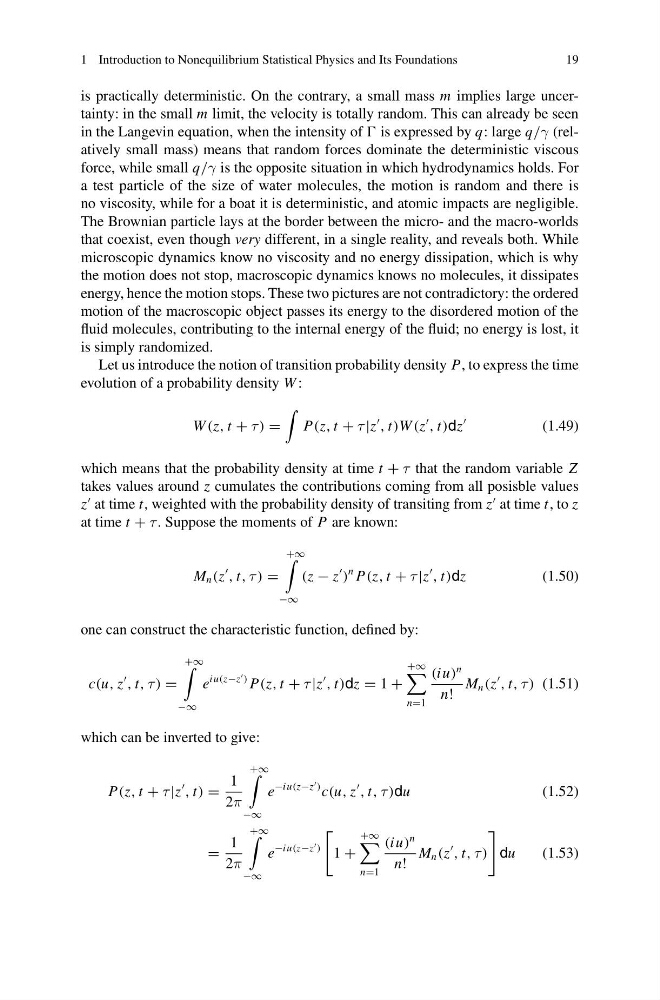
Let us introduce the notion of transition probability density P, to express the time
evolution of a probability density W :
W (z, t + τ ) =
P(z, t + τ |z
, t)W (z
, t)dz
(1.49)
which means that the probability density at time t + τ that the random variable Z
takes values around z cumulates the contributions coming from all posisble values
z
at time t, weighted with the probability density of transiting from z
at time t, to z
at time t + τ . Suppose the moments of P are known:
M n (z
, t, τ ) =
+∞
−∞
(z − z
)
n P(z, t + τ |z
, t)dz
(1.50)
one can construct the characteristic function, defined by:
c(u, z
, t, τ ) =
+∞
−∞
e
iu(z−z
) P(z, t + τ |z
, t)dz = 1 +
+∞
n=1
(iu)
n
n!
M n (z
, t, τ ) (1.51)
which can be inverted to give:
P(z, t + τ |z
, t) =
1
2π
+∞
−∞
e
−iu(z−z
) c(u, z
, t, τ )du
(1.52)
=
1
2π
+∞
−∞
e
−iu(z−z
)
1 +
+∞
n=1
(iu)
n
n!
M n (z
, t, τ )
du
(1.53)
19
is practically deterministic. On the contrary, a small mass m implies large uncertainty: in the small m limit, the velocity is totally random. This can already be seen
in the Langevin equation, when the intensity of is expressed by q: large q/γ (relatively small mass) means that random forces dominate the deterministic viscous
force, while small q/γ is the opposite situation in which hydrodynamics holds. For
a test particle of the size of water molecules, the motion is random and there is
no viscosity, while for a boat it is deterministic, and atomic impacts are negligible.
The Brownian particle lays at the border between the micro- and the macro-worlds
that coexist, even though very different, in a single reality, and reveals both. While
microscopic dynamics know no viscosity and no energy dissipation, which is why
the motion does not stop, macroscopic dynamics knows no molecules, it dissipates
energy, hence the motion stops. These two pictures are not contradictory: the ordered
motion of the macroscopic object passes its energy to the disordered motion of the
fluid molecules, contributing to the internal energy of the fluid; no energy is lost, it
is simply randomized.
Let us introduce the notion of transition probability density P, to express the time
evolution of a probability density W :
W (z, t + τ ) =
P(z, t + τ |z
, t)W (z
, t)dz
(1.49)
which means that the probability density at time t + τ that the random variable Z
takes values around z cumulates the contributions coming from all posisble values
z
at time t, weighted with the probability density of transiting from z
at time t, to z
at time t + τ . Suppose the moments of P are known:
M n (z
, t, τ ) =
+∞
−∞
(z − z
)
n P(z, t + τ |z
, t)dz
(1.50)
one can construct the characteristic function, defined by:
c(u, z
, t, τ ) =
+∞
−∞
e
iu(z−z
) P(z, t + τ |z
, t)dz = 1 +
+∞
n=1
(iu)
n
n!
M n (z
, t, τ ) (1.51)
which can be inverted to give:
P(z, t + τ |z
, t) =
1
2π
+∞
−∞
e
−iu(z−z
) c(u, z
, t, τ )du
(1.52)
=
1
2π
+∞
−∞
e
−iu(z−z
)
1 +
+∞
n=1
(iu)
n
n!
M n (z
, t, τ )
du
(1.53)