

6 Cocoon Silk: From Mesoscopic Materials Design …
257
crystallites become unstable if the size of the crystallites is smaller than the critical
size. This gives rise to the collectiveness of non-covalent bonds within the volume,
displaying much stronger bonding. In this case, although a single noncovalent interaction is weak, the combination of noncovalent interactions can result in a strong
bonding case. This encourages strong connections and stable binding points in the
networks in silk materials [37]. In this regard, β-crystallization plays a key role in
the stabilization of the meso structure of silk protein materials. Therefore, without
β-crystallization, silk protein materials are very unstable and highly water soluble.
To acquire a comprehensive understanding of the role of hydrophobic interactions in maintaining the structural integrity of β-crystallites, the strength and number
of hydrophobic interactions within different silk fibers were semi-quantitatively
compared. According to the latest simulation results, the strength of the ensemble
of hydrophobic interactions can be roughly estimated by counting the number of
alanine and serine residues per sheet [18]. In addition, the regularity with which
the alanine/serine pattern occurs is also relevant [18]. For instance, according to the
protein sequence and residues forming β-sheets within B. mori cocoon silk (BMCS)
and spider Nephila antipodiana eggcase silk (NAES) fibers, the number of times
the alanine/serine pattern occurs within NAES is relatively low; consequently, the
probability of the occurrence of hydrophobic interactions between β-sheets in NAES
is smaller. Hence, the average peel-off force in BMCS fibrils is stronger than that for
recombinant NAES fibrils (250 ± 95 pN and 162 ± 49 pN, respectively) [18]. This
difference can further explain why a higher breaking stress (550 MPa) is associated
with natural BMCS fibers than with recombinant NAES fibers (256 MPa) [18].
Apart from the inter-β-sheet interaction strength, the size of β-crystallites is also
an important structural factor that influences the performance of silk materials. The
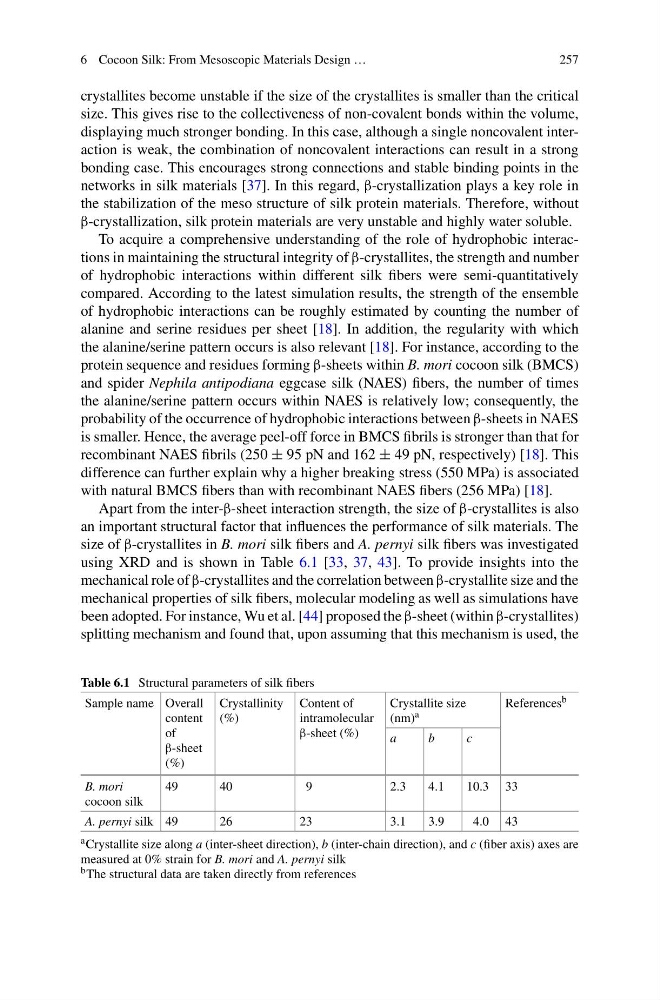
size of β-crystallites in B. mori silk fibers and A. pernyi silk fibers was investigated
using XRD and is shown in Table 6.1 [33, 37, 43]. To provide insights into the
mechanical role of β-crystallites and the correlation between β-crystallite size and the
mechanical properties of silk fibers, molecular modeling as well as simulations have
been adopted. For instance, Wu et al. [44] proposed the β-sheet (within β-crystallites)
splitting mechanism and found that, upon assuming that this mechanism is used, the
Table 6.1 Structural parameters of silk fibers
Sample name Overall
content
of
β-sheet
(%)
Crystallinity
(%)
Content of
intramolecular
β-sheet (%)
Crystallite size
(nm) a
References b
a
b
c
B. mori
cocoon silk
49
40
9
2.3
4.1
10.3 33
A. pernyi silk 49
26
23
3.1
3.9
4.0 43
a Crystallite size along a (inter-sheet direction), b (inter-chain direction), and c (fiber axis) axes are
measured at 0% strain for B. mori and A. pernyi silk
b The structural data are taken directly from references
257
crystallites become unstable if the size of the crystallites is smaller than the critical
size. This gives rise to the collectiveness of non-covalent bonds within the volume,
displaying much stronger bonding. In this case, although a single noncovalent interaction is weak, the combination of noncovalent interactions can result in a strong
bonding case. This encourages strong connections and stable binding points in the
networks in silk materials [37]. In this regard, β-crystallization plays a key role in
the stabilization of the meso structure of silk protein materials. Therefore, without
β-crystallization, silk protein materials are very unstable and highly water soluble.
To acquire a comprehensive understanding of the role of hydrophobic interactions in maintaining the structural integrity of β-crystallites, the strength and number
of hydrophobic interactions within different silk fibers were semi-quantitatively
compared. According to the latest simulation results, the strength of the ensemble
of hydrophobic interactions can be roughly estimated by counting the number of
alanine and serine residues per sheet [18]. In addition, the regularity with which
the alanine/serine pattern occurs is also relevant [18]. For instance, according to the
protein sequence and residues forming β-sheets within B. mori cocoon silk (BMCS)
and spider Nephila antipodiana eggcase silk (NAES) fibers, the number of times
the alanine/serine pattern occurs within NAES is relatively low; consequently, the
probability of the occurrence of hydrophobic interactions between β-sheets in NAES
is smaller. Hence, the average peel-off force in BMCS fibrils is stronger than that for
recombinant NAES fibrils (250 ± 95 pN and 162 ± 49 pN, respectively) [18]. This
difference can further explain why a higher breaking stress (550 MPa) is associated
with natural BMCS fibers than with recombinant NAES fibers (256 MPa) [18].
Apart from the inter-β-sheet interaction strength, the size of β-crystallites is also
an important structural factor that influences the performance of silk materials. The
size of β-crystallites in B. mori silk fibers and A. pernyi silk fibers was investigated
using XRD and is shown in Table 6.1 [33, 37, 43]. To provide insights into the
mechanical role of β-crystallites and the correlation between β-crystallite size and the
mechanical properties of silk fibers, molecular modeling as well as simulations have
been adopted. For instance, Wu et al. [44] proposed the β-sheet (within β-crystallites)
splitting mechanism and found that, upon assuming that this mechanism is used, the
Table 6.1 Structural parameters of silk fibers
Sample name Overall
content
of
β-sheet
(%)
Crystallinity
(%)
Content of
intramolecular
β-sheet (%)
Crystallite size
(nm) a
References b
a
b
c
B. mori
cocoon silk
49
40
9
2.3
4.1
10.3 33
A. pernyi silk 49
26
23
3.1
3.9
4.0 43
a Crystallite size along a (inter-sheet direction), b (inter-chain direction), and c (fiber axis) axes are
measured at 0% strain for B. mori and A. pernyi silk
b The structural data are taken directly from references