

256
W. Qiu and X.-Y. Liu
Recently, it has been widely accepted that different contents of β-sheets and βcrystallites give rise to distinct mechanical properties of different silk fibers. For
instance, in A. pernyi silk fibers, the intramolecular β-sheet content is 23% [43].
In comparison, B. mori silk fibers exhibit a much smaller ratio of intramolecular
β-sheet content (9% out of 49%) [33]. XRD analysis of the β-crystallite structure
further confirms that the crystallites within the B. mori silkworm fibers exhibit an
orthorhombic crystal lattice (with the space group of P22 1 2 1 ) structure and have unit
cell dimensions of a = 9.2, b = 9.4, and c = 6.94 Å, respectively, where a is the
direction in which the β-sheets are stacked (inter-sheet distance), b is the direction
of a β-sheet that is perpendicular to the strand axis (backbone-backbone hydrogen
bonding direction, or inter-chain direction), and c is the direction of the strand axis
[33].
Detailed investigation into the structure of β-sheets reveals that the side chains
of adjacent β-strands within the same β-sheet plates are the same, that is, the front
side of an entire β-sheet projects only the glycine side chains (–H), whereas the back
side projects only the alanine (–CH 3 )/serine (–CH 2 OH) side chains. Above/beneath
this β-sheet plate, the arrangement of the next plate is the opposite; thus, the β-sheet
assembly is realized in a front-to-front and back-to-back manner. The side chains
are arranged in such a way that the –CH 3 and –CH 2 OH groups of opposing β-sheets
can be closely packed; this gives rise to inter-sheet interactions (Fig. 6.10d) [22].
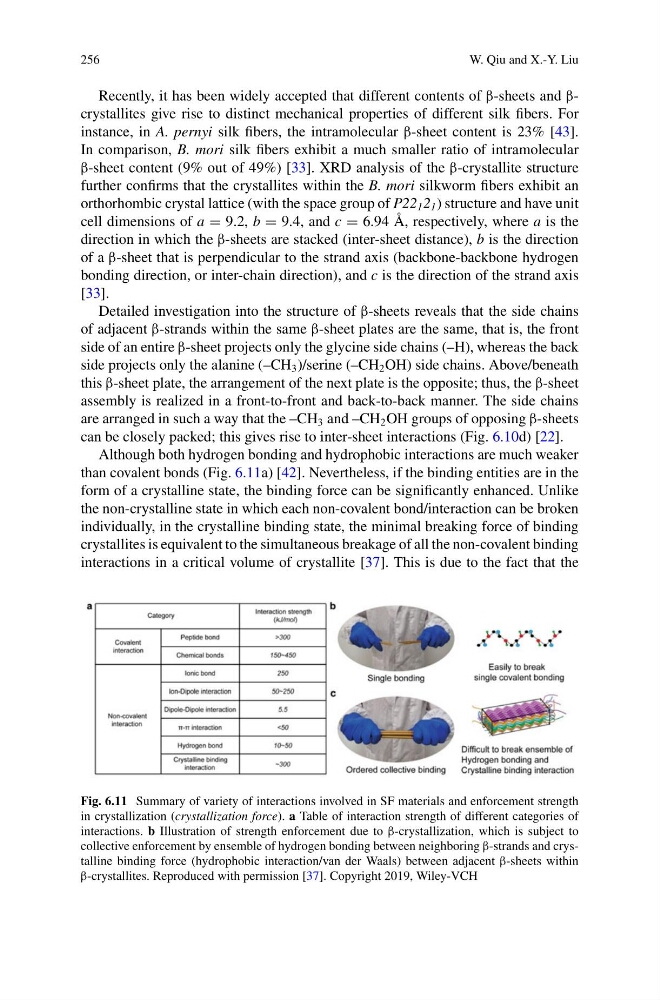
Although both hydrogen bonding and hydrophobic interactions are much weaker
than covalent bonds (Fig. 6.11a) [42]. Nevertheless, if the binding entities are in the
form of a crystalline state, the binding force can be significantly enhanced. Unlike
the non-crystalline state in which each non-covalent bond/interaction can be broken
individually, in the crystalline binding state, the minimal breaking force of binding
crystallites is equivalent to the simultaneous breakage of all the non-covalent binding
interactions in a critical volume of crystallite [37]. This is due to the fact that the
Fig. 6.11 Summary of variety of interactions involved in SF materials and enforcement strength
in crystallization (crystallization force). a Table of interaction strength of different categories of
interactions. b Illustration of strength enforcement due to β-crystallization, which is subject to
collective enforcement by ensemble of hydrogen bonding between neighboring β-strands and crystalline binding force (hydrophobic interaction/van der Waals) between adjacent β-sheets within
β-crystallites. Reproduced with permission [37]. Copyright 2019, Wiley-VCH
W. Qiu and X.-Y. Liu
Recently, it has been widely accepted that different contents of β-sheets and βcrystallites give rise to distinct mechanical properties of different silk fibers. For
instance, in A. pernyi silk fibers, the intramolecular β-sheet content is 23% [43].
In comparison, B. mori silk fibers exhibit a much smaller ratio of intramolecular
β-sheet content (9% out of 49%) [33]. XRD analysis of the β-crystallite structure
further confirms that the crystallites within the B. mori silkworm fibers exhibit an
orthorhombic crystal lattice (with the space group of P22 1 2 1 ) structure and have unit
cell dimensions of a = 9.2, b = 9.4, and c = 6.94 Å, respectively, where a is the
direction in which the β-sheets are stacked (inter-sheet distance), b is the direction
of a β-sheet that is perpendicular to the strand axis (backbone-backbone hydrogen
bonding direction, or inter-chain direction), and c is the direction of the strand axis
[33].
Detailed investigation into the structure of β-sheets reveals that the side chains
of adjacent β-strands within the same β-sheet plates are the same, that is, the front
side of an entire β-sheet projects only the glycine side chains (–H), whereas the back
side projects only the alanine (–CH 3 )/serine (–CH 2 OH) side chains. Above/beneath
this β-sheet plate, the arrangement of the next plate is the opposite; thus, the β-sheet
assembly is realized in a front-to-front and back-to-back manner. The side chains
are arranged in such a way that the –CH 3 and –CH 2 OH groups of opposing β-sheets
can be closely packed; this gives rise to inter-sheet interactions (Fig. 6.10d) [22].
Although both hydrogen bonding and hydrophobic interactions are much weaker
than covalent bonds (Fig. 6.11a) [42]. Nevertheless, if the binding entities are in the
form of a crystalline state, the binding force can be significantly enhanced. Unlike
the non-crystalline state in which each non-covalent bond/interaction can be broken
individually, in the crystalline binding state, the minimal breaking force of binding
crystallites is equivalent to the simultaneous breakage of all the non-covalent binding
interactions in a critical volume of crystallite [37]. This is due to the fact that the
Fig. 6.11 Summary of variety of interactions involved in SF materials and enforcement strength
in crystallization (crystallization force). a Table of interaction strength of different categories of
interactions. b Illustration of strength enforcement due to β-crystallization, which is subject to
collective enforcement by ensemble of hydrogen bonding between neighboring β-strands and crystalline binding force (hydrophobic interaction/van der Waals) between adjacent β-sheets within
β-crystallites. Reproduced with permission [37]. Copyright 2019, Wiley-VCH