

226
C. Tang (唐晨宇) and Y. Wang (王延颋)
V (r) =
V
real
(r) r ≤ r c
0 r > r c
(5.6.3)
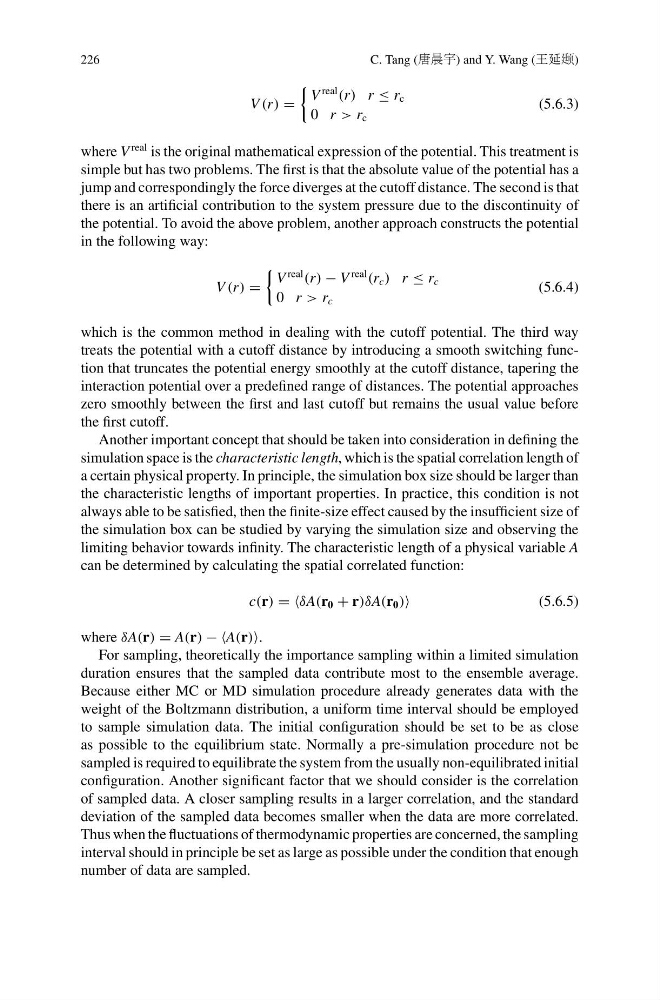
where V
real is the original mathematical expression of the potential. This treatment is
simple but has two problems. The first is that the absolute value of the potential has a
jump and correspondingly the force diverges at the cutoff distance. The second is that
there is an artificial contribution to the system pressure due to the discontinuity of
the potential. To avoid the above problem, another approach constructs the potential
in the following way:
V (r) =
V
real
(r) − V
real
(r c ) r ≤ r c
0 r > r c
(5.6.4)
which is the common method in dealing with the cutoff potential. The third way
treats the potential with a cutoff distance by introducing a smooth switching function that truncates the potential energy smoothly at the cutoff distance, tapering the
interaction potential over a predefined range of distances. The potential approaches
zero smoothly between the first and last cutoff but remains the usual value before
the first cutoff.
Another important concept that should be taken into consideration in defining the
simulation space is the characteristic length, which is the spatial correlation length of
a certain physical property. In principle, the simulation box size should be larger than
the characteristic lengths of important properties. In practice, this condition is not
always able to be satisfied, then the finite-size effect caused by the insufficient size of
the simulation box can be studied by varying the simulation size and observing the
limiting behavior towards infinity. The characteristic length of a physical variable A
can be determined by calculating the spatial correlated function:
c(r) = δA(r 0 + r)δA(r 0 )
(5.6.5)
where δA(r) = A(r) − A(r).
For sampling, theoretically the importance sampling within a limited simulation
duration ensures that the sampled data contribute most to the ensemble average.
Because either MC or MD simulation procedure already generates data with the
weight of the Boltzmann distribution, a uniform time interval should be employed
to sample simulation data. The initial configuration should be set to be as close
as possible to the equilibrium state. Normally a pre-simulation procedure not be
sampled is required to equilibrate the system from the usually non-equilibrated initial
configuration. Another significant factor that we should consider is the correlation
of sampled data. A closer sampling results in a larger correlation, and the standard
deviation of the sampled data becomes smaller when the data are more correlated.
Thus when the fluctuations of thermodynamic properties are concerned, the sampling
interval should in principle be set as large as possible under the condition that enough
number of data are sampled.
C. Tang (唐晨宇) and Y. Wang (王延颋)
V (r) =
V
real
(r) r ≤ r c
0 r > r c
(5.6.3)
where V
real is the original mathematical expression of the potential. This treatment is
simple but has two problems. The first is that the absolute value of the potential has a
jump and correspondingly the force diverges at the cutoff distance. The second is that
there is an artificial contribution to the system pressure due to the discontinuity of
the potential. To avoid the above problem, another approach constructs the potential
in the following way:
V (r) =
V
real
(r) − V
real
(r c ) r ≤ r c
0 r > r c
(5.6.4)
which is the common method in dealing with the cutoff potential. The third way
treats the potential with a cutoff distance by introducing a smooth switching function that truncates the potential energy smoothly at the cutoff distance, tapering the
interaction potential over a predefined range of distances. The potential approaches
zero smoothly between the first and last cutoff but remains the usual value before
the first cutoff.
Another important concept that should be taken into consideration in defining the
simulation space is the characteristic length, which is the spatial correlation length of
a certain physical property. In principle, the simulation box size should be larger than
the characteristic lengths of important properties. In practice, this condition is not
always able to be satisfied, then the finite-size effect caused by the insufficient size of
the simulation box can be studied by varying the simulation size and observing the
limiting behavior towards infinity. The characteristic length of a physical variable A
can be determined by calculating the spatial correlated function:
c(r) = δA(r 0 + r)δA(r 0 )
(5.6.5)
where δA(r) = A(r) − A(r).
For sampling, theoretically the importance sampling within a limited simulation
duration ensures that the sampled data contribute most to the ensemble average.
Because either MC or MD simulation procedure already generates data with the
weight of the Boltzmann distribution, a uniform time interval should be employed
to sample simulation data. The initial configuration should be set to be as close
as possible to the equilibrium state. Normally a pre-simulation procedure not be
sampled is required to equilibrate the system from the usually non-equilibrated initial
configuration. Another significant factor that we should consider is the correlation
of sampled data. A closer sampling results in a larger correlation, and the standard
deviation of the sampled data becomes smaller when the data are more correlated.
Thus when the fluctuations of thermodynamic properties are concerned, the sampling
interval should in principle be set as large as possible under the condition that enough
number of data are sampled.