

200
C. Tang (唐晨宇) and Y. Wang (王延颋)
simulations. An empirical classical molecular model can be built up upon data from
experiments and/or first-principles calculations. Therefore, we will start with a brief
overview of the first-principles calculations.
5.2 First-Principles Calculations
First-principles calculations compute physical and chemical properties of molecular
systems with the resolution of nuclei and electrons by numerically solving quantum
mechanics equations. The purpose of this introduction is to show how the interactions
between atoms at zero temperature of a non-relativistic time-independent molecular
system can be accurately calculated at the quantum mechanics level, whose results
can be used, sometimes along with experimental data, to build up empirical classical
molecular models.
5.2.1 Electronic Structure Methods
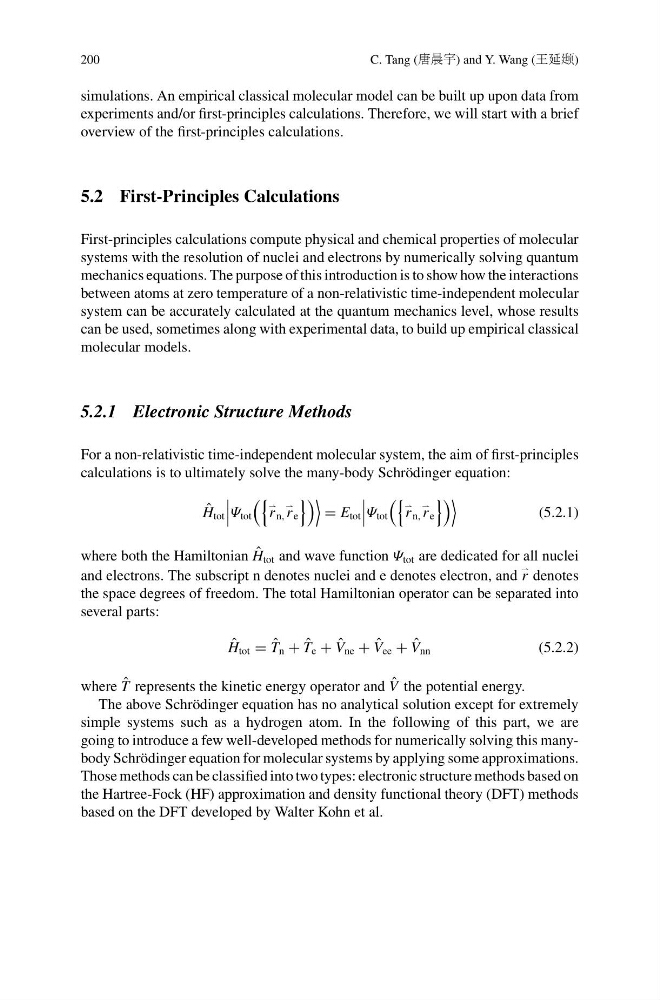
For a non-relativistic time-independent molecular system, the aim of first-principles
calculations is to ultimately solve the many-body Schrödinger equation:
ˆ
H tot
Ψtot
r n,
r e
= E tot
Ψtot
r n,
r e
(5.2.1)
where both the Hamiltonian ˆ
H tot and wave function Ψ tot are dedicated for all nuclei
and electrons. The subscript n denotes nuclei and e denotes electron, and
r denotes
the space degrees of freedom. The total Hamiltonian operator can be separated into
several parts:
ˆ
H tot = ˆ
T n + ˆ
T e + ˆ
V ne + ˆ
V ee + ˆ
V nn
(5.2.2)
where ˆ
T represents the kinetic energy operator and ˆ
V the potential energy.
The above Schrödinger equation has no analytical solution except for extremely
simple systems such as a hydrogen atom. In the following of this part, we are
going to introduce a few well-developed methods for numerically solving this manybody Schrödinger equation for molecular systems by applying some approximations.
Those methods can be classified into two types: electronic structure methods based on
the Hartree-Fock (HF) approximation and density functional theory (DFT) methods
based on the DFT developed by Walter Kohn et al.
C. Tang (唐晨宇) and Y. Wang (王延颋)
simulations. An empirical classical molecular model can be built up upon data from
experiments and/or first-principles calculations. Therefore, we will start with a brief
overview of the first-principles calculations.
5.2 First-Principles Calculations
First-principles calculations compute physical and chemical properties of molecular
systems with the resolution of nuclei and electrons by numerically solving quantum
mechanics equations. The purpose of this introduction is to show how the interactions
between atoms at zero temperature of a non-relativistic time-independent molecular
system can be accurately calculated at the quantum mechanics level, whose results
can be used, sometimes along with experimental data, to build up empirical classical
molecular models.
5.2.1 Electronic Structure Methods
For a non-relativistic time-independent molecular system, the aim of first-principles
calculations is to ultimately solve the many-body Schrödinger equation:
ˆ
H tot
Ψtot
r n,
r e
= E tot
Ψtot
r n,
r e
(5.2.1)
where both the Hamiltonian ˆ
H tot and wave function Ψ tot are dedicated for all nuclei
and electrons. The subscript n denotes nuclei and e denotes electron, and
r denotes
the space degrees of freedom. The total Hamiltonian operator can be separated into
several parts:
ˆ
H tot = ˆ
T n + ˆ
T e + ˆ
V ne + ˆ
V ee + ˆ
V nn
(5.2.2)
where ˆ
T represents the kinetic energy operator and ˆ
V the potential energy.
The above Schrödinger equation has no analytical solution except for extremely
simple systems such as a hydrogen atom. In the following of this part, we are
going to introduce a few well-developed methods for numerically solving this manybody Schrödinger equation for molecular systems by applying some approximations.
Those methods can be classified into two types: electronic structure methods based on
the Hartree-Fock (HF) approximation and density functional theory (DFT) methods
based on the DFT developed by Walter Kohn et al.