

4 An Introduction to Emergence Dynamics in Complex Systems
183
α n (t) =
α n (ω, t)g(ω)d ω,
(4.120)
where α n (ω, t) is the local order parameter with the natural frequency ω:
α n (ω, t) =
e
inθ
ρ(ω, θ, t)d θ,
(4.121)
and it can also be understood as the n-order Fourier expansion of ρ(ω, θ, t). The
following recursive equation can be obtained using the continuity equation
˙
α n (ω, t) = in
∞
j=−∞
f j (α, β,ω)α j+n (ω, t),
(4.122)
Similar to (4.106), if the coupling function contains only the first-order Fourier
coefficients, then the Ott-Antonsen ansatz for a given value of the natural frequency
ω
α n (ω, t) = α
n
1 (ω, t),
(4.123)
is a set of special solutions of Eqs. (4.111). Specifically, the first order parameter is
α 1 (t) =
α 1 (ω, t)g(ω)d ω.
(4.124)
When the distribution function g(ω) is the rational fraction of ω, such
as Lorentz distribution, one can analytically extend the real ω to the complex regime.
If there is no divergence (|α 1 (t)| ≤ 1), the evolution equation of α 1 (t) can be worked
out.
4.4.5.4 The Mean-Field Kuramoto Model Revisited
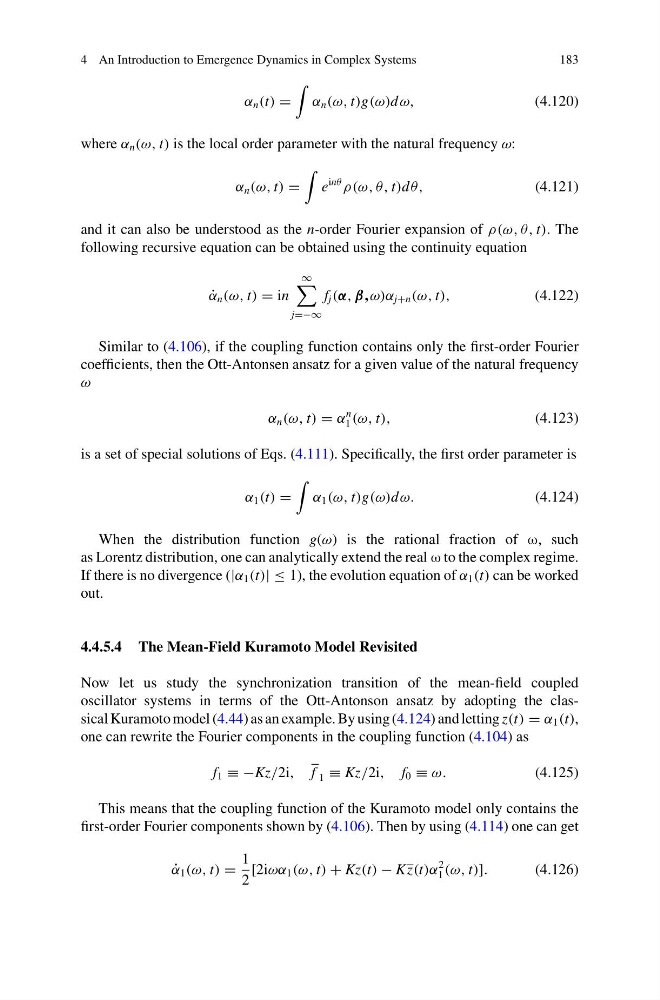
Now let us study the synchronization transition of the mean-field coupled
oscillator systems in terms of the Ott-Antonson ansatz by adopting the classical Kuramoto model (4.44) as an example. By using (4.124) and letting z(t) = α 1 (t),
one can rewrite the Fourier components in the coupling function (4.104) as
f 1 ≡ −Kz/2i, f 1 ≡ Kz/2i, f 0 ≡ ω.
(4.125)
This means that the coupling function of the Kuramoto model only contains the
first-order Fourier components shown by (4.106). Then by using (4.114) one can get
˙
α 1 (ω, t) =
1
2
[2iωα 1 (ω, t) + Kz(t) − Kz(t)α
2
1 (ω, t)].
(4.126)
183
α n (t) =
α n (ω, t)g(ω)d ω,
(4.120)
where α n (ω, t) is the local order parameter with the natural frequency ω:
α n (ω, t) =
e
inθ
ρ(ω, θ, t)d θ,
(4.121)
and it can also be understood as the n-order Fourier expansion of ρ(ω, θ, t). The
following recursive equation can be obtained using the continuity equation
˙
α n (ω, t) = in
∞
j=−∞
f j (α, β,ω)α j+n (ω, t),
(4.122)
Similar to (4.106), if the coupling function contains only the first-order Fourier
coefficients, then the Ott-Antonsen ansatz for a given value of the natural frequency
ω
α n (ω, t) = α
n
1 (ω, t),
(4.123)
is a set of special solutions of Eqs. (4.111). Specifically, the first order parameter is
α 1 (t) =
α 1 (ω, t)g(ω)d ω.
(4.124)
When the distribution function g(ω) is the rational fraction of ω, such
as Lorentz distribution, one can analytically extend the real ω to the complex regime.
If there is no divergence (|α 1 (t)| ≤ 1), the evolution equation of α 1 (t) can be worked
out.
4.4.5.4 The Mean-Field Kuramoto Model Revisited
Now let us study the synchronization transition of the mean-field coupled
oscillator systems in terms of the Ott-Antonson ansatz by adopting the classical Kuramoto model (4.44) as an example. By using (4.124) and letting z(t) = α 1 (t),
one can rewrite the Fourier components in the coupling function (4.104) as
f 1 ≡ −Kz/2i, f 1 ≡ Kz/2i, f 0 ≡ ω.
(4.125)
This means that the coupling function of the Kuramoto model only contains the
first-order Fourier components shown by (4.106). Then by using (4.114) one can get
˙
α 1 (ω, t) =
1
2
[2iωα 1 (ω, t) + Kz(t) − Kz(t)α
2
1 (ω, t)].
(4.126)