

182
Z. Zheng
by the complex function α 1 (t) and satisfy the following power law, namely
α n (t) = α
n
1 (t), α n (t) = α
n
1 (t).
(4.116)
One then gets the following form:
ρ(θ, t) =
1
2π
1 +
∞
n=1
α
n
1 (t)e
inθ
+ α
n
1 (t)e
−inθ
,
(4.117)
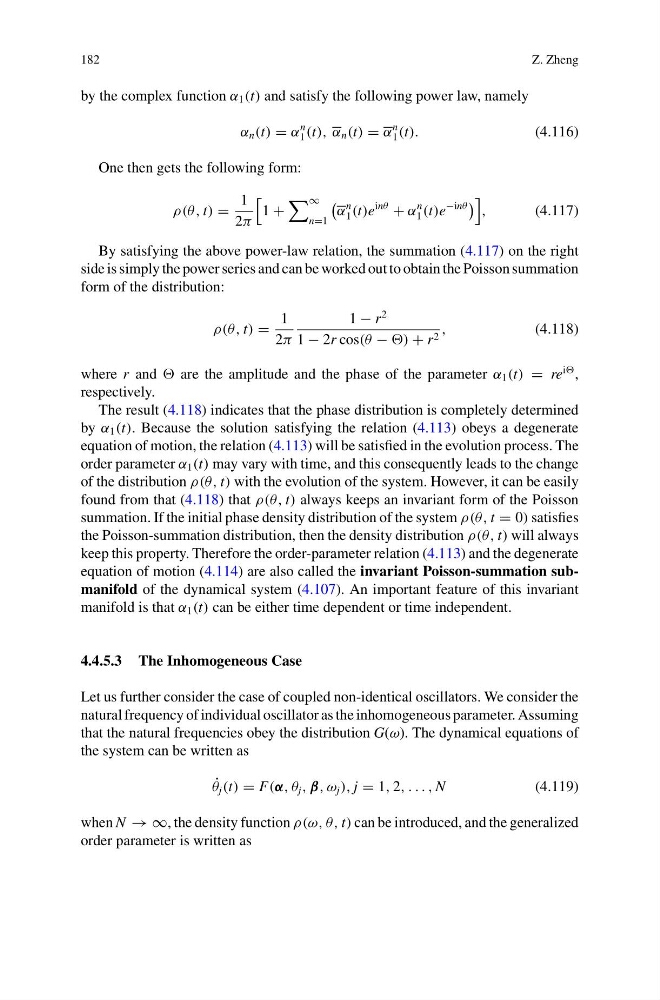
By satisfying the above power-law relation, the summation (4.117) on the right
side is simply the power series and can be worked out to obtain the Poisson summation
form of the distribution:
ρ(θ, t) =
1
2π
1 − r
2
1 − 2r cos(θ − ) + r 2 ,
(4.118)
where r and are the amplitude and the phase of the parameter α 1 (t) = re
i ,
respectively.
The result (4.118) indicates that the phase distribution is completely determined
by α 1 (t). Because the solution satisfying the relation (4.113) obeys a degenerate
equation of motion, the relation (4.113) will be satisfied in the evolution process. The
order parameter α 1 (t) may vary with time, and this consequently leads to the change
of the distribution ρ(θ, t) with the evolution of the system. However, it can be easily
found from that (4.118) that ρ(θ, t) always keeps an invariant form of the Poisson
summation. If the initial phase density distribution of the system ρ(θ, t = 0) satisfies
the Poisson-summation distribution, then the density distribution ρ(θ, t) will always
keep this property. Therefore the order-parameter relation (4.113) and the degenerate
equation of motion (4.114) are also called the invariant Poisson-summation submanifold of the dynamical system (4.107). An important feature of this invariant
manifold is that α 1 (t) can be either time dependent or time independent.
4.4.5.3 The Inhomogeneous Case
Let us further consider the case of coupled non-identical oscillators. We consider the
natural frequency of individual oscillator as the inhomogeneous parameter. Assuming
that the natural frequencies obey the distribution G(ω). The dynamical equations of
the system can be written as
˙
θ j (t) = F(α, θ j , β, ω j ), j = 1, 2, . . . , N
(4.119)
when N → ∞, the density function ρ(ω, θ, t) can be introduced, and the generalized
order parameter is written as
Z. Zheng
by the complex function α 1 (t) and satisfy the following power law, namely
α n (t) = α
n
1 (t), α n (t) = α
n
1 (t).
(4.116)
One then gets the following form:
ρ(θ, t) =
1
2π
1 +
∞
n=1
α
n
1 (t)e
inθ
+ α
n
1 (t)e
−inθ
,
(4.117)
By satisfying the above power-law relation, the summation (4.117) on the right
side is simply the power series and can be worked out to obtain the Poisson summation
form of the distribution:
ρ(θ, t) =
1
2π
1 − r
2
1 − 2r cos(θ − ) + r 2 ,
(4.118)
where r and are the amplitude and the phase of the parameter α 1 (t) = re
i ,
respectively.
The result (4.118) indicates that the phase distribution is completely determined
by α 1 (t). Because the solution satisfying the relation (4.113) obeys a degenerate
equation of motion, the relation (4.113) will be satisfied in the evolution process. The
order parameter α 1 (t) may vary with time, and this consequently leads to the change
of the distribution ρ(θ, t) with the evolution of the system. However, it can be easily
found from that (4.118) that ρ(θ, t) always keeps an invariant form of the Poisson
summation. If the initial phase density distribution of the system ρ(θ, t = 0) satisfies
the Poisson-summation distribution, then the density distribution ρ(θ, t) will always
keep this property. Therefore the order-parameter relation (4.113) and the degenerate
equation of motion (4.114) are also called the invariant Poisson-summation submanifold of the dynamical system (4.107). An important feature of this invariant
manifold is that α 1 (t) can be either time dependent or time independent.
4.4.5.3 The Inhomogeneous Case
Let us further consider the case of coupled non-identical oscillators. We consider the
natural frequency of individual oscillator as the inhomogeneous parameter. Assuming
that the natural frequencies obey the distribution G(ω). The dynamical equations of
the system can be written as
˙
θ j (t) = F(α, θ j , β, ω j ), j = 1, 2, . . . , N
(4.119)
when N → ∞, the density function ρ(ω, θ, t) can be introduced, and the generalized
order parameter is written as