

172
Z. Zheng
stable. When K ≥ K c the uniformly distributed solution is unstable and replaced
by the collective solution where the oscillators are locked, i.e. the solution when i
is equal, at which point the oscillator can maintain a fixed phase, and R = 0. In the
latter case, all oscillators are oscillatory with the same frequency
−
ω, =
−
ω t. By
introducing variables
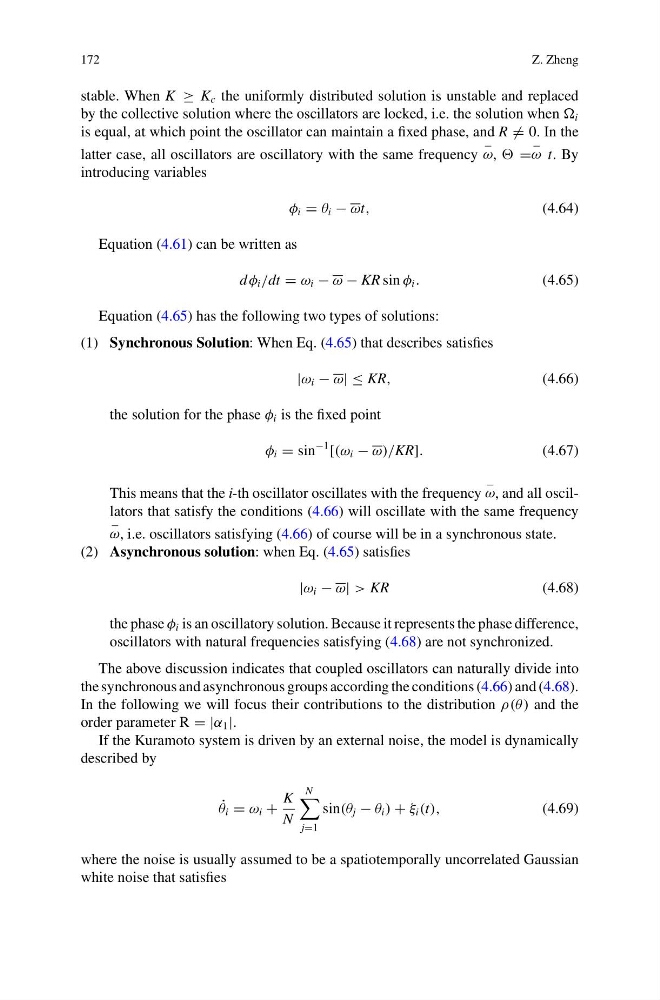
φ i = θ i − ωt,
(4.64)
Equation (4.61) can be written as
d φ i /dt = ω i − ω − KR sin φ i .
(4.65)
Equation (4.65) has the following two types of solutions:
(1) Synchronous Solution: When Eq. (4.65) that describes satisfies
|ω i − ω| ≤ KR,
(4.66)
the solution for the phase φ i is the fixed point
φ i = sin
−1
[(ω i − ω)/KR].
(4.67)
This means that the i-th oscillator oscillates with the frequency
−
ω, and all oscillators that satisfy the conditions (4.66) will oscillate with the same frequency
−
ω, i.e. oscillators satisfying (4.66) of course will be in a synchronous state.
(2) Asynchronous solution: when Eq. (4.65) satisfies
|ω i − ω| > KR
(4.68)
the phase φ i is an oscillatory solution. Because it represents the phase difference,
oscillators with natural frequencies satisfying (4.68) are not synchronized.
The above discussion indicates that coupled oscillators can naturally divide into
the synchronous and asynchronous groups according the conditions (4.66) and (4.68).
In the following we will focus their contributions to the distribution ρ(θ) and the
order parameter R = |α 1 |.
If the Kuramoto system is driven by an external noise, the model is dynamically
described by
˙
θ i = ω i +
K
N
N
j=1
sin(θ j − θ i ) + ξ i (t),
(4.69)
where the noise is usually assumed to be a spatiotemporally uncorrelated Gaussian
white noise that satisfies
Z. Zheng
stable. When K ≥ K c the uniformly distributed solution is unstable and replaced
by the collective solution where the oscillators are locked, i.e. the solution when i
is equal, at which point the oscillator can maintain a fixed phase, and R = 0. In the
latter case, all oscillators are oscillatory with the same frequency
−
ω, =
−
ω t. By
introducing variables
φ i = θ i − ωt,
(4.64)
Equation (4.61) can be written as
d φ i /dt = ω i − ω − KR sin φ i .
(4.65)
Equation (4.65) has the following two types of solutions:
(1) Synchronous Solution: When Eq. (4.65) that describes satisfies
|ω i − ω| ≤ KR,
(4.66)
the solution for the phase φ i is the fixed point
φ i = sin
−1
[(ω i − ω)/KR].
(4.67)
This means that the i-th oscillator oscillates with the frequency
−
ω, and all oscillators that satisfy the conditions (4.66) will oscillate with the same frequency
−
ω, i.e. oscillators satisfying (4.66) of course will be in a synchronous state.
(2) Asynchronous solution: when Eq. (4.65) satisfies
|ω i − ω| > KR
(4.68)
the phase φ i is an oscillatory solution. Because it represents the phase difference,
oscillators with natural frequencies satisfying (4.68) are not synchronized.
The above discussion indicates that coupled oscillators can naturally divide into
the synchronous and asynchronous groups according the conditions (4.66) and (4.68).
In the following we will focus their contributions to the distribution ρ(θ) and the
order parameter R = |α 1 |.
If the Kuramoto system is driven by an external noise, the model is dynamically
described by
˙
θ i = ω i +
K
N
N
j=1
sin(θ j − θ i ) + ξ i (t),
(4.69)
where the noise is usually assumed to be a spatiotemporally uncorrelated Gaussian
white noise that satisfies