

170
Z. Zheng
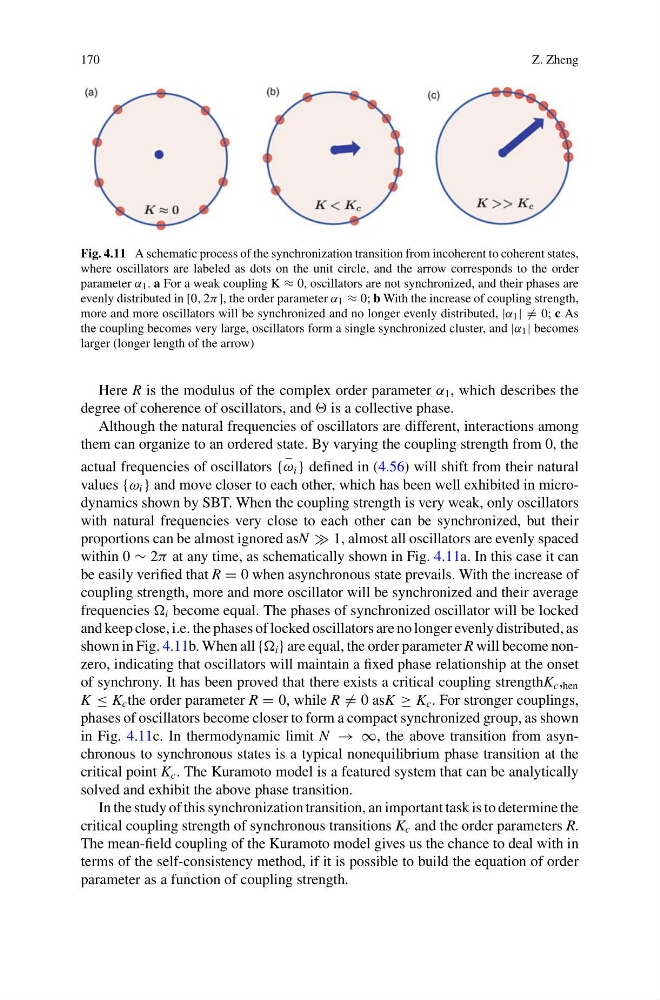
Fig. 4.11 A schematic process of the synchronization transition from incoherent to coherent states,
where oscillators are labeled as dots on the unit circle, and the arrow corresponds to the order
parameter α 1 . a For a weak coupling K ≈ 0, oscillators are not synchronized, and their phases are
evenly distributed in [0, 2π ], the order parameter α 1 ≈ 0; b With the increase of coupling strength,
more and more oscillators will be synchronized and no longer evenly distributed, |α 1 | = 0; c As
the coupling becomes very large, oscillators form a single synchronized cluster, and |α 1 | becomes
larger (longer length of the arrow)
Here R is the modulus of the complex order parameter α 1 , which describes the
degree of coherence of oscillators, and is a collective phase.
Although the natural frequencies of oscillators are different, interactions among
them can organize to an ordered state. By varying the coupling strength from 0, the
actual frequencies of oscillators {
−
ω i } defined in (4.56) will shift from their natural
values {ω i } and move closer to each other, which has been well exhibited in microdynamics shown by SBT. When the coupling strength is very weak, only oscillators
with natural frequencies very close to each other can be synchronized, but their
proportions can be almost ignored asN 1, almost all oscillators are evenly spaced
within 0 ∼ 2π at any time, as schematically shown in Fig. 4.11a. In this case it can
be easily verified that R = 0 when asynchronous state prevails. With the increase of
coupling strength, more and more oscillator will be synchronized and their average
frequencies i become equal. The phases of synchronized oscillator will be locked
and keep close, i.e. the phases of locked oscillators are no longer evenly distributed, as
shown in Fig. 4.11b. When all { i } are equal, the order parameter R will become nonzero, indicating that oscillators will maintain a fixed phase relationship at the onset
of synchrony. It has been proved that there exists a critical coupling strengthK c , hen
K ≤ K c the order parameter R = 0, while R = 0 asK ≥ K c . For stronger couplings,
phases of oscillators become closer to form a compact synchronized group, as shown
in Fig. 4.11c. In thermodynamic limit N → ∞, the above transition from asynchronous to synchronous states is a typical nonequilibrium phase transition at the
critical point K c . The Kuramoto model is a featured system that can be analytically
solved and exhibit the above phase transition.
In the study of this synchronization transition, an important task is to determine the
critical coupling strength of synchronous transitions K c and the order parameters R.
The mean-field coupling of the Kuramoto model gives us the chance to deal with in
terms of the self-consistency method, if it is possible to build the equation of order
parameter as a function of coupling strength.
Z. Zheng
Fig. 4.11 A schematic process of the synchronization transition from incoherent to coherent states,
where oscillators are labeled as dots on the unit circle, and the arrow corresponds to the order
parameter α 1 . a For a weak coupling K ≈ 0, oscillators are not synchronized, and their phases are
evenly distributed in [0, 2π ], the order parameter α 1 ≈ 0; b With the increase of coupling strength,
more and more oscillators will be synchronized and no longer evenly distributed, |α 1 | = 0; c As
the coupling becomes very large, oscillators form a single synchronized cluster, and |α 1 | becomes
larger (longer length of the arrow)
Here R is the modulus of the complex order parameter α 1 , which describes the
degree of coherence of oscillators, and is a collective phase.
Although the natural frequencies of oscillators are different, interactions among
them can organize to an ordered state. By varying the coupling strength from 0, the
actual frequencies of oscillators {
−
ω i } defined in (4.56) will shift from their natural
values {ω i } and move closer to each other, which has been well exhibited in microdynamics shown by SBT. When the coupling strength is very weak, only oscillators
with natural frequencies very close to each other can be synchronized, but their
proportions can be almost ignored asN 1, almost all oscillators are evenly spaced
within 0 ∼ 2π at any time, as schematically shown in Fig. 4.11a. In this case it can
be easily verified that R = 0 when asynchronous state prevails. With the increase of
coupling strength, more and more oscillator will be synchronized and their average
frequencies i become equal. The phases of synchronized oscillator will be locked
and keep close, i.e. the phases of locked oscillators are no longer evenly distributed, as
shown in Fig. 4.11b. When all { i } are equal, the order parameter R will become nonzero, indicating that oscillators will maintain a fixed phase relationship at the onset
of synchrony. It has been proved that there exists a critical coupling strengthK c , hen
K ≤ K c the order parameter R = 0, while R = 0 asK ≥ K c . For stronger couplings,
phases of oscillators become closer to form a compact synchronized group, as shown
in Fig. 4.11c. In thermodynamic limit N → ∞, the above transition from asynchronous to synchronous states is a typical nonequilibrium phase transition at the
critical point K c . The Kuramoto model is a featured system that can be analytically
solved and exhibit the above phase transition.
In the study of this synchronization transition, an important task is to determine the
critical coupling strength of synchronous transitions K c and the order parameters R.
The mean-field coupling of the Kuramoto model gives us the chance to deal with in
terms of the self-consistency method, if it is possible to build the equation of order
parameter as a function of coupling strength.