

152
Z. Zheng
4.3.4 Self-sustained Oscillation in Excitable Networks
4.3.4.1 Oscillation Sources and Wave Propagations
We first take the representative excitable dynamics as a prototype example to reveal
the mechanism of global oscillations. Cooperation among units in the system leads to
an ordered dynamical topology to maintain the oscillatory process. In regular media,
the oscillation core of a spiral wave is a self-organized topological defect. People also
found that loop topology is significant in maintaining the self-sustained oscillation.
Jahnke and Winfree proposed the dispersion relation in the Oregonator model [68].
Courtemanche et al. studied the stability of the pulse propagation in 1D chains [69].
If a loop composed of excitable nodes can produce self-sustained oscillations, one
may call it the Winfree loop.
It is not difficult to understand the loop topology for a basic structural basis of
collective oscillation for a network of non-oscillatory units. An excitable node in a
sustained oscillatory state must be driven by other nodes. To maintain such drivings,
a simple choice is the existence of a looped linking among interacting nodes. A local
excitation leads to a pulse and are propagated along the loop to drive other nodes
in order, which forms a feedback mechanism of repeated driving. Furthermore, the
oscillation along the loop can be propagated by nodes outside the loop and spread
throughout the system. The propagation of oscillation in the media gives rise to the
wave patterns.
The loop structure is ubiquitous in real networks plays an important role in network
dynamics. Recurrent excitation has been proposed to be the reason supporting selfsustained oscillations in neural networks. The DPAD method can reveal the underlying dynamic structure of self-sustained waves in networks of excitable nodes and
the oscillation source. In complex networks, numerous local regular connections
coexist with some long-range links. The former plays an important role in target wave
propagation and the latter are crucial for maintaining the self-sustained oscillations.
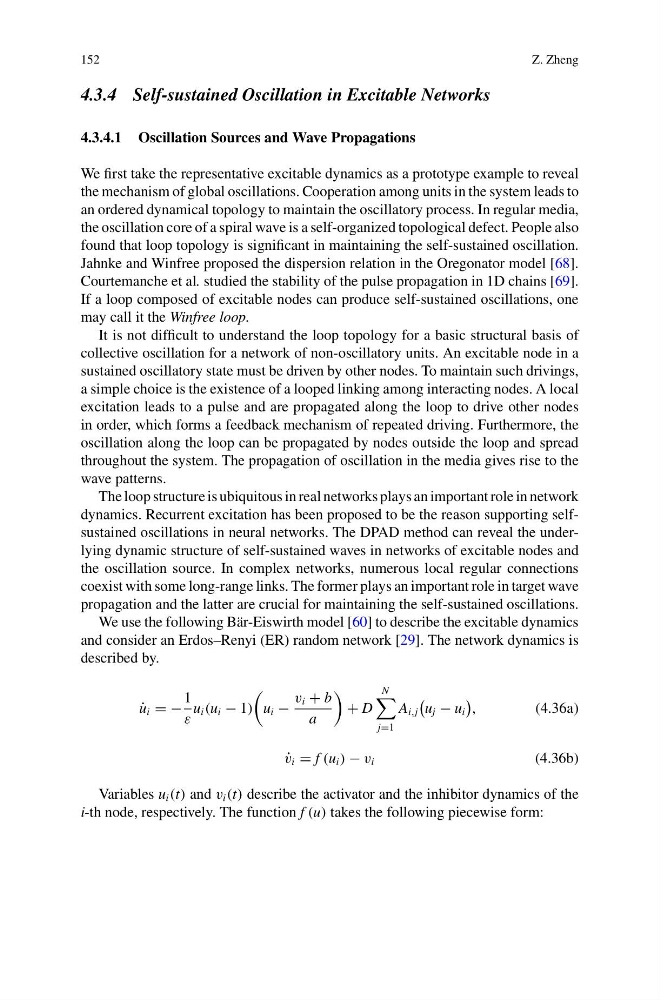
We use the following Bär-Eiswirth model [60] to describe the excitable dynamics
and consider an Erdos–Renyi (ER) random network [29]. The network dynamics is
described by.
˙
u i = −
1
ε
u i (u i − 1)
u i −
v i + b
a
+ D
N
j=1
A i,j
u j − u i
,
(4.36a)
˙
v i = f (u i ) − v i
(4.36b)
Variables u i (t) and v i (t) describe the activator and the inhibitor dynamics of the
i-th node, respectively. The function f (u) takes the following piecewise form:
Z. Zheng
4.3.4 Self-sustained Oscillation in Excitable Networks
4.3.4.1 Oscillation Sources and Wave Propagations
We first take the representative excitable dynamics as a prototype example to reveal
the mechanism of global oscillations. Cooperation among units in the system leads to
an ordered dynamical topology to maintain the oscillatory process. In regular media,
the oscillation core of a spiral wave is a self-organized topological defect. People also
found that loop topology is significant in maintaining the self-sustained oscillation.
Jahnke and Winfree proposed the dispersion relation in the Oregonator model [68].
Courtemanche et al. studied the stability of the pulse propagation in 1D chains [69].
If a loop composed of excitable nodes can produce self-sustained oscillations, one
may call it the Winfree loop.
It is not difficult to understand the loop topology for a basic structural basis of
collective oscillation for a network of non-oscillatory units. An excitable node in a
sustained oscillatory state must be driven by other nodes. To maintain such drivings,
a simple choice is the existence of a looped linking among interacting nodes. A local
excitation leads to a pulse and are propagated along the loop to drive other nodes
in order, which forms a feedback mechanism of repeated driving. Furthermore, the
oscillation along the loop can be propagated by nodes outside the loop and spread
throughout the system. The propagation of oscillation in the media gives rise to the
wave patterns.
The loop structure is ubiquitous in real networks plays an important role in network
dynamics. Recurrent excitation has been proposed to be the reason supporting selfsustained oscillations in neural networks. The DPAD method can reveal the underlying dynamic structure of self-sustained waves in networks of excitable nodes and
the oscillation source. In complex networks, numerous local regular connections
coexist with some long-range links. The former plays an important role in target wave
propagation and the latter are crucial for maintaining the self-sustained oscillations.
We use the following Bär-Eiswirth model [60] to describe the excitable dynamics
and consider an Erdos–Renyi (ER) random network [29]. The network dynamics is
described by.
˙
u i = −
1
ε
u i (u i − 1)
u i −
v i + b
a
+ D
N
j=1
A i,j
u j − u i
,
(4.36a)
˙
v i = f (u i ) − v i
(4.36b)
Variables u i (t) and v i (t) describe the activator and the inhibitor dynamics of the
i-th node, respectively. The function f (u) takes the following piecewise form: