

4 An Introduction to Emergence Dynamics in Complex Systems
151
δ ˙
f ij (x) =
∂f i (x)/∂x j
˙
x j ,
(4.31)
where the total driving force is expressed as a simple summation of the contributions
of all its neighbors.
δ ˙
f i (x) =
N
j=1,j =i
δ ˙
f ij (x).
(4.32)
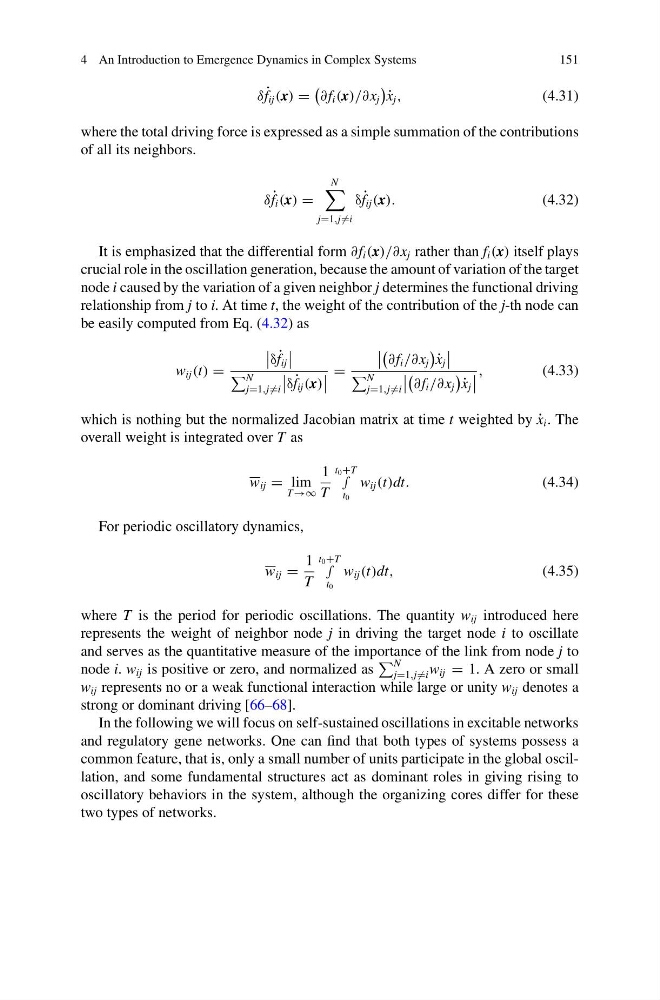
It is emphasized that the differential form ∂f i (x)/∂x j rather than f i (x) itself plays
crucial role in the oscillation generation, because the amount of variation of the target
node i caused by the variation of a given neighbor j determines the functional driving
relationship from j to i. At time t, the weight of the contribution of the j-th node can
be easily computed from Eq. (4.32) as
w ij (t) =
δ ˙
f ij
N
j=1,j =i
δ ˙
f ij (x)
=
∂f i /∂x j
˙
x j
N
j=1,j =i
∂f i /∂x j
˙
x j
,
(4.33)
which is nothing but the normalized Jacobian matrix at time t weighted by ˙
x i . The
overall weight is integrated over T as
w ij = lim
T →∞
1
T
t 0 +T
∫
t 0
w ij (t)dt.
(4.34)
For periodic oscillatory dynamics,
w ij =
1
T
t 0 +T
∫
t 0
w ij (t)dt,
(4.35)
where T is the period for periodic oscillations. The quantity w ij introduced here
represents the weight of neighbor node j in driving the target node i to oscillate
and serves as the quantitative measure of the importance of the link from node j to
node i. w ij is positive or zero, and normalized as
N
j=1,j =i w ij = 1. A zero or small
w ij represents no or a weak functional interaction while large or unity w ij denotes a
strong or dominant driving [66–68].
In the following we will focus on self-sustained oscillations in excitable networks
and regulatory gene networks. One can find that both types of systems possess a
common feature, that is, only a small number of units participate in the global oscillation, and some fundamental structures act as dominant roles in giving rising to
oscillatory behaviors in the system, although the organizing cores differ for these
two types of networks.
151
δ ˙
f ij (x) =
∂f i (x)/∂x j
˙
x j ,
(4.31)
where the total driving force is expressed as a simple summation of the contributions
of all its neighbors.
δ ˙
f i (x) =
N
j=1,j =i
δ ˙
f ij (x).
(4.32)
It is emphasized that the differential form ∂f i (x)/∂x j rather than f i (x) itself plays
crucial role in the oscillation generation, because the amount of variation of the target
node i caused by the variation of a given neighbor j determines the functional driving
relationship from j to i. At time t, the weight of the contribution of the j-th node can
be easily computed from Eq. (4.32) as
w ij (t) =
δ ˙
f ij
N
j=1,j =i
δ ˙
f ij (x)
=
∂f i /∂x j
˙
x j
N
j=1,j =i
∂f i /∂x j
˙
x j
,
(4.33)
which is nothing but the normalized Jacobian matrix at time t weighted by ˙
x i . The
overall weight is integrated over T as
w ij = lim
T →∞
1
T
t 0 +T
∫
t 0
w ij (t)dt.
(4.34)
For periodic oscillatory dynamics,
w ij =
1
T
t 0 +T
∫
t 0
w ij (t)dt,
(4.35)
where T is the period for periodic oscillations. The quantity w ij introduced here
represents the weight of neighbor node j in driving the target node i to oscillate
and serves as the quantitative measure of the importance of the link from node j to
node i. w ij is positive or zero, and normalized as
N
j=1,j =i w ij = 1. A zero or small
w ij represents no or a weak functional interaction while large or unity w ij denotes a
strong or dominant driving [66–68].
In the following we will focus on self-sustained oscillations in excitable networks
and regulatory gene networks. One can find that both types of systems possess a
common feature, that is, only a small number of units participate in the global oscillation, and some fundamental structures act as dominant roles in giving rising to
oscillatory behaviors in the system, although the organizing cores differ for these
two types of networks.