

138
Z. Zheng
spatiotemporal patterns and dynamics have been revealed. Readers can reach related
reviews and monographs to get more information [14–16].
4.2.2 Slaving Principles and the Emergence of Order
Parameters
The study of dissipative structure is, in fact, largely based on the dynamics of
macrostate variables. However, it is very important to appropriately select these
macroscopic variables. These state variables are required to reveal the emergence of
dissipative structures, hence they should act as order parameters similar to studies
of those in phase transitions. The concept of order parameter was first introduced in
statistical physics and thermodynamics to describe the emergence of order and the
transitions of a thermodynamic system among different macroscopic phases [17–19].
It had been naturally extended to non-equilibrium situations to reveal the order out
of equilibrium.
Haken and his collaborators proposed the synergetic theory and focused on the
conditions, features and evolution laws of the self organization in a complex system
with a large number of degrees of freedom under the drive of external parameters [20,
21]. and the interaction between subsystems to form spatial, temporal or functional
ordered structures on a macroscopic scale. The core of synergetics is the slaving principle, which reveals how order parameters emerge from a large number of degrees
of freedom through competitions and collaborations. As the system approaches the
critical point, only a small number of modes/variables with a slow relaxation dominate the macroscopic behavior of the system and characterize the degree of order
(called the order parameters) of the system. A large number of fast-changing modes
are governed by the order parameters and can be eliminated adiabatically. Thus we
can establish the basic equation of the order parameters. The low-dimensional evolution equation of order parameters can thus be used to study the emergence of various
non-equilibrium states, their stability and bifurcations/transitions.
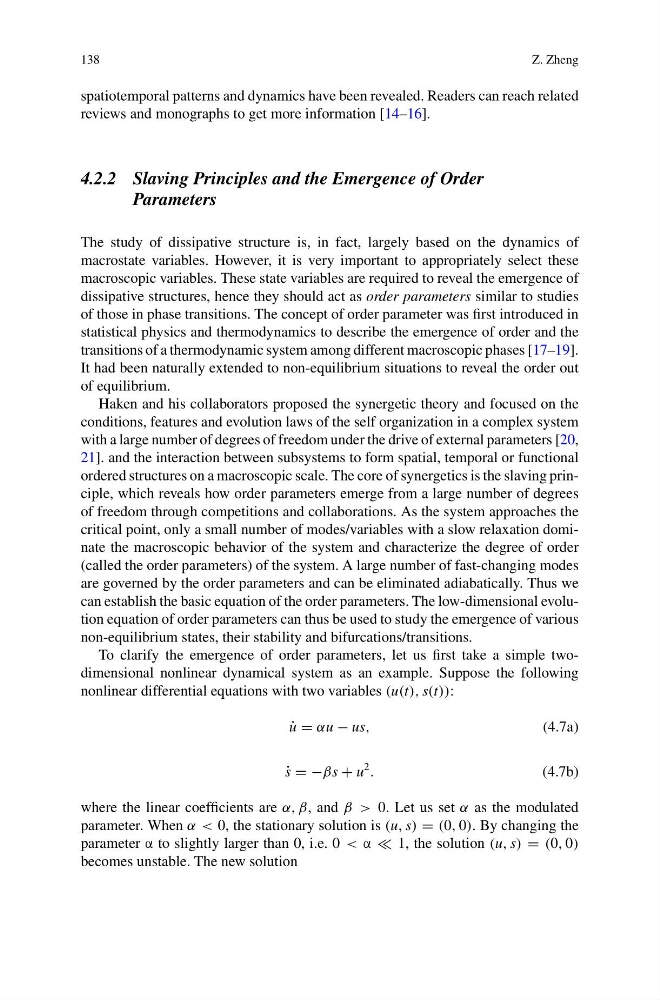
To clarify the emergence of order parameters, let us first take a simple twodimensional nonlinear dynamical system as an example. Suppose the following
nonlinear differential equations with two variables (u(t), s(t)):
˙
u = αu − us,
(4.7a)
˙
s = −βs + u
2
.
(4.7b)
where the linear coefficients are α, β, and β > 0. Let us set α as the modulated
parameter. When α < 0, the stationary solution is (u, s) = (0, 0). By changing the
parameter α to slightly larger than 0, i.e. 0 < α 1, the solution (u, s) = (0, 0)
becomes unstable. The new solution
Z. Zheng
spatiotemporal patterns and dynamics have been revealed. Readers can reach related
reviews and monographs to get more information [14–16].
4.2.2 Slaving Principles and the Emergence of Order
Parameters
The study of dissipative structure is, in fact, largely based on the dynamics of
macrostate variables. However, it is very important to appropriately select these
macroscopic variables. These state variables are required to reveal the emergence of
dissipative structures, hence they should act as order parameters similar to studies
of those in phase transitions. The concept of order parameter was first introduced in
statistical physics and thermodynamics to describe the emergence of order and the
transitions of a thermodynamic system among different macroscopic phases [17–19].
It had been naturally extended to non-equilibrium situations to reveal the order out
of equilibrium.
Haken and his collaborators proposed the synergetic theory and focused on the
conditions, features and evolution laws of the self organization in a complex system
with a large number of degrees of freedom under the drive of external parameters [20,
21]. and the interaction between subsystems to form spatial, temporal or functional
ordered structures on a macroscopic scale. The core of synergetics is the slaving principle, which reveals how order parameters emerge from a large number of degrees
of freedom through competitions and collaborations. As the system approaches the
critical point, only a small number of modes/variables with a slow relaxation dominate the macroscopic behavior of the system and characterize the degree of order
(called the order parameters) of the system. A large number of fast-changing modes
are governed by the order parameters and can be eliminated adiabatically. Thus we
can establish the basic equation of the order parameters. The low-dimensional evolution equation of order parameters can thus be used to study the emergence of various
non-equilibrium states, their stability and bifurcations/transitions.
To clarify the emergence of order parameters, let us first take a simple twodimensional nonlinear dynamical system as an example. Suppose the following
nonlinear differential equations with two variables (u(t), s(t)):
˙
u = αu − us,
(4.7a)
˙
s = −βs + u
2
.
(4.7b)
where the linear coefficients are α, β, and β > 0. Let us set α as the modulated
parameter. When α < 0, the stationary solution is (u, s) = (0, 0). By changing the
parameter α to slightly larger than 0, i.e. 0 < α 1, the solution (u, s) = (0, 0)
becomes unstable. The new solution