

3 Generalized Onsager Principle and It Applications
125
σ
s
αβ = σ αβ − σ
e
αβ − σ
a
αβ ,
σ
a
αβ =
1
2
( p α h β − p β h α ) + (Q αγ G γβ − G αγ Q γβ ),
∂ β σ
e
αβ = −(c∂ α μ + h γ ∂ α p γ + G βγ ∂ α Q βγ ).
(3.113)
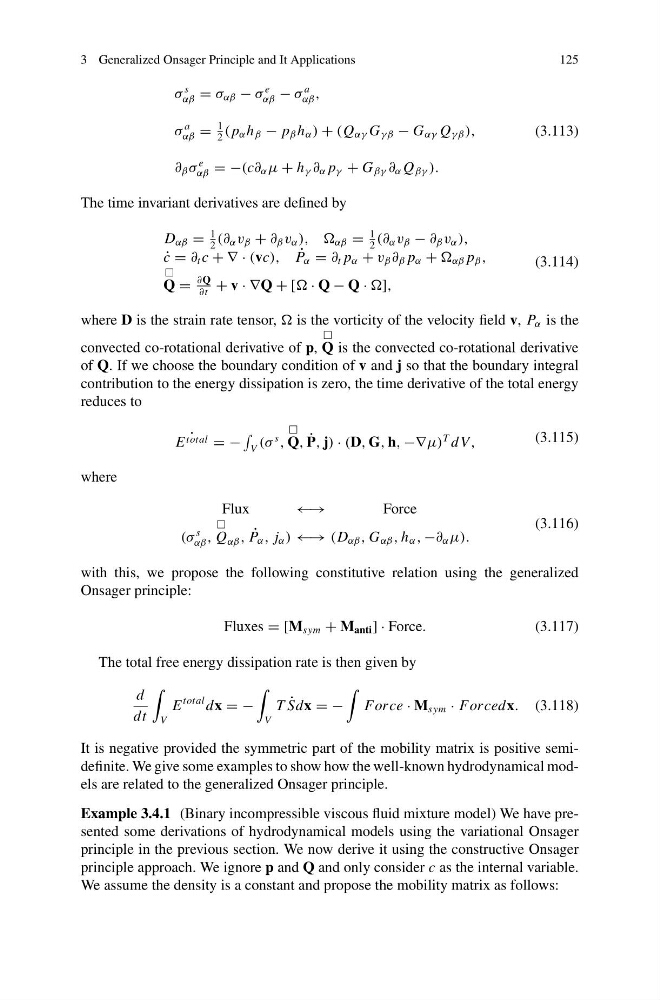
The time invariant derivatives are defined by
D αβ =
1
2
(∂ α v β + ∂ β v α ), , αβ =
1
2
(∂ α v β − ∂ β v α ),
˙
c = ∂ t c + ∇ · (vc), ˙
P α = ∂ t p α + v β ∂ β p α + αβ p β ,
Q =
∂Q
∂t
+ v · ∇Q + [ · Q − Q · ],
(3.114)
where D is the strain rate tensor, is the vorticity of the velocity field v, P α is the
convected co-rotational derivative of p,
Q is the convected co-rotational derivative
of Q. If we choose the boundary condition of v and j so that the boundary integral
contribution to the energy dissipation is zero, the time derivative of the total energy
reduces to
˙
E total = −
V (σ
s
,
Q, ˙
P, j) · (D, G, h, −∇μ)
T dV,
(3.115)
where
Flux
←→
Force
(σ
s
αβ ,
Q αβ , ˙
P α , j α ) ←→ (D αβ , G αβ , h α , −∂ α μ).
(3.116)
with this, we propose the following constitutive relation using the generalized
Onsager principle:
Fluxes = [M sym + M anti ] · Force.
(3.117)
The total free energy dissipation rate is then given by
d
dt
V
E
total dx = −
V
T ˙
Sdx = −
Force · M sym · Forcedx. (3.118)
It is negative provided the symmetric part of the mobility matrix is positive semidefinite. We give some examples to show how the well-known hydrodynamical models are related to the generalized Onsager principle.
Example 3.4.1 (Binary incompressible viscous fluid mixture model) We have presented some derivations of hydrodynamical models using the variational Onsager
principle in the previous section. We now derive it using the constructive Onsager
principle approach. We ignore p and Q and only consider c as the internal variable.
We assume the density is a constant and propose the mobility matrix as follows:
125
σ
s
αβ = σ αβ − σ
e
αβ − σ
a
αβ ,
σ
a
αβ =
1
2
( p α h β − p β h α ) + (Q αγ G γβ − G αγ Q γβ ),
∂ β σ
e
αβ = −(c∂ α μ + h γ ∂ α p γ + G βγ ∂ α Q βγ ).
(3.113)
The time invariant derivatives are defined by
D αβ =
1
2
(∂ α v β + ∂ β v α ), , αβ =
1
2
(∂ α v β − ∂ β v α ),
˙
c = ∂ t c + ∇ · (vc), ˙
P α = ∂ t p α + v β ∂ β p α + αβ p β ,
Q =
∂Q
∂t
+ v · ∇Q + [ · Q − Q · ],
(3.114)
where D is the strain rate tensor, is the vorticity of the velocity field v, P α is the
convected co-rotational derivative of p,
Q is the convected co-rotational derivative
of Q. If we choose the boundary condition of v and j so that the boundary integral
contribution to the energy dissipation is zero, the time derivative of the total energy
reduces to
˙
E total = −
V (σ
s
,
Q, ˙
P, j) · (D, G, h, −∇μ)
T dV,
(3.115)
where
Flux
←→
Force
(σ
s
αβ ,
Q αβ , ˙
P α , j α ) ←→ (D αβ , G αβ , h α , −∂ α μ).
(3.116)
with this, we propose the following constitutive relation using the generalized
Onsager principle:
Fluxes = [M sym + M anti ] · Force.
(3.117)
The total free energy dissipation rate is then given by
d
dt
V
E
total dx = −
V
T ˙
Sdx = −
Force · M sym · Forcedx. (3.118)
It is negative provided the symmetric part of the mobility matrix is positive semidefinite. We give some examples to show how the well-known hydrodynamical models are related to the generalized Onsager principle.
Example 3.4.1 (Binary incompressible viscous fluid mixture model) We have presented some derivations of hydrodynamical models using the variational Onsager
principle in the previous section. We now derive it using the constructive Onsager
principle approach. We ignore p and Q and only consider c as the internal variable.
We assume the density is a constant and propose the mobility matrix as follows: